Canadian Theatre Encyclopedia

The Aberhart Summer
Drama in two acts by Conni Massing, based on the novel of the same name by Bruce Allen Powe. It was first produced by Great West Theatre in Fort Macleod, Alberta, July, 1994, directed by David Mann, designed by Robert Shannon, with musical direction by Trudi Ellis, stage management by Allan Bassil and featuring Kevin Kruchkywich, Scott Lancastle, Geoff Lacny, George Szilagyi, Tony Eyamie, Craig Wademan, Grahame Renyk, Rhonda NuGent, Kelly Hubka and Sharla Matkin. It was subsequently presented at Alberta Theatre Projects as part of playRites, 1999, and at the Citadel Theatre in January, 2000. These productions were directed by Stephen Heatley, who was instrumental in the development of the play.
The Aberhart Summer, a memory play, takes place in Edmonton in the summer of 1935, during an election campaign which would see William (Bible Bill) Aberhart swept into power as Premier of the province. The atmosphere is one of religious and political volatility. We follow the "investigation" of a suicide (or was it murder?) of a boy, Babe, led by the boy's friend, Doug.
Extensively workshopped prior to its premiere, the play consists of 47 intricately interwoven scenes, and unfolds like a pageant. The play works as a murder mystery, but also as a pointed comment on Alberta, and, indeed, Canadian politics not only of the era but to the present. It touches on the ongoing problem of how Canada deals with outsiders (whether they are immigrants, religious minorities or the sexually suspect) and how our political machines are greased by cronyism.
The Aberhart Summer brings Alberta's history into the present: there are disconcerting correspondences between the then and now. It is also a reflection on the irrational forces that take over the lives of individuals - whether they be droughts, hail, and frost, political movements, or wars. Doug learns that Babe's death is symptomatic of a much larger human tragedy.
Critical response to the work has been generally positive. Of the playRites production, Lisa Wilton of The Calgary Sun wrote, "Massing has written a compelling play with all the right ingredients - mystery, religion, politics and sex." American Theatre called the work "vivid and unsentimental." The Calgary Herald said the play was, "one big, bright ball of theatrical energy and verve." Of the Citadel production, Kate Taylor, writing for the Globe and Mail, said, "This big and ambitious adaptation of the novel is highly impressive but also less than perfect." Also of the Citadel production, Paul Matwychuk of Edmonton's Vue wrote, "Massing is after something along the lines of a politicized Our Town, with the young Doug's solitary, Hardy Boys-like investigation into his friend's death serving as the hook that draws us into her evocation of Depression-era Edmonton and the rise of the Socreds.
Commentary by Gaetan Charlebois and Anne Nothof
Last updated 2023-11-14
Theatre 3
Company in Edmonton, Alberta, founded in 1970 by Mark Schoenberg, Drew Borland and Anne Green, and disbanded in 1981.
Dr. Schoenberg, a professor of theatre at University of Alberta, felt that the city needed another company as an alternative to the Citadel Theatre, "dedicated to presenting important plays of a non-commercial nature from the classic and modern repertoire, and, whenever possible, plays that reflect contemporary Canadian life."
The company first played in the 90-seat "Theatre Beside" in Victoria Composite High School, then in the 250-seat Centennial Library theatre. In 1976, Theatre 3 acquired its own house - a renovated welding shop. In 1978, Dr. Schoenberg was replaced by Keith Digby.
From its foundation, the company grew steadily each year. Though it always presented a healthy dose of Canadian works (including world premieres of Sharon Pollock's Blood Relations and Gaëtan Charlebois' Aléola),it also included works like Brendan Behan's The Hostage, Pinter's Homecoming, Racine's Phèdre and Shakespeare's Taming of the Shrew.
In 1981, the company collapsed under a debt load of $800,000, and the theatre was given over to its creditors. However, from the ashes, Digby founded Phoenix Theatre in Edmonton.
Source: Moira Day. "Theatre 3," Oxford Companion to Canadian Theatre. Ed. Eugene Bentley and L.W.Conolly. Toronto: Oxford UP, 1989.
Last updated 2011-12-09
Theatre Alberta
Provincial Arts Service Organization (PASO) dedicated to encouraging and promoting the continued development of theatre in Alberta. Incorporated in 1981, Theatre Alberta has evolved since its inception, adapting to numerous changes and challenges, to emerge as one of the largest and most active of the PASOs in Alberta.
The organization has over 1200 members, primarily from Alberta but also from across Canada and from other countries. Its membership consists of professional and community theatre practitioners, drama educators and students, as well as general enthusiasts. Theatre Alberta’s volunteer board of directors and many of its full and part-time staff are active theatre practitioners from all across the province and from varied disciplines within the theatre community.
Theatre Alberta facilitates interaction and communication amongst professional, community, and educational theatre practitioners through its programs and services: Artstrek, a residential summer theatre program for teens; Dramaworks, a summer theatre workshops series for adults; PlayWorks Ink, a fall theatre conference and workshop series produced in association with the Alberta Playwrights’ Network; Workshops by Request, theatre workshops for community theatres; Emerge, an annual audition event for graduating post-secondary actors; and Safe Stages, an occupational health and safety best practices resource.
Theatre Alberta also serves its membership and the community at large with a comprehensive website detailing information about its programs and services, its publications - including All Stages Magazine, Theatre Buzz, Community Theatre Handbook, Theatre Facility Handbook, and library catalogues - and a monthly Playbill calendar listing live theatre events taking place around the province. There is also a section where the community can post information about jobs, auditions, workshops, and other theatre resources. Links to Theatre Alberta’s member organizations and other service and theatre related organizations are also listed.
Theatre Alberta boasts a fully circulating member library with over 16,000 titles consisting of Canadian and international playscripts, musicals, periodicals, reference materials and other resources. The organization encourages and promotes awareness of and dissemination of Albertan and Canadian plays within its membership and the community at large and focuses a large part of its acquisition budget each year on Canadian plays and reference materials.
Theatre Alberta provides information and advocacy to the theatre community on local, provincial, and national fronts and provides direct support to Alberta Playwrights’ Network, Canadian Institute of Theatre Technology Alberta Section, and to the Alberta High School Drama Festival Association. Theatre Alberta is supported by the Alberta Foundation for the Arts, the Edmonton Arts Council, program and membership fees, and donations.
Website: www.theatrealberta.com
Last updated 2014-10-30
Theatre Aquarius
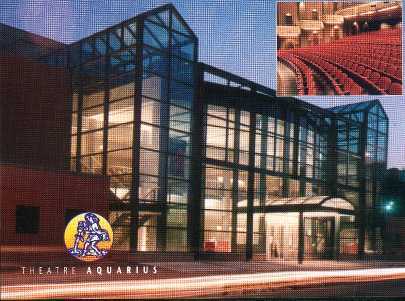
Company in Hamilton, Ontario, founded in 1973. Its founding Artistic Director was Peter Mandia; its founding production director was Stephen Newman.
Until 1991, the company performed at the Hamilton Place Studio Theatre. In September, 1991, it moved into the $12 million du Maurier Ltd. Centre (now Dofasco Centre for the Arts), designed by Lett Smith Architects, with a 750-seat proscenium theatre and a 125-seat studio theatre. After the move, the company experienced a financial crisis due to a shortfall in the building fund and increases in the company's property tax. In 1996 the company faced bankruptcy. After a period of fundraising, cuts to the budget and deferred payments, the company went into its 1997-98 season at the break-even mark. By 1999, nearly 96% of its budget of $3.5 million came from box office and fundraising, and it was the most self-sufficient not-for-profit company in the country.
Prior to 1996, the company presented a largely populist theatre, with occasional Canadian work (Fortune and Men's Eyes, 1973-4;Jitters, 1979-80; Balconville and Salt-Water Moon1985-6/1993-4 among others). Since 1996, a commitment was made by managing Artistic Director Max Reimer to present more Canadian works, and some of the company's productions have been Canadian premieres. Notable productions include: Fronteras Americanas by Guillermo Verdecchia (1996); 2 Pianos, 4 Hands (1999) by Ted Dykstra and Richard Greenblatt: Lawrence and Holloman by Morris Panych (2001); The Drawer Boy (2001) by Michael Healey; For the Pleasure of Seeing Her Again by Michel Tremblay (2002); Unity (1918) by Kevin Kerr (2004); Strawberries in January by Evelyne de la Chenelière (2005); Sexy Laundry by Michele Riml (2006); In a World Created by a Drunken God by Drew Hayden Taylor (2008); and Half Life by John Mighton (2009). The 2011/12 season included Queen Milli Of Galt by Gary Kirkham and Wingfield Lost and Found by Dan Needles. In 2012, Theatre Aquarius produced Where the Blood Mixes by Kevin Loring, directed by Bradley Moss. The Ladies Foresome by Norm Foster played on the main stage in 2016.
During the Covid-19 pandemic in 2020-21, the theatre was closed, reopening in December 2021 with a Christmas show. The 2022 productions, Old Stock: A Refugee Love Story by Hannah Moscovitch, Christian Barry, and Ben Caplan; Made in Italy, created and performed by Farren Timoteo; and The Hours that Remain by Keith Barker were rescheduled.
Theatre Aquarius features new and more experimental Canadian works in the TA2 Studio Theatre series on its studio space (125 seats).
Some artists who have worked for the company: Henry Czerny, Martin Short, Wayne Best, Martha Henry, Douglas Campbell, Stephen Russell, Kate Reid, Marion Gilsenan, and Jim Betts.
From 2008 to 2020, the Artistic Director was Ron Ulrich. In 2021, Marie Francis Moore began her tenure as AD.
The company has a Performing Arts Program which includes a theatre school. Its archives are at the L.W. Conolly Theatre Archives of the University of Guelph, Ontario.
Website: www.theatreaquarius.org
Profile by Gaetan Charlebois. Additional information provided by Christopher Hoile and Anne Nothof.
Last updated 2022-02-14
Theatre Baddeck

Professional, non-profit theatre company based in Baddeck, Cape Breton, Nova Scotia. Theatre Baddeck began operations in 2014. It mounted its first summer season in 2015 with the historical fiction comedy The Young Ladies of Baddeck Club by founders and Co-Artistic Producers Christy MacRae-Ziss and her daughter, Hannah Ziss, both of whom had worked previously with Lost & Found Theatre in Kitchener-Waterloo.
Its mission is to enrich Victoria County and Cape Breton Island culture with a high quality, professional theatre experience, and to entertain visitors to Victoria County with stories that offer a distinct local flavour such as Murder at the Inverary Inn by Sam Bobrick and Ron Clark (2017), Dancing on the Elephant (2018) by Lisa Hagen (set in a retirement home), and He'd Be Your Mother's Father's Cousin (2019) by Mary-Colin Chisholm; plus Canadian comedies with a twist such as Harvest (2016 and 2017) by Ken Cameron, The Ladies Foursome (2018) by Norm Foster, Pocket Rocket by Lea Daniel and Gary Kirkham (2018, directed by Linda Moore), Sexy Laundry by Michele Riml (2019), and The Shoplifters by Morris Panych. In 2019, the season included Outside Mullingar by John Patrick Shanley (2021).
Theatre Baddeck has been nominated for five Merritt Awards (and won two) for achievements in professional theatre in Nova Scotia.
The Company performs in the Baddeck Masonic Hall.
Website: www.theatrebaddeck.com
Last updated 2021-11-30
Theatre Beyond Words
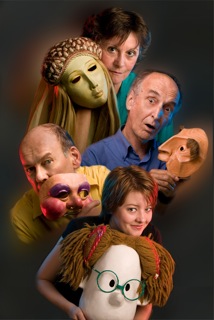
From top to bottom: Robin Patterson, Harro Maskow, Terry Judd, Katharine Dubois
Theatre company located in St. Catharines, Ontario, whose work places “particular emphasis on non-verbal, mime, physical, visual or image-based theatre.” It was formed in 1977, and celebrated its 35th birthday in 2012. Five of its six founding members came from the Canadian Mime Theatre (1969-1979), having resigned in a body when the board of that company replaced its artistic director, Adrian Pecknold, with another in whom they had no confidence. Within months, they had a name, derived from a lengthy sketch, “Beyond Words,” which they had performed on a world tour the year before, a mandate, an agent, a constitution, a board of directors, and secure funding. The absence of the word “Mime” in the name gave the company freedom to explore many forms of physical theatre, without and with text. Three of the founding members are still active in the company: Harro Maskow, formerly associate artistic director of Canadian Mime Theatre, Robin Patterson, present Artistic Director, and Terry Judd, Co-Artistic Director.
The company is best known for Potato People, a series of fourteen non-verbal plays for children and families, performed in larval masks. Its genesis was a brief sketch in which Bud the Dog teaches toddler Nancy Potato to fetch. The first of the series, Nuthin’ But Trouble, was first produced in 1977. In addition the company has created twenty plays for both general and mature audiences in various physical theatre styles including its own brand of mask, mime, clown and commedia dell'arte and retains many in the repertoire.
All of their shows tour widely; they have performed in Canada, the USA, Spain, France, Germany, Portugal, Russia, Latvia, Ukraine, Georgia, Moldavia, Azerbaijan, Japan, Taiwan, Hong Kong, Singapore, Korea, Australia and Argentina. They have frequently performed in theatre festivals.
Many of their shows have been created in collaboration with other artists: for example, Tourists (1984) with director Peter Froelich; The Rites of Spring (1987) with Theatre Smith-Gilmour; The Boy Who Could Sing Pictures (1990), with the playwright John Lazarus; Night Train to Foggy Bottom (1990) with Coad Canada Puppets; Imaginarius (2005), with the Omar Alvarez Puppet Company of Argentina. While touring in Galicia in northwestern Spain, the company learned that the celebrated Galician poet, Castelao, had written a play for masks, Os vellos non deben de namorarse. Translated into English, and developed in collaboration with the commedia dell’arte specialist Laurie Stephen, it became Silly Old Men Ought Not to Fall in Love (2004). In 2009 the company began collaborating with the Shaw Festival in the creation of a physical theatre adaptation of Oscar Wilde's short story, “The Canterville Ghost.” Their latest collaboration is a workshop with Tottering Biped Theatre (a physical theatre company based in Burlington, Ontario) and is a multi-media adaptation of a graphic novel.
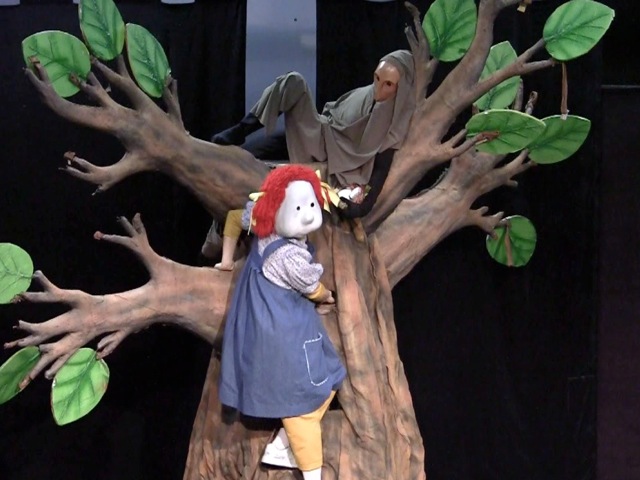
Theatre Beyond Works received the UNIMA Citation of Excellence Award in 1987 for Potato People. Imaginarius won the Best Play for Children in 2006/2007 at the GETEA Annual Awards in Buenos Aires, Argentina. TBW was the first Western theatre company invited to play at the National Theatre of Japan in 1979.
Since 1982 Theatre Beyond Words has been the Resident Theatre Company at Brock University in St. Catharines, and is a Professional Affiliate of the Marilyn I. Walker School of Fine and Performing Arts. Members of TBW's Artistic Committee teach mime, mask, clown and physical theatre courses at Brock and at Niagara University in Niagara Falls, New York. The company also offers workshops in Larval Mask, Expressive Mask and Theatrical Clown.
Since 2006 TBW has been mentoring a young company, Sprouts, in visual theatre collective creation. Sprouts was challenged to reinvent the Potato People style of mask performance. Their first show was Potato Chips (2006) composed of scenes ("chips") from the Potato People series. Subsequently, members of the young company have developed a play for children, Tales of the Garden (2011); another play on adult themes, Tales of the City, is in development.
TBW also produced an annual Wednesday Playwriting Salon series from 2006 to 2012, in which new playscripts by local playwrights were given a reading by actors, followed by audience feedback and discussion.
Website: www.theatrebeyondwords.ca
Profile by Robert Nunn.
Last updated 2021-12-01
Théâtre Biscuit
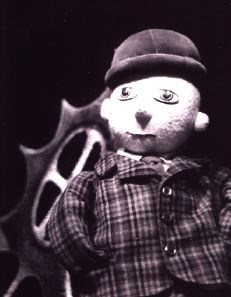
Puppet theatre company in Montreal, Quebec, founded by Vladimir Agéev and Benoît Dubois in 1990. They presented works which were not always just for children.
Agéev, who studied with several puppetry institutions and worked with many others in Europe, was working at a puppet store in Montreal when he arranged to mount a small production for the store's clients. Dubois was giving Agéev courses in French via theatre. As Agéev had no money to pay for the courses, Agéev taught Dubois Russian and a professional partnership formed. Soon, they chose a pocket-sized theatre in Old Montreal and mounted Parade, which won the Association québécoise des critiques de théâtre's award for best children's production of the year.
Since then, the Company presented several productions a year and housed the tours of several others. It also toured its productions (like Concert) around the country and abroad.
In 1994 Théâtre Biscuit moved to a slightly larger house, also in Old Montreal, and performed on weekend afternoons for children and adults.
They presented puppetry as art form, mounting textured, complex pieces whose sources were diverse and international.
Profile by Gaetan Charlebois
Last updated 2021-11-30
Theatre by the Bay
Theatre by the Bay is a professional regional theatre arts company focused on the development and production of new plays inspired by the people of Barrie, Ontario and the surrounding region of Central Ontario. It seeks to grow the Barrie theatre arts community by empowering local theatre artists and engaging local audiences. The company performs in the Five Points Theatre in downtown Barrie and tours its work throughout the region.
Theatre by the Bay was founded in 2001 by Larissa Mair and Nick Baillie, and was immediately a sensation in Barrie. It has since mounted more than fifty professional productions and employed hundreds of theatre artists, including Daryl Cloran, Maev Beaty, Richard Rose, Leslie Arden, Jeannette Lambermont-Morey, Tyler Murree, Alex Furber, Brett Christopher, MJ Shaw, Robert Joy, Jackie Francis and many others.
T
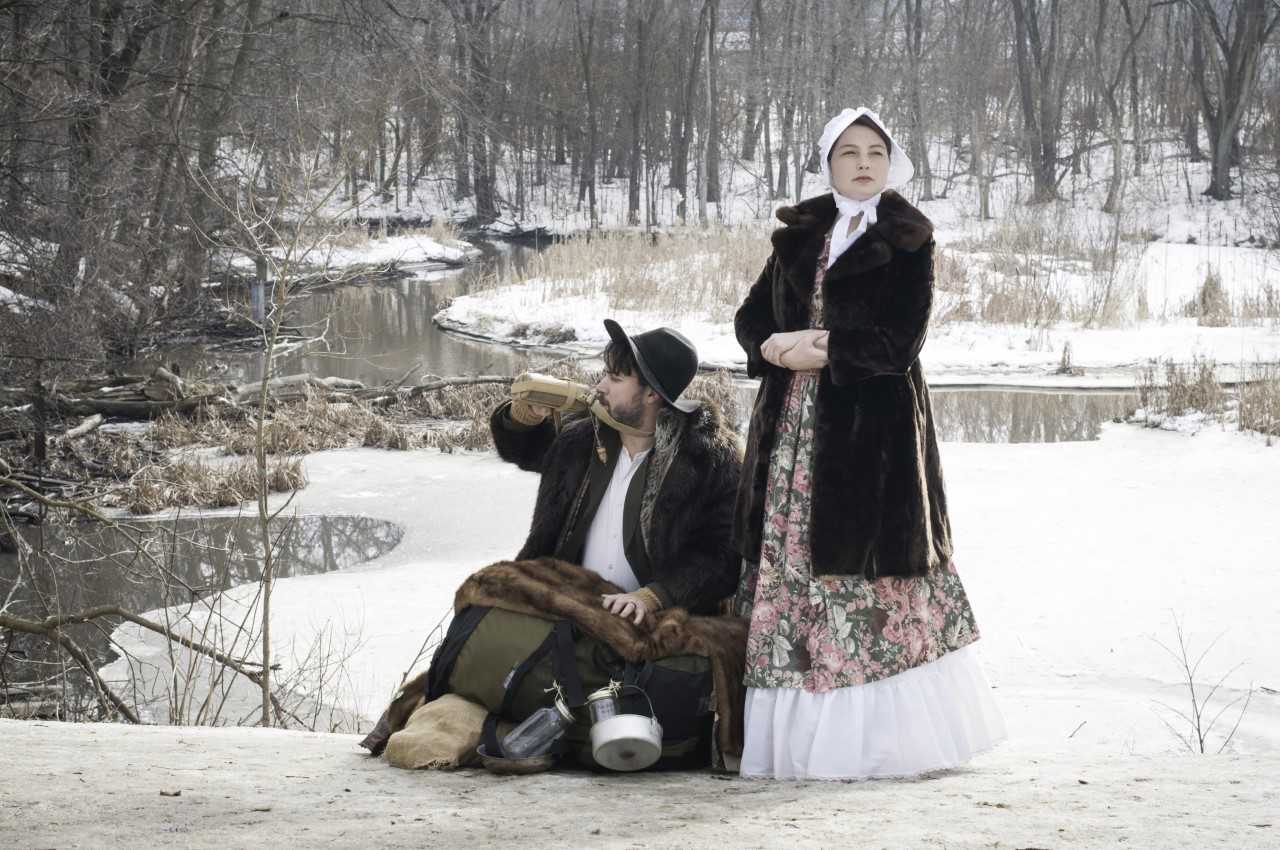
Alex Dault became Artistic Director of Theatre by the Bay in 2014, specializing in working with verbatim text and exploring local histories. Under his leadership, the company reworked its mandate to tell local stories using local artists, and introduced new development programs for emerging artists. It also offered a monthly play reading series for community members.
In 2014, Theatre by the Bay began to develop new work, commencing with Nine Mile Portage. This show was devised through an investigation of Barrie's origins prior to European contact. The production was immensely popular with residents and, with a multi-year grant from Trillium, returned for three subsequent years.
In 2016, Theatre by the Bay commissioned and produced We Must Have More Men! Barrie and the Great War, which looked at the leadership of women in the Barrie community during the war. The play was directed by Leah Holder and featured ten local actors. The production was staged site-specifically in the hall of Trinity Anglican. It was well-received by the community and sold out its entire run. The production was remounted in 2017, and after a two week run in Barrie toured to Base Borden and Collingwood and seen by more than 3,000 students and community residents.
In 2017, TBTB presented The Five Points (developed by Alex Dault and the ensemble) a verbatim play incorporating the voices of more than 150 people who live in Barrie's downtown, including persons who were homeless, business owners, politicians, sex workers, ice fishermen and many others.
Theatre by the Bay commissioned a new work by Vern Thiessen in 2021: a dramatic look at Barrie's ice industry of the 20th century. Artistic Director Iain Moggach will direct its world premiere in the 2023 season.
Website: www.theatrebythebay.com
Last updated 2021-11-30
Theatre Calgary
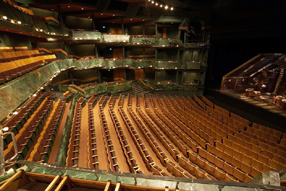
Theatre Calgary, founded in 1968, is the oldest professional theatre company in Calgary, Alberta. Its origins are in the merger of "Workshop 14," an amateur theatre company formed in the 1940s by the students of Dr. Betty Mitchell, drama teacher at Calgary's Western Canada High School; and "The Musicians' and Actors' Club" (MAC), comprising Calgary business people, staging short plays and excerpts from musicals in the old Isis movie house in the 1960s. Under the direction of Kenneth Dyba, playwright and novelist, MAC 14 staged its productions in a converted tractor house, renamed the QR Centre.
The first Artistic Director of the renamed Theatre Calgary was Christopher Newton, who staged the first seasons in the Betty Mitchell Theatre (1968-1971). His opening ambitious and eclectic season of seven plays included The Odd Couple, The Alchemist (with music by the Fifth Dimension), Gaslight, and James Reaney's The Three Desks (1968). Subsequently, Newton staged his own plays, You Stay Here, The Rest Come Along With Me and Trip. He invited actor friends and colleagues from Stratford, such as William Hutt, Eric Donkin, and Frances Hyland.
Newton was followed, for one season, by Clarke Rogers, and then Harold G. Baldridge until 1978. Baldridge directed the premiere production of Walsh (1973) by Sharon Pollock; and The Condemned of Altoona, starring Douglas Campbell. Under Baldridge's tenure, Frances Hyland directed J. M. Synge's Playboy of the Western World. He left Calgary in 1981 to become Executive Director of the Neighbourhood Playhouse School of Theatre in New York.
Rick McNair served as AD from 1978 to 1984, encouraging the production of Canadian plays and forming a travelling theatre troupe which brought plays to schools in Western Canada. McNair commissioned and produced an adaptation of Robert Kroetsch's novel, The Words of My Roaring, and of W.O. Mitchell's stories, The Black Bonspiel of Wullie MacCrimmon (1979) and The Kite(1981). He also directed John Murrell's Farther West (1982), and premieres of Pollock's Whiskey Six Cadenza(1983), and Doc (1984). Sharon Pollock then assumed the position of AD for three months, resigning after a difference of opinion with the board over the prerogatives of artistic direction
In 1985, Theatre Calgary relocated to the Max Bell Theatre in the Epcor Centre for the Performing Arts (renamed "Arts Commons" in 2014) - a 750-seat theatre with an adjustable proscenium arch, and with no seat further than sixty feet from the stage. Artistic Director, Martin Kinch (1985 to 1991) introduced George Walker's plays to Calgary, and hired Alberta writer, Gordon Pengilly, as playwright-in-residence. Brian Rintoul was AD until 1996, followed by Ian Prinsloo. Dennis Garnhum was AD from September 2005 to 2016. During his eleven season tenure, Theatre Calgary produced seven world premieres. Associate Artistic Director Shari Wattling was named Interim Artistic Director, effective September 12, 2016. In April 2018, Stafford Arima commenced his tenure as Artistic Director. Born in Toronto, and educated at York University, he has worked in New York and elsewhere in the US for twenty years, directing musical theatre.
The mission statement of Theatre Calgary is "to entertain, challenge, and enlighten our diverse audience with plays produced from the Canadian and international repertoires; to develop and nurture the Calgary theatrical community by engaging local artists, designers, and technicians to participate in creating stories relevant to Calgarians."

Typically Theatre Calgary produces one piece of musical theatre each season, such as Camelot (2000), and one Canadian play, such as Fire by Paul Ledoux and David Young. In 2014, it co-produced with Western Canada Theatre Company the premiere of Liberation Days by David Van Belle (dir. Daryl Cloran). Set in a small Dutch town at the end of World War II, it shows the positive and negative personal consequences of liberation from the Nazis by Canadian soldiers. In May 2015, Theatre Calgary produced Dear Johnny Deere, a highly entertaining musical based on the songs of Fred Eaglesmith by Ken Cameron, directed by Eric Coates with the original cast from the Blyth Festival premiere. In September, 2015, it launched the Canadian premiere of The Shoplifters by Morris Panych (dir. Haysam Kadri), an absurdist comedy which debates the morality of individual and corporate theft. Theatre Calgary mounted an outstanding production of The Crucible by Arthur Miller in October, 2015, designed by Cameron Porteous, and directed by RH Thomson, with strong performances by Vanessa Sabourin as Elizabeth Proctor, Karl H. Sine as John Proctor, and Stephen Hair as Danforth.
To celebrate its 50th anniversary, Theatre Calgary announced a strong 2017-18 season of plays, including the premiere of Sharon Pollock's latest work, Blow Wind High Water, about the consequences to a family of the 2016 Calgary flood; Sisters: The Musical, adapted by Rene Richard Cyr from Les Belles-soeurs by Michel Tremblay; Twelfth Night, designed by the Old Trout Puppet Workshop for the National Arts Centre (dir. Jillian Keiley); and Onegin, a new musical commissioned and premiered by Arts Club Theatre based on Pushkin's poem by Amiel Gladstone and Veda Hille.
The 2018/19 season included the premiere of Honour Beat by First Nations playwright, Tara Beagan, with Monique Mojica as a daughter visiting her dying mother and reconnecting with a fraught family history. The 2019/20 season included the musical The Louder We Get by Kent Staines (book) and Colleen Douncey (music), directed by Lonny Price, a revised version of Prom Queen that premiered at the Segal Centre for Performing Arts in 2016. In March 2020, Theatre Calgary closed to live audiences, due to the Covid-19 pandemic, and moved to digital, on-line entertainment. It reopened in November, 2021 with an abridged version of A Christmas Carol for three actors.
Website: www.theatrecalgary.com
Sources: Joyce Doolittle. "Theatre Calgary," Oxford Companion to Canadian Theatre, and Theatre Calgary website.
Profile by Anne Nothof, Athabasca University
Last updated 2021-11-30
Théâtre Capitole
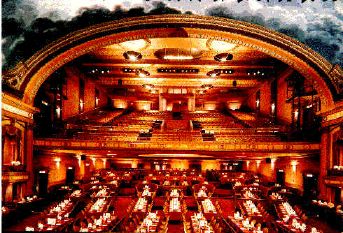
Heritage Beaux Arts theatre in Quebec City, Quebec, located across Place d'Youville from the Palais Montcalm. Théâtre Capitole was listed on the Répertoire du patrimoine culturel du Québec in 1984, and became a National Historic Site of Canada in 1986. It was renovated in 1992 for sixteen million dollars.
It now serves as a cabaret/theatre/revue house/restaurant. Its most popular production since the renovation has been a huge tribute to Elvis Presley.
The complex also includes a small hotel which helps subsidize the cost of the building.
Website: https://www.theatrecapitole.com
Last updated 2021-11-30
Théâtre Carrousel
World renowned young people's theatre company in Montreal, Quebec, founded in 1975 by Gervais Gaudreault and Suzanne Lebeau, who were both co-directors of the company until 2016, when Marie-Eve Huot replaced Lebeau. Théâtre Carrousel uses a spirit of intense exploration both toward text and theatrical form, setting out to redefine children's theatre with each production, and has won many international and Canadian awards (including the Chalmers Award the Masque Award and, twice, the Quebec critics circle award).
Théâtre Carrousel has participated in ninety-three international and Canadian festivals, including the Festival de Théâtre des Amériques (now Festival TransAmériques) and duMaurier World Stage Festival. The company has toured extensively in Europe and the US, giving some 3000 performances of over sixteen works, most of them written by Lebeau. They are a favourite company in France, having, in November, 1999, celebrated their 25th anniversary by premiering their 20th work L'autoroute, in that country (in co-production with houses in Narbonne and Chambéry).
Website: www.lecarrousel.net
Profile by Gaetan Charlebois.
Last updated 2021-12-01
Théâtre Catapulte
Founded in Ottawa in 1992 by a group of young artists under the direction of Patrick Leroux, Théâtre Catapulte engages in the research and development of Franco-Ontarian plays for adult and young audiences. More recently, its focus has been on women and minority artists’ voices. The Company's productions stimulate critical thinking, and open a dialogue on contemporary social issues. Through their close partnership with the French theatre of the National Arts Centre, Théâtre Français de Toronto, Théâtre du Nouvel-Ontario in Sudbury, Théâtre la Seizième in Vancouver, le Réseau Ontario, and La Nouvelle Scène Gilles Desjardins in Gatineau Théâtre Catapulte has reached audiences across Canada.
In 2002-2003 the theatre toured its production of Le Testament du couturier (The Will of the dressmaker) by Michel Ouellette to four provinces.
It also presents works in translation; for example Des mondes possibles (Possible Worlds) by John Mighton in 2003; and Cette fille-là (The Shape of a Girl) by Joan MacLeod in the 2005/06 season.
Joel Beddows was Artistic Director from 1998 to 2010; Jean Stéphane Roy from 2010 to 2017; Danielle Le Saux-Farmer from 2017.
Its home productions take place in La Nouvelle Scène Gilles Desjardins in Ottawa, a space shared with three other French language theatres since 1999: Théâtre du Trillium, Théâtre de la Vieille 17, and Cie Vox Théâtre.
Website: www.catapulte.ca
Last updated 2021-12-08
Theatre-Club
Company in Montreal Quebec, founded in 1953 by Monique Lepage and Jacques Létourneau.
It opened with the work Beau Sang by Jules Roy, and went on to present the works of Henri Troyat, J.B. Priestley, de Musset, Racine, Shakespeare (their 1956 production of Nuit des rois/Twelfth Night was their first major success, seen by 25,000 people), and the premiere of Marcel Dubé's Le Barrage.
At first the company played all over the city, including in high school auditoriums, before performing for three seasons (1957-60) in a small 200-seat hall. They then performed at the Comédie-Canadienne. Theatre-Club was one of the first companies in Canada to present professional children's theatre.
Artists who worked there included Marcel Sabourin, Jacques Languirand, Robert Gadouas, and Jean-Claude Rinfret. Létourneau directed many of the Club's works.
Though the company began as an unsubsidized troupe, it did eventually receive grants. These, however, were cut in 1964 and the company went out of business a year later.
Profile by Gaetan Charlebois
Last updated 2021-03-15
Theatre & Company
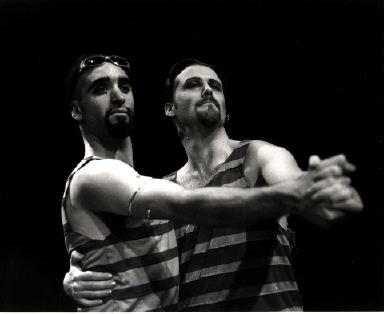
Theatre company in Kitchener, Ontario, founded in 1988 by Stuart Scadron-Wattles, the Artistic Director until 2006. Daryl Cloran became AD in January 2007. It ceased operation in 2008.
The mandate was one of performing, teaching and training.
The Company performed in the 170-seat flex venue, the Water Street Theatre, created out of a retail space in a shopping centre. In spring, 2000, it began a capital campaign to build a permanent home, the King Street Theatre Centre. On September 13, 2001, the Company opened the house with a commissioned work, Gary Kirkham's Queen Milli of Galt
The Company presented a September-May season since 1990. In 1997, it established the Young Ensemble Theatre, which selected nominated high school students and used the company resources to help the students form their own writing and performing ensemble. The Company also gave studio classes open to the public and in partnership with schools.
In 1998 the Company created Writers Bloc, a playwriting workshop lead by a house dramaturge.
Theatre & Company was funded through subscription and ticket sales, grants from various levels of government and gifts from individuals and corporations.
Its first production in 1988 was the collective creation This Side Up. Since then, it presented a wide variety of works -- from Lanford Wilson's Talley's Folly, to Athol Fugard's A Road to Mecca and Oscar Wilde's The Importance of Being Earnest. It also presented many Canadian works including Sharon Pollock's Saucy Jack (1995); Eugene Stickland's Sitting on Paradise (1996) and Some Assembly Required (1997); Jason Sherman's Three in the Back, Two in the Head(1999); Mansel Robinson's The Heart as It Lived (2000); David French's Salt-Water Moon(2001); George F. Walker's Problem Child; Maureen Hunter's Transit of Venus; Connie Gault's Red Lips (2003); Vern Thiessen's Einstein's Gift; Morris Panych's Girl in a Goldfish Bowl (2004) and Earshot (2006); Stephen Massicotte's Mary's Wedding (2005) and The Boy's Own Jedi Handbook (2005); David Belke's Ten Times Two (2006); Daniel MacIvor's Marion Bridge (2006), and Emil Sher's Mourning Dove.
Information provided by Kate Holt and Christopher Hoile.
Last updated 2013-03-21
Théâtre d’Aujourd’hui
Montreal theatre, initiated in 1968 by three small semi-professional theatre companies, Le Mouvement contemporain (directed by André Brassard, Les Saltimbanques (dir. Rodrig Mathieu), and Les Apprentis-Sorciers (dir. Jean-Pierre Saulnier and Pierre Collin). The first venue was an old garage seating 100 people, used by the Apprentis-Sorciers since 1965, and named Le Centre du Théâtre d’Aujourd’hui.
The founding companies mounted separate productions of post-war European plays in the first season; and Centre des auteurs dramatiques(CEAD) sponsored public readings, including Michel Tremblay’s Les Belles-soeurs in March 1968. In the following season Les Saltimbanques and Le Mouvement contemporain ceased production, and Le Théâtre d’Aujourd’hui devoted itself entirely to the production of Quebecois drama.
The first show of the 1969-70 season was a collective work by Le Théâtre de Même Nom entitled Un Autre grand spectacle d’adieu, (dir. Jean-Claude Germain) establishing a tone of innovative and satiric Quebec theatre, and a resistance to the traditional foreign plays that had previously dominated the stage.
Jean-Claude Germain, Artistic Director from 1972 to 1982, confirmed the theatre’s mandate to produce new Quebec plays which questioned the province’s political and cultural history, directing twenty of his own plays, and works by Michel Garneau, Roland Lepage, Michelle Lalonde, Suzanne Aubry, Elizabeth Bourget, Maryse Pelletier, Gilbert Turp, and Victor-Lévy Beaulieu.
The productions featured a regular group of actors, and were accompanied by a program which provided an overview of current theatrical activities. Germain also encouraged new young directors.
Gilbert Lepage was Artistic Director from 1983 to 1987, producing plays by Michel Marc Bouchard, Normand Chaurette, René Gingras, Jean-Raymond Marcoux, Jocelyne Beaulieu, René-Daniel Dubois, Carole Frechette, and René Richard Cyr.
Robert Lalonde was AD from 1987 to 1988, and Michelle Rossignol from 1989 to 1998. In 1991, Michelle Rossignol relocated the theatre to a reconstructed cinema at 3900 rue Saint Denis, and inaugurated the new location with a trilogy of plays by Michel Tremblay. The theatre has two stages, “Salle principale” and “Salle Jean-Claude Germain,” which provides a space for the creation and development of plays by small companies.
During the 1990s Théâtre d’Aujourd’hui produced new works by Abla Farhoud and Wajdi Mouawad, among many others.
René Richard Cyr was AD from 1999, producing works by Serge Boucher, Evelyne de la Chenelière, François Archambault, and Daniel Danis. Marie-Thérèse Fortin was Co-director General and Artistic Director from 2004 to 2012.
Théâtre d’Aujourd’hui has been a playwright-centred theatre, in which dramatic text constitutes the point of departure and the centre of artistic projects. It was dedicated exclusively to the creation, production, and dissemination of Quebec dramatic works in French. It has also toured its productions abroad. From its inception, it has produced over 300 plays, reaching an average of 30,000 spectators each season.
In 2012, Sylvain Bélanger became General and Artistic Director, returning the Company to its roots as a "Centre" of creation with a strong social and collective orientation, and a focus more on performance and spectacle than text.
Web site: www.theatredaujourdhui.qc.ca
Additional Source: Pierre MacDuff. The Oxford Companion to Canadian Theatre. Eds. Eugene Benson and L.W. Conolly. Toronto: Oxford UP, 1989.
Last updated 2021-12-01
Théâtre de la Bordée
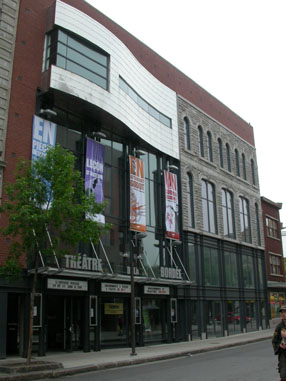
Mainstream theatre company in Quebec City, founded in 1976 by a group of young actors newly graduated from the Conservatoire d'Art Dramatique de Québec, including Pierrette Robitaille. Its artistic objectives are to produce quality productions with themes of everyday life that will speak to important issues for the community, to respect its public, and to explore new international theatre trends. It focuses on compelling and well-built stories, conveying strong ideas without undue intellectualism, hermeticism or estheticism.
From 1989, when the company moved into a new 256 seat venue, it had an increasing accumulated debt and, as a result, did not produce two of the four shows slated for the 1996-1997 season. With the support of the Quebec City drama community, the company announced its revival at the beginning of the 1997-98 season under new Artistic Director Jack Robitaille, with plays by John Pielmeier, Louisette Dussault, Jules Romains and Chrystine Brouillet.
In 2002 the company moved into its own venue, a four story building with a 350 seat theatre, a rehearsal room and administrative space. In 2004, actor and opera director Jacques Leblanc became Artistic Director. Under his direction Théâtre de la Bordée increased its membership and number of artistic activities. Since 2016, Michel Nadeau is the Artistic Director.
Among works the company has presented are Appelez-moi Stéphane by Louis Saïa and Claude Meunier, Oublier by Marie Laberge, Je ne suis pas Rappaport by Herb Gardner, Les frères Karamazov by Dostoïevski, Hosanna by Michel Tremblay, High Life by Lee MacDougall, Problem Child by George F. Walker (in a French translation), George Dandin by Molière and En attendant Godot by Samuel Beckett.
In 2006 the company celebrated its 30th anniversary with a season of four plays with a family theme: Les muses orphelines by Michel Marc Bouchard, Une pièce espagnole by Yasmina Reza, Phèdre by Racine, and Couche avec moi (c’est l’hiver) by Fanny Britt.
In November 2020, Théâtre de la Bordée moved on-line with its production of Le Gars de Québec by Michel Tremblay, when the Covid-19 pandemic closed theatres across Canada and the world.
website: https://bordee.qu.ca
Last updated 2021-09-13
Théâtre de la Crique
Company in Ville-Marie, northern Quebec, founded in 1979 by Jules Belliard to produce professional theatre involving theatre artists of the region, and to create a local dramatic literature. The company aspired towards a theatre that was simple, clear and accessible to all.
To this end it produced over 22 works including 15 premieres. Among them were: Les Célébrations by Michel Garneau (1980), Les danseurs de la fin du monde by Pierre K. Malouf (1981), Une amie d'enfance by Louis Saïa and Louise Roy (1983), Tortue by Michel Chénier (1985), Voisins-Voisines by Christian Bédard (1987), Avec le soleil...la mère (1990), Chalet à louer (1992) by Marie-Louise Nadeau and Serge Boucher, and L'Homme aux trésors by Nadeau (1995) which was toured across Quebec.
In 1997, Théâtre de la Crique fused with the company of Théâtre de La Poudrerie to form Le Théâtre du Tandem, with co-directors Odette Caron and Jean-Guy Côté to realize the mission of creation, production, and diffusion of professional theatre in Abitibi-Témiscamingue and beyond. The current Artistic Director is Julie Renault.
Website: www.theatretandem.com
Last updated 2021-05-07
Théâtre de la Dame de Coeur

Marionette theatre in Upton, Quebec, founded in 1977 by Richard Blackburn and specializing in productions for families. Since its establishment it has been a centre for research, creation, productions and education.
The Company uses huge puppets, indoor and outdoor venues, actors and music to create symbol-driven theatre. Its outdoor venue includes heated chairs that swivel so that the audience can watch shows at 360 degrees.
Among its many productions (including La légende de la blanche et de la noire, La petite Bougraisse and Dragon sur table), the Company has participated in special projects such as the parade to celebrate the 350th anniversary of the city of Montreal.
Productions at Dame de Coeur are marked by a social conscience and an awesome grandeur.
In summer 2000, they revived their 1999 production, the hugely successful La route des étoiles by Bernard Vandal.
Website: www.damedecoeur.com
Profile by Gaetan Charlebois
Last updated 2020-05-05
Théâtre de la Fenière

Oldest summer company in Quebec founded in 1958 by Georges Delisle. Its venue is a barn in a suburb of Quebec City (Ancienne-Lorette).
From its start it was conceived as a theatre of popular entertainment and provided a steady feast of French boulevard comedies and bedroom farces. The formula has proven to be hugely successful. Over the past 50 years, 166 comedies have been performed at Théâtre de la Fenière
Many of the city's and province's best actors have played the venue including Dorothée Berryman and Paul Hébert. The company has also premiered works, including Yves Thériault's Bérengère; ou la chair en feu (1965).
website: www.lafeniere.qc.ca/
Last updated 2021-12-01
Théâtre de la Manufacture
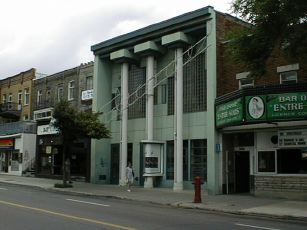
Company in Montreal, Quebec, founded in 1976 by Jean-Denis Leduc and Daniel Simard. For the last thirty years it has presented all of its works at Théâtre la Licorne.
The Company's mandate includes much space for new works (Maryse Pelletier's Le Samouraï amoureux), but also translations of contemporary theatre from across Canada and around the world; for example, David Young's Inexpressible Island in 2000.
The Company now produces three works per year as well as hosting many productions from small companies around the world.
From 2009 to 2019, the Artistic Director was Denis Bernard. In 2021, Julia Vidit was appointed Director.
Website: www.theatre-manufacture.fr
Last updated 2021-12-01
Théâtre de la Poudrerie
Company in Rouyn-Noranda, Quebec, founded in 1963.
The company's output was focussed on texts from Quebec with occasional productions from the world repertory. Since 1992, it made an added effort to explore the texts of playwrights of the Northern Quebec region.
Among works presented there were Le Testament by Marcel Dubé (1981), Appelez-moi Stéphane by Claude Meunier and Louis Saïa (1984), Les Hauts et les bas d'la vie d'une Diva by Jean-Claude Germain (1988), Surprise! Surprise! by Michel Tremblay (1989), Le Chien by Jean-Marc Dalpé (1991), Aurélie, ma soeur by Marie Laberge (1992), and Junior by Réal Beauchamp (1995).
In 1997, Théâtre de la Poudrerie fused with the company of Théâtre de la Crique to form Le Théâtre du Tandem, with co-directors Odette Caron and Jean-Guy Côté, to realize Tandem's mission of creation, production, and diffusion of professional theatre in Abitibi-Témiscamingue and beyond. The current Artistic Director is Julie Renault.
Website: www.theatretandem.com
Last updated 2021-12-01
Théâtre de la Récidive

Experimental theatre company, based in Montreal Quebec, founded in 1991 by a group of students graduating from the drama department of the Université de Québec à Montréal. The artistic director is Jean-Claude Coté.
Its first play was Odon von Horvath's Don Juan revient de guerre, a superb production mounted on a shoestring, yet still a stylistic wonder. The company then produced two short works by Vaclav Havel very well mounted at the tiny Théâtre Biscuit; and a vivid Gypsy-styled production of Stravinsky's L'histoire d'un soldat. In 1998, the company mounted the oddball French farce, Gustave n'est pas moderne, which was also well received. In 1999, its production of Olivier Choinière's Le Soldat de bois, appeared at the Festival de Théâtre des Amériques (now Festival TransAmériques).
The company's mandate requires a full integration of all the theatrical arts (dance, mime, opera, puppetry) with other forms (painting, cinema, music, video). The name of the company was chosen to highlight the founders' belief that theatre is a malady that afflicts and unsettles, and that should be spread across the entire society and continuously recur (récidiver).
Profile by Gaetan Charlesbois
Last updated 2017-09-29
Théâtre de La Veillée (Groupe [de] La Veillée, Espace de la Veillée)
Company in Montreal, Quebec, founded in 1974 by Gabriel Arcand.
It specializes in the theatrical deconstruction of literary works (including plays) and is strongly actor-propelled with productions hugely visual and, often, deeply obscure. Because of the Slavic slant of the actors' training and in-house workshops (ie: Jerzy Grotowski), and of three of the company's original artists - Vladimir Agéev, Gregory Hlady and past artistic director Téo Spychalski - the group's theatrical vocabulary is not based solely on North American iconography. Productions can be as perplexing as they are inspiring. Arcand continues to act for the company as does Carmen Jolin, who was Artistic Director from 2010 to 2021. In November 2021, Vincent de Repentigny and Philippe Cyr were appointed Co-General Directors.
Among works which have been presented are Knut Hamsen's La Faim/Hunger, Ionesco's Le roi se meurt/Exit the King, Kafka's Amerika, and Dostoevsky Crime et châtiment/Crime and Punishment.
In 1999, the company's newly renovated theatre was renamed Théâtre Prospéro.
Website: www.theatreprospero.com
Profile by Gaetan Charlebois
Last updated 2021-12-01
Théâtre de la Vieille 17

Franco-Ontarian company founded in 1979 by Jean-Marc Dalpé, Lise L. Roy, Roch Castonguay and Robert Bellefeuille, committed to creating new works. It performs at La Nouvelle Scene, in Ottawa.
Since its foundation it has created over 35 new works and toured many of them nationally and internationally. It often works in collaboration with other theatre companies including the Théâtre du Nouvel-Ontario, Théâtre Niveau Parking, and the National Arts Centre.
Among works created by the company are Lucky Lady, Les Rogers, Hawkesbury Blues, Le Nez and, in co-production with Théâtre populaire d'Acadie, the 1998 touring production of Bellefeuille's Louis-Dominque Lavigne's Mentire.
Robert Bellefeuille was Artistic Director for 25 years. From 2006 to 2019 the Artistic Director was Esther Beauchemin. In 2020, Geneviève Pineault was appointed Artistic Director.
Website: www.vieille17.ca
Last updated 2021-12-01
Théâtre de l’Oeil

Founded in 1973 by Francine Saint-Aubin and André Laliberté, Théâtre de l’Oeil is a puppet theatre for children and young adults, based in Montreal. The Company has created twenty-eight original productions, which feature a wide range of puppets in highly imaginative works. Théâtre de l’Oeil is a touring company, performing its shows in festivals and on stages across Québec and Canada as well as abroad. Since its inception, it has employed of 350 artists and craftspeople, and has reached more than 1.3 million spectators during its 5,000 or so performances on four continents.
Works include: Les grands vacances by Michel Tremblay (1981), and Marco bleu by Larry Tremblay (2018).
André Laliberté was Artistic Director from 1973 to 2020; he also wrote, directed, and performed in new works for the theatre. He was awarded the Prix Albert-Tessier for outstanding contribution to Quebec performing arts in 2020, when he retired. The current A.D. is Simon Boudreault.
Website: www.theatredeloeil.qc.ca
Last updated 2021-12-01
Théâtre de Marjolaine

Unconventional summer theatre in Eastman, Quebec, near Sherbrooke, founded in 1960 by Marjolaine Hébert (after whom it is named), Gilbert Comtois, Hubert Loiselle and Louise Rémy.
At the beginning the company offered the usual light summer fare but in 1964 dedicated itself to the presentation of new and repertory Quebec works, especially musical theatre.
When Mme Hébert retired in 1993, the building was sold off and housed the Théâtre d'Eastman.
However, in summer, 2002, a new company took over the theatre and decided to use its original name.
Website: www.lamarjolaine.info.
Last updated 2020-01-16
Théâtre de Quat'Sous
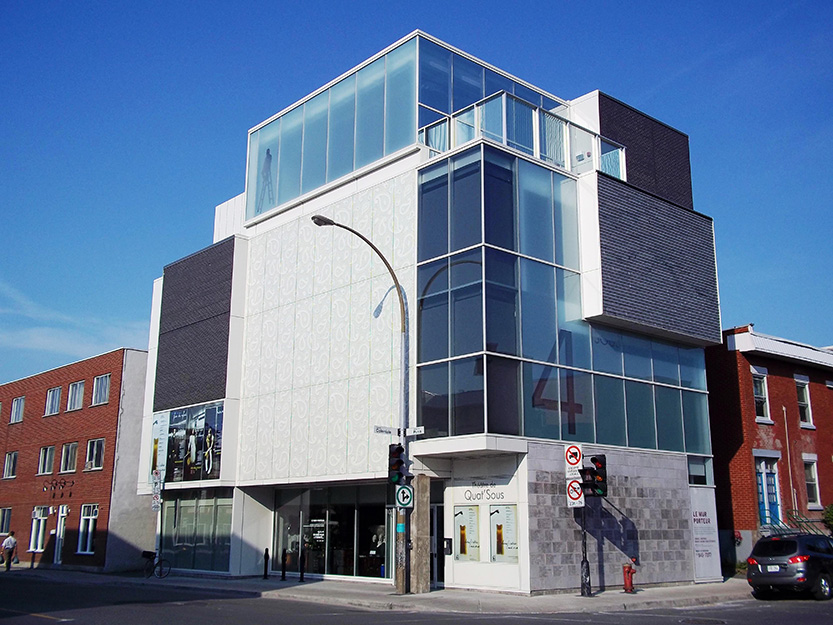
Montreal theatre founded in 1955 by Paul Buissonneau. The name, “Four Penny Theatre,” was suggested in fun by Claude Robillard, and has been retained for over sixty years. In the first ten years Buissonneau produced a play annually at various venues in Montreal, most of which were comedies and spectacles. Quat’Sous became a non-profit organization in 1963, and established its own theatre space in 1965 in a 160-seat converted synagogue on Avenue des Pins. The “Quat’Sous bar” opened in 1978, presenting small spectacles in the foyer. The theatre was extensively renovated in 1985. In 1998 a fire destroyed the archives, but the stage was spared. In 2009, Quat'Sous was deconstructed and reconstructed as an impressive glass and stone structure.
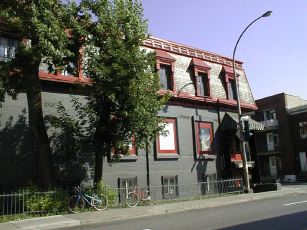
Buissonneau questioned prevailing theatre aesthetics and dominant social values through provocative and innovative productions, and supported talented young artists. In 1968 his musical “happening,” Osstidcho contributed to a changing cultural milieu in Quebec.
Quat’Sous was instrumental in the development of Quebec drama through its collective creation, and its support of playwrights such as Jean Morin, Robert Gurik, Marie Savard, and Serge Sirois. It also produced Michel Tremblay’s early plays, including Hosanna in 1973 (dir. André Brassard), and the premiere of Michel Garneau’s Quatre à Quatre in 1974.
Quat’Sous collaborated with other alternative and experimental theatres during the 1970s, supported new playwrights such as Norman Chaurette and René-Daniel Dubois, but also produced works by Brecht and Ionesco. In the 1980s musical performers such as André Gagnon appeared on the main stage, as did productions of Hamlet, and adaptations of Kafka’s Metamorphosis and Boccaccio’s Decameron, directed by Alexandre Hausvater.
Actor Louise Latraverse became Artistic Director in 1984, introducing Théâtre Repère productions of Circulations and Vinci (performed by Robert Lepage in 1986). In 1985 Quat’Sous produced Jovette Marchessault’s Anais dans la queue de la comète, and René-Daniel Dubois’ Being at Home with Claude.
Louison Danis was AD from 1986-8, and Pierre Bernard from 1988 to 1995. In 1988 Robert Lepage and Marie Brassard’s Polygraph premiered at Quat’Sous. In 1991 the theatre produced a French translation of Brad Fraser’s Unidentified Human Remains and the True Nature of Love, and in 1998 a translation of George F. Walker’s Suburban Motel. In fact, many of the productions during the 1990s were translations of English plays.
Robert Lalonde became AD in 1996, and Wajdi Mouawad from 2000 to 2004, directing several of his own plays, including Rèves and Incendie. The focus of the theatre broadened to cover a wide range of international plays.
Eric Jean became AD in 2004, presenting Impératif présent by Michel Tremblay, in the 2003-04 season. As of 2016, playwright Olivier Kemeid (whose parents emigrated from Egypt) is the Artistic Director.
Website: www.quatsous.com
Additional source: Pierre MacDuff. "Théâtre de Quat'Sous," Oxford Companion to Canadian Theatre, Eds. Eugene Benson and L.W. Conolly. Toronto: Oxford UP, 1989.
Last updated 2020-11-11
Théâtre des Confettis
Company in Quebec City, Quebec, founded in 1977 by actors Hélène Blanchard and Judith Savard, who are still co-artistic directors. Théâtre des Confettis specializes in collaborative young people's theatre.
The Company uses fantasy, humour, and tenderness to inspire awe and to move children towards asking hard questions about life. It also uses theatre to create a rapprochement between children and adults.
Since its foundation the company has given over 1800 performances for an estimated 400,000 spectators.
The Company performs in its home city but also tours extensively, including across Canada, to the US, to England, France, Switzerland and, more recently (1998) to the Dublin Theatre Festival with the English-language version of its latest work Un éléphant dans le coeur (directed by Jean-Frédéric Messier and which won a Masque Award in February, 2000).
Website: www.theatredesconfettis.ca
Last updated 2021-12-06
Théâtre des Variétés
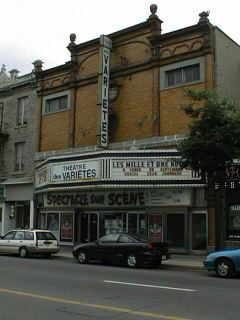
Quebec company founded in Montreal by Gilles Latulippe in 1967 to present variety, cabaret and comic theatre.
It was housed in a 725-seat slightly renovated cinema (the Dominion, built in 1913) on Montreal's Rue Papineau in the east end, across the street from the Théâtre la Licorne and a Bingo Hall. A common sight in front of the theatre, were lines of buses arriving from all over the province to take in the shows that were programmed or starred or were directed by or written by (or all of the above) the beloved comic Latulippe.
Some of the performers who played the hall to enormous success were Jean-Louis Millette, Olivier Guimond, Rose Ouellette (La Poune) and the popular cross-dresser, Jean Gilda. Many new comics, seeing the venue's built-in audience and, also, as an homage to the great past of Quebec comedy, began to play the Variétés. Performances staged by the house company, under Latulippe, included variety shows and plays written by Latulippe as well as vaudevilles and farces from around the world.
In 1998, Latulippe conferred managment of the house on his son Olivier (named for Olivier Guimond). The house was subsequently sold, in February 2000, and renamed the Théâtre des Nouveautés. It was up for sale again a year later. The space is now called Le Cabaret du Plateau.
It is important to note that since the beginning, Latulippe has recorded every work during his tenure at the house on tape or video.
The house and Latulippe's company received no governmental funding.
Profile by Gaetan Charlebois
Last updated 2020-04-17
Theatre Direct
Theatre for young people, located in Toronto Ontario, founded by playwright David S. Craig in 1976. Theatre Direct has produced and toured over eighty-five productions reaching 45,000 young people annually in schools and theatres.
Its mandate is to create and present sophisticated and uncompromising theatre for, with and by young people that provokes, challenges and inspires; to present theatre that is socially conscious and reflects and interprets the diversity of the Canadian experience; to nurture the audience’s appreciation of the arts and each other through community and education based programs (Website).
In 2009 Theatre Direct relocated to the Artscape Wychwood Barns, a redeveloped historic site in a park in central Toronto. The company’s facilities include a fully-equipped professional theatre venue and an education studio.
Noteworthy productions of Canadian works include: Thin Ice by Banuta Rubess and Beverly Cooper, Getting Wrecked by Tom Walmsley, The General by Robert Morgan, and Flesh and Blood by Colin Thomas, one of the first plays dealing with HIV/AIDS; A Secret Life by Ed Roy, and Toronto at Dreamer’s Rock by Drew Hayden Taylor (which toured across Canada).
Since 2002, productions include Alphonse by Wajdi Mouawad; And by the Way Miss… by the interdisciplinary collective URGE; Beneath the Banyan Tree by Emil Sher, which toured Canada and England and won a Dora Mavor Moore Award in 2015; I Met a Bully on the Hill by Martha Brooks and Maureen Hunter; Sanctuary Song, composed by Abigail Richardson and written by Marjorie Chan.
In 2001 and 2002, The Buncha’ Young Artists Festivals premiered eight new works for young adults by emerging playwrights.
The company has received seven Dora Mavor Moore Awards, ten Chalmers Awards and the Canada Council Theatre for Young Audiences Prize.
Since 2001, the Artistic Director was Lynda Hill. In January 2019, Lisa Marie DiLiberto was appointed AD.
Website: www.theatredirect.ca
Last updated 2021-12-01
Théâtre du Bois de Coulonges
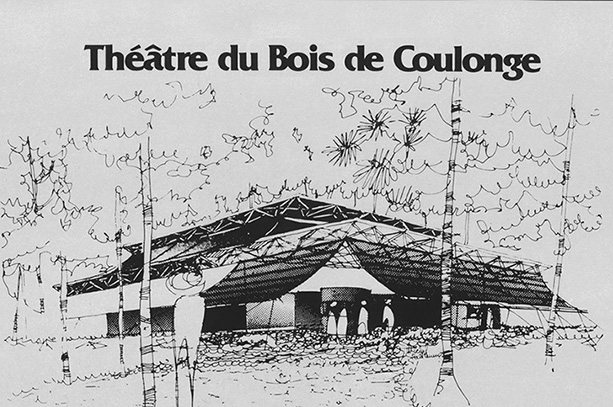
Company in Quebec City, Quebec, that presented a wide range of plays every summer from 1977 to 1995: 53 productions in 19 seasons. The Company performed in a tent accommodating 500 people, located in the scenic Bois de Coulonges, its origins similar to the Stratford Festival. Co-founders were Jean-Marie Lemieux, his wife Rachel Lortie, and a group of enthusiastic friends.
Many Quebec actors began their careers in productions at Théâtre du Bois de Coulonges, including Yves Jacques and Huguette Oligny.
The first production was Les Grands Soleils by Jacques Ferron. Among other works by Quebec playwrights were: Citrouille by Jean Barbeau (1979); Ils étaient venus pour… by Marie Laberge (1981, dir. Laberge); Les Belles-soeurs by Michel Tremblay (1984); Bousille et les justes by Gratien Gélinas and Les Gars by Jean Barbeau (1989). Other notable productions include: La Ronde, Fleurs d'acier/Steel Magnolias, Qui a peur de Virginia Woolf/Who's Afraid of Virginia Woolf, Topaze, and Equus.
Jean-Marie Lemieux directed many of the early productions. Other directors included Paul Hébert, Albert Millaire, and Robert Lepage.
In 1989, the board of directors announced that the company would no longer have an artistic director, that plays and directors would be selected by the board; as a consequence, the productions were more a "summer-theatre" fare of light comedies.
Website: https://theatreboisde coulonge.com.
Last updated 2021-02-05
Théâtre du Nouveau Monde
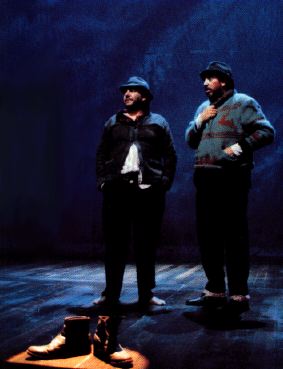
Company in Montreal, Quebec, founded in 1951 by Georges Groulx, Jean Gascon, Jean-Louis Roux and Guy Hoffmann.
It was established as a repertory house with an accent on the works of Molière, but has evolved into a house which presents a combination of large-cast classics (Shakespeare, the Greeks), Quebec repertory (Michel Tremblay) and the occasional new work (Michel Marc Bouchard's Voyage de couronnement).
The first thirty years of the company were dominated by Jean Gascon (AD until 1968) and Jean-Louis Roux (AD until 1981). The company was itinerant at the beginning, playing the Salle du Gésu and the Orpheum (later Comédie-Canadienne, and later still taken over by the TNM itself in 1972). It included a training facility (much of which became the National Theatre School of Canada). In 1958, the company toured to France to ecstatic reviews from the critics for the its production of Molière, and the company has not looked back since. It is now a fixture of Montreal cultural life despite fiscal and artistic ups and downs.
From the start it was home to the emerging stars of Quebec theatre: Denise Pelletier, Monique Miller, Geneviève Bujold, Albert Millaire, and in more recent years, Claude Poissant, Sylvie Drapeau, Lorraine Pintal (the present AD),Michel Tremblay, Macha Limonchik and René Richard Cyr. It also employs the best designers in the country like Claude Accolas and Daniele Levesque.
The house underwent a complete renovation in 1997 (by architect Dan S. Hanganu).
Since becoming artistic director in 1992, Lorraine Pintal has responded well to the criticism that the TNM was in artistic stasis by presenting seasons that are imaginative combinations of the classics reinterpreted and more recent works (for instance, a season that included Cyrano de Bergerac, a premiere of Michel Marc Bouchard's latest work, Hedda Gabler and Lulu). A night at the TNM is a night at a well-funded, large-scale theatre that doesn't count its pennies in terms of design. TNM has also experienced its share of controversy. It was the centre of one of Quebec's biggest debates, that surrounding Denise Boucher's Les fées ont soif. In a more recent season, there was some discussion surrounding the production of Wedekind's Lulu, and unpleasant (but brilliant) images director Denis Marleau had created from the work. The posters for its 1998-99 season, each featuring nudity, also generated debate, with some being banned from bus shelters.
At the beginning of the 1999/2000 season, for the revival of the previous season's Don Quichotte, adapted from Cervantes by Wajdi Mouawad, Mouawad published, in the program, his violent and scatalogical opinion of sponsors' placards, which appear on the stage prior to performances. Pintal, who also published a rebuttal in the program, claimed the author's right to free speech even as she abjured the words.
In 2001, TNM celebrated its 50th season, beginning it with a production of L'Orestie/The Oresteia, from France, and then remounting L'Avare/The Miser, the first piece presented by the company. They also took their adaptation of Réjean Ducharme's L'Hiver de force to Paris.
The 65th anniversary season included: Tartuff by Moliere, Le Jeu de L'Amour et du hasard by Marivaux, and Pourquoi tu pleures? by Christian Bégin and Marie Charlebois.
Forced to close for eighteen months during the Covid-19 pandemic in 2020-21, TNM opened for its seventieth anniversary for the 2021-22 season with productions of Les Reines by Normand Chaurette (dir. Denis Marleau); Lysis by Fanny Britt and Alexia Burgey (dir Pintal); Les Trois soeurs by Chekhov (trans. and dir. René Richard Cyr); Un ennemi du peuple by Ibsen (dir. Edith Patenaude); and Cher Tchekhov by Michel Tremblay (dir. Serge Denoncourt).
Viewings: Côté cour... côté jardin, dir. Roger Blais, National Film Board, 1953 - backstage during a TNM performance of L'Avare/The Miser, featuring Gascon, Hoffman, Roux, Pelletier, Antoinette Giroux and Jean Duceppe.
The current Artistic Director is Geoffrey Gaquère
Website: www.tnm.qc.ca
Profile by Gaetan Charlebois.
Last updated 2025-10-12
Théâtre du Nouvel-Ontario
Francophone company in Sudbury, Ontario, founded in 1970.
Among the works the company has performed are André Paiement's Lavalléville (1974), Jean-Marc Dalpé's and Brigitte Haentjens's Nickel (1984), Dalpé's, Robert Marnier's and Robert Bellefeuille's Les Rogers (1986) and the world premiere of Dalpé's Governor General’s Award-winning Le Chien (1988).
The company has worked in co-production several times notably with Théâtre de la Vieille 17 and Théâtre Français de Toronto. With the former, the company presented its 1998 production of Le Moine. More recent co-productions include: Quand la mer... with Théâtre de la Vieille 17 and Théâtre Sortie de Secours.
In 1997, the company opened its own theatre space in salle André-Paiement, and with André Perrier as its new director, it launched into a new era of play production and touring. Since 2004, the Artistic Director is Geneviève Pineault.
Website: www.letno.ca
Last updated 2020-07-17
Théâtre du Rideau Vert
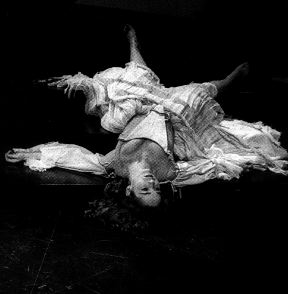
Company in Montreal, Quebec, founded in 1949 by Mercedes Palomino and Yvette Brind'Amour. It is the oldest professional French theatre company in North America. Yvette Brind'Amour was Artistic Director until her death in 1992, and Guillermo de Andrea assumed the position until 2004. The current Artistic Director is Denise Filiatrault. Céline Marcotte is the Director General. Both directors have announced their retirement in June 2025 after 21 years in their roles.
The Company was launched with a production of Lillian Hellman's Les innocentes/The Children's Hour, directed by and starring Yvette Brind'Amour. Over the years, many of Canada's great actors have performed in the theatre, including: Denise Pelletier, Jean Gascon, Gérard Poirier and Geneviéve Bujold.
The repertoire was primarily traditional and international. The Rideau Vert took a big leap forward in 1968 with the premiere of Michel Tremblay's Les Belles-soeurs (directed by André Brassard). Although it had presented premieres before and did after, this was perhaps one of the most significant in the history of modern Canadian theatre. From the modest little house which presented the works of Shakespeare, Molière, Ibsen and Feydeau, Rideau Vert launched itself into the forefront of the new Quebec theatre.
Since 1972 and Rideau Vert's production of La Sagouine, the company has championed the theatrical career of Antonine Maillet as well, presenting the premieres of most of her plays and translations.
The company has also toured extensively in Canada and abroad (to Europe and Russia).
From 1968, the Rideau Vert has owned (and in 1992 extensively renovated) the same theatre on St-Denis Street. It is a monument to nearly five decades of fiscal and artistic ups and downs, but also of solid, accomplished theatrical life.
The company began its 50th season with the production of a new work by Michel Tremblay, the brilliant Encore une fois, si vous le perméttez. It continues to present classics of all repertoires.

Canada Post issued a stamp celebrating Théâtre du Rideau Vert on its 50th anniversary, February 17, 1999. The stamp was designed by Marie Rouleau and Yves Paquin, of Montreal, and combine the masks of tragedy and comedy, but also the faces of the company's co-founders: Yvette Brind'Amour (foreground) and Mercedes Palomino.
Additional reading: Le Théâtre du Rideau vert: 50 ans à célébrer le théâtre, 1949-1999. Publié sous la direction de Mercedes Palomino, Guillermo de Andrea, Serge Turgeon. Montréal: Leméac, 1999.
Website: www.rideauvert.qc.ca
Profile by Gaetan Charlebois
Last updated 2025-02-18
Théâtre du Trident
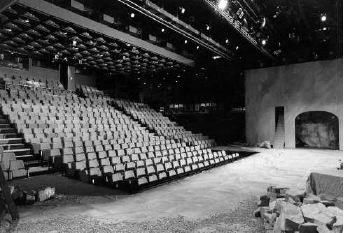
Quebec-city company founded in 1970 as a substitute for several local companies which had disbanded (notably Théâtre de l'Estoc).
Its first artistic director was Paul Hébert and the company's first production, presented at the Grand Théâtre de Quebec, was Jean Barbeau's 0-71.
Théâtre du Trident was precisely what the capital city needed and was a resounding success from its first season. Hébert's leadership made it almost immediately an important force. Its mandate has been to produce a balance of classic and international works, Quebec plays, and new work developed by the company as well as co-productions.
Plays presented there included Éloi de Grandmont's adaptation of Pygmalion (starring a young Dorothée Berryman and Albert Millaire); Charbonneau et le Chef; and La mort d'un commis voyageur/Death of a Salesman (these last two starring a brilliant Jean Duceppe).
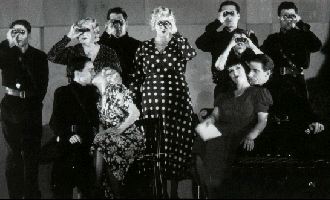
The company has presented the works of Marie Laberge, Maryse Pelletier, and Roland Lepage, as well as works by Shakespeare, Molière, Mrozek, and Williams. In 1999, it revived Réjean Ducharme's very difficult work Inès Pérée et Inat Tendu and in 2000, presented Robert Lepage's La face cachée de la lune.
Artistic Directors have included Serge Denoncourt and Marie-Thérèse Fortin (1998). The current Artistic Director is Emile Beauchemin, and the Executive Producer is Martin Brouard.
To celebrate its 45th season (2015/16), Théâtre du Trident offered a season full of emotion and surprises: a dramatic adaptation of Orwell's novel,1984; Robert Lepage's interpretation of the Marquis de Sade in Quills; and a stunning adaptation of Larry Tremblay's novel, L’orangeraie.
The 2016/17 season included 887 by and starring Robert Lepage; and a dramatic adaptation by Frédéric Duboi of the classic and enigmatic Quebec film Les bons débarras by Réjean Ducharme, in a co-production by Trident and Théâtre des Fonds de Tiroirs.
Website: www.letrident.com
Profile by Gaetan Charlebois and Anne Nothof
Last updated 2020-03-26
Théâtre Ex Machina
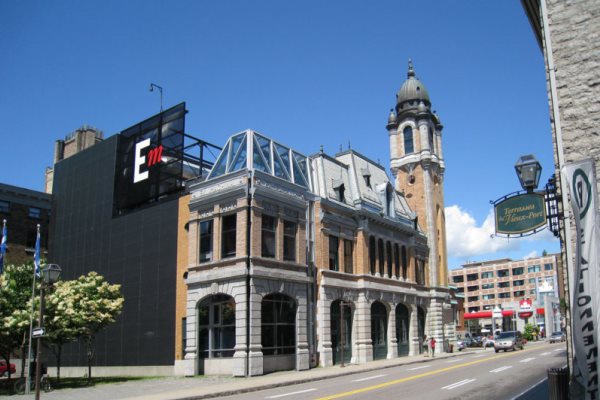
Multi-disciplinary theatre company in Quebec City, Quebec, founded in 1990 by Robert Lepage.
The Company serves as a workshop and a theatre research lab for productions mounted by Lepage. It has created and extensively toured works like Plaques tectoniques, Aiguilles et Opium, and Le Polygraphe, but it is probably now best known for the nine-hour (with intermissions) epic, The Seven Streams of the River Ota that was presented around the world.
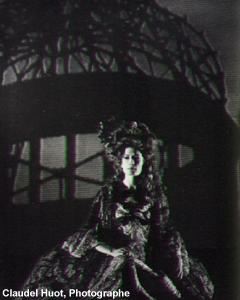
In 1997, the Company converted a fire station in Quebec City, Caserne Dalhousie, into a state of the art venue and exploration space for dance, film, opera, theatre, and emerging arts technologies.
Website: https://exmachina.ca
Last updated 2021-12-13
Théâtre Expérimental des Femmes
Company in Montreal, Quebec, founded in 1979 by Pol Pelletier, Nicole Lecavalier and Louise Laprade as a women's experimental collective.
The company's activities included productions, workshops, mounting festivals of women's works as well as seminars on women's history. At the centre of all the work were social causes, the domination of the patriarchy (in society and culture) and liberationist philosophy.
A hotbed of activity, almost the entire history of the company came with controversy and debt. A performance, Beau Show in 1986 went a long way to saving the group, as did subsequent aid from sponsors. In 1987 Ginette Noiseux assumed the artistic directorship.
The company began performing at Espace Go (a barely converted garage) in 1985 and the original name soon vanished as did the company's mandate when Espace Go broadened into other kinds of theatre and away from strictly defined feminism and women's theatre.
Among the works performed by the group are: Jovette Marchessault's La terre est trop courte, Violette Leduc and Pelletier's La lumière blanche.
Pol Pelletier's participation and difficulties with the collective are partly described in her one-woman show Joie.
Profile by Gaetan Charlebois.
Last updated 2010-12-03
Théâtre Français de Toronto
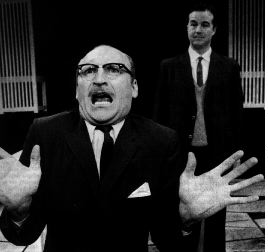
French-language theatre company in Toronto, Ontario, the largest francophone company outside Quebec.
It was founded in 1967 by John Van Burek as Théâtre du P'tit Bonheur and performed out of a church basement. It turned professional in 1973, and expanded quickly, moving to Adelaide Court in 1978 and to Harbourfront in 1987, where it rented the du Maurier Theatre Centre. It now performs out of the Berkeley Street Theatre. It changed its name to Théâtre Français de Toronto in 1987.
The theatre enjoys a consistently large audience for its work. Since its founding it has presented over 200 productions from the Canadian, French and international repertoires.
Quebec plays, particularly those of Michel Tremblay, feature prominently in the repertoire. It also attracts top-notch artists like Brigitte Haentjens, Pierre Collin and Huguette Oligny.
The Acadian play, La Sagouine by Antonine Maillet, and starring Viola Léger, played to near capacity houses in French in 1979, in English in 1980, and again in French in 1988. In 2002 Tremblay's L'Etat de lieu was directed by André Brassard. The 2003-04 season included Pour une fois by Herménégilde Chiasson, and Helen's Necklace by Carole Frechette. The 2007 season featured Grace and Gloria by Tom Ziegler, also starring Acadian actor Viola Léger, in a translation by Michel Tremblay; and Apocalypse a Kamloops by Stephan Cloutier, a joint production by Théâtre la Seizième in Vancouver, Théâtre Catapulte in Ottawa and Théâtre Français de Toronto.
In October 2016, the theatre co-produced The (Post)Mistress by Tomson Highway in English and French with Pleiades Theatre (dir. John van Burek, with set by Teresa Przybylski). Patricia Cano performed and sang, Highway accompanied on the piano. In her review, Karen Fricker enthused about the production: "Along with great songs and a winning performance, what’s delivered here is a celebration of Francophone Northern Ontario, and the place in it of Native cultures, languages, and spirituality" (thestar.com 17 Oct 16).
The theatre also mounts and tours productions for young audiences. In 2005 English surtitles were introduced.
Van Burek was Artistic Director from 1971 to 1974, and from 1980 to 1991. Between 1974 and 1976 volunteer ADs Claire Pageau and Carmelle Brodeur ran the theatre. Eugene Gallant was AD from 1976 to 1980; Diana Leblanc from 1991 to 1997, followed by Guy Mignault. Joel Beddows was AD from 2015 to 2021, followed by Karine Ricard as of July 21, 2021.
The company's archives are at the L.W. Conolly Theatre Archives of the University of Guelph, Ontario.
Sources include: The Oxford Companion to Canadian Theatre. Eds. Eugene Benson, L.W. Conolly. Oxford UP: Toronto, 1989.
Web site:www.theatrefrancais.com
Last updated 2021-12-08
Theatrefront
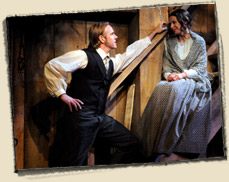
Ensemble, intercultural theatre company, founded in Kingston Ontario by Daryl Cloran, Sue Balint, Shane Carty, Holly Lewis, Christopher Morris, Michel Protti, Grahame Renyk, Claire Sakaki, Dylan Trowbridge, Gema Zamprogna , and since 1999 based in Toronto. Daryl Cloran was the first Artistic Director. The last AD was Vikki Anderson. Theatrefront disbanded in 2021, when the Covid-19 pandemic closed theatres across Canada and the world.
The Company's mandate reflected a focus on collective creation with an international purview: Theatrefront was dedicated to stretching the boundaries of the human experience through theatre. It collaborated with artists from other countries to cross geographic and cultural borders in the creation of unique multimedia work (website).
Theatrefront’s early productions included: Unidentified Human Remains and the True Nature of Love by Brad Fraser (1995, Grand Theatre Kingston; House by Daniel MacIvor (1998, Adelaide Fringe Festival, Australia); Our Country's Good by Timberlake Wertenbaker (2001, Tarragon Theatre); Mojo by Jez Butterworth (2002, CanStage, Berkeley Street Theatre); Swimming in the Shallows by Adam Bock (2003, produced in association with Buddies in Bad Times).
The first collective project, Return (The Sarajevo Project) (Tarragon Theatre 2006) was developed with a group of actors from Sarajevo, and a workshop production presented at the Sarajevo International Winter Festival in Bosnia-Hercgovinia in 2003. In Return, a Bosnian man living in Canada visits his family ten years after he had fled the war-torn country. His family resists his attempts to relocate them to Canada, and resents his apparent abnegation of his country. It received five Dora Mavor Moore Award nominations for Outstanding Production, Outstanding New Play, Outstanding Direction, Outstanding Female Performance, Outstanding Set Design. It is published by Playwrights Canada Press (2007).
Ubuntu (The Cape Town Project) (2009, co-produced with Tarragon Theatre and Neptune Theatre) was conceived by five members of Theatrefront and four South African actors from the Baxter Theatre Centre “to develop a common theatrical language, to find the meeting point between the two cultures, to learn about ourselves while learning about people from the other side of the world” (website). In South Africa, “ubuntu” refers to the spirit of community, the belief that humanity is tied together. In this collective creation, “ghosts haunt a man and a woman, continents apart, as they are drawn together to discover the secrets of their past” (website). Music and dance are used extensively: “actions often assume dance-like forms, and characters frequently transform into objects; physicality frequently serves as an expressionistic replacement for dialogue in the play” – which became hallmarks of Theatrefront. (Ratsoy 49). In 2012 the production toured Western Canada, appearing at the High Performance Rodeo in Calgary, Western Canada Theatre Company, and Firehall Arts Centre in Vancouver.
The Mill (2009, The Young Centre for the Performing Arts) was the biggest project ever undertaken by Theatrefront. It is a series of four full-length plays, written by four Canadian playwrights, starring the same ensemble of actors: Part 1: Now We are Brody by Matthew MacFadzean (dir. Daryl Cloran); Part 2: The Huron Bride by Hannah Moscovitch (dir. Christian Barry); Part 3: The Woods by Tara Beagan (dir. Sarah Garton Stanley); Part 4: Ash by Damien Atkins (dir. Vikki Anderson). The plays follow the lives of the inhabitants of Brody, a Canadian pioneer town, over four hundred years, revealing the horrifying story of the mill's past, and the secrets of the town's inhabitants. The Mill received four Dora Awards for Outstanding Production, Outstanding Set Design (Gillian Gallow), Outstanding Costume Design (Dana Osborne), and Outstanding Lighting Design (Andrea Lundy).
Mules by Beth Graham and Daniela Vlaskalic premiered at Crow’s Theatre in February 2019 (dir. Vikki Anderson). "Holed up in a washroom in Vancouver’s International Airport, Cindy and Crystal are fighting for their lives. Crystal has a belly full of cocaine and a limited time to get it out of her system and Cindy is trying to keep her violent drug smuggling boyfriend at bay. When the janitor interrupts them, the crisis escalates and the consequences are tragic" (Theatrefront website).
Eva Barry was the 2017 playwright-in-residence. Jason Maghanoy was the 2018 playwright-in-residence.
Further Reading: Ginny Ratsoy. "Interculturalism and Theatrefront: Shifting Meanings in Canadian Collective Creation,” Theatre Research in Canada 34.1 (2013): 37-55.
Last updated 2022-06-27
Théâtre Il Va Sans Dire
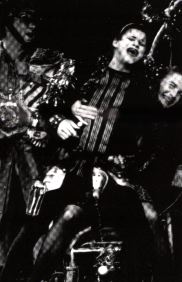
Company in Montreal, Quebec, founded by Dominic Champagne in 1984 and initially comprised of students from the CEGEP François-Xavier-Garneau in Ste-Foy.
Its mandate is to find the link between actor and the written word, and toward that end, the works presented are exhaustively researched and workshopped before presentation. It seeks to unite word, music and the grotesque in its creations, and as a result the Company has reached a huge public, including the most elusive one: young spectators.
Among its works have been the seminal Cabaret Neiges Noires (1992), a freewheeling, often vulgar, satirical, funny and hugely entertaining work which lampooned everything from Québécois television to the cult of Martin Luther King Jr. It also premiered Champagne's La Répétition(1990, with subsequent national and international tours), La Cité Interdite (1991) and Lolita (1995). In 1998, the company entered the sanctum sanctorum of Quebec theatre, the Théâtre du Nouveau Monde, with a brilliant adaptation of Don Quixote (Don Quichotte), written by Wajdi Mouawad and directed by Champagne. In March, 1999, the company launched L'Asile starring Monique Mercure and in February, 2000, again at TNM L'Odysée..
The creators who have worked with the company represent the cream of the Quebec new wave: Sylvie Drapeau, René Richard Cyr, Marc Labrèche, Jean-Frédéric Messier, Roger La Rue, Céline Bonnier, Lou Arteau, Jean-François Caron.
Commentary by Gaetan Charlebois.
Last updated 2021-12-08
Theatre Junction
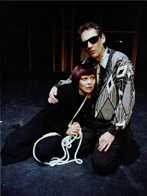
Ensemble theatre company founded in Calgary, Alberta in 1991. Theatre Junction was based in the Dr. Betty Mitchell Theatre in the Southern Alberta Jubilee Auditorium in Calgary for fourteen years, interpreting classical, contemporary, and new Canadian plays. Its founding Artistic Director was Mark Lawes.
Theatre Junction's initial mandate was to create exciting and challenging works that stimulate dialogue, to present contemporary plays from the national and international repertoire, and to bring its work to other performance spaces in Canada and abroad. The Company presented a wide range of works by Canadian playwrights, including John Murrell, Dominic Champagne, and Sharon Pollock. It also offered an annual festival of original works over a three-day period, called “Random Acts.”
Following the demolition of the Dr. Betty Mitchell Theatre space in 2016, Theatre Junction relocated to the newly restored Grand Theatre in Calgary, which was built in 1912 as a 1,350-seat vaudeville house, converted to a film house, and then a golf centre. The restored auditorium is flexible in design, and can be reconfigured as a proscenium stage, a theatre-in-the-round, or a thrust stage, and seats between 144 and 400 patrons.
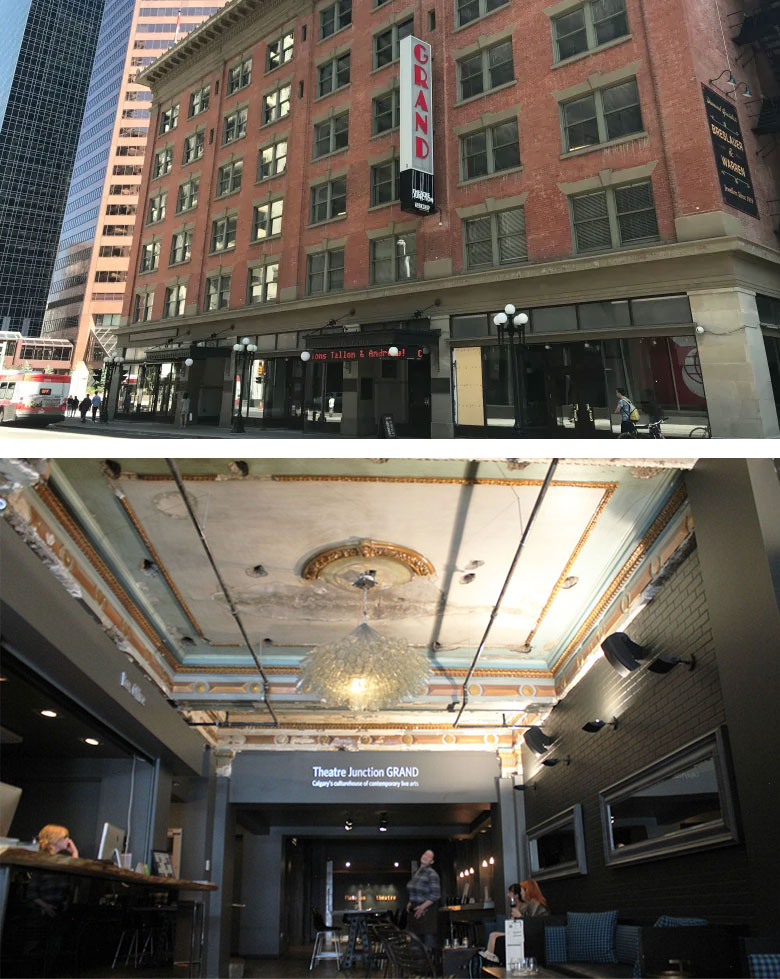
In 2016 Mark Lawes stepped away from the position of Executive Director to develop artistic projects including the creation of The Supernova Trilogy which received a New Chapter Grant from the Canada Council for the Arts. The Supernova Trilogy premiered in France at the Festival des Francophonies in Limoges and toured to the International Festival of the Arts in Bordeaux in 2018 and to Usine C in Montreal in April 2019.
After the tour of The Supernova Trilogy, it became difficult for Theatre Junction to continue to expand and flourish as an artistic innovator in the Grand theatre in Calgary due to unfavorable cultural conditions and an accumulated a deficit of half a million dollars. The Company made the decision to move its operations to Montreal in April 2019, and appointed Raphaële Thiriet as co-artistic director. Montreal has been more aligned with Theatre Junction’s cultural and artistic values, and has generously contributed to its development by hosting the Company several times over the last decade, in its theatres, in residencies, and on tour.
Since moving to Montreal, Theatre Junction has created several new works including Chaosmos, a decolonized cabaret (2021), created with the celebrated African American visual artist and vocalist Malcolm Mooney; the digital premiere of Outside/In (2022) that is being developed into a hybrid digital/live work in partnership with EMPAC in Troy NY; The End of a Dream (2021), a video art installation presented at the Yegip Museum of Art in Gunsan South Korea; and the French language première of Jordan Tannahill’s Concord Floral directed by Raphaële Thiriet (2020).
Website: www.theatrejunction.com
Last updated 2022-07-30
Theatre Kingston
Company in Kingston, Ontario, founded in 1990 as Theatre Beyond by Paul Gelineau. It became the People's Theatre Kingston in 1992 (artistic directors included Kathryn MacKay and Kathleen LeRoux). In 1997 Craig Walker was appointed artistic director, and the company took its present name. It moved into the Baby Grand Studio where it began offering a full season of three or more productions. Walker was Artistic Director from 1997 to 2007, followed by Kim Renders (2008-2011), and Brett Christopher (2012-2016). The current AD is Rosemary Doyle.
Theatre Kingston is known for the quality and innovative nature of its productions. These include two co-productions with the local French theatre group, Les Treteaux de Kingston, of bilingual plays: David Fennario's Balconville and Marianne Ackerman's L'Affaire Tartuffe; productions of Ann-Marie MacDonald's The Arab's Mouth and Judith Thompson's Perfect Pie.
Theatre Kingston also takes original approaches to more familiar plays, such as Thompson's Lion in the Streets, presented in the round on a sand-floor in a setting which resembled a cross between a public park and a bullring. Its production of Henry James' ghost story, The Turn of the Screw took place in a long dark hallway with the two performers isolated by spots of light. Bernard Shaw's Pygmalion was set as if in the playwright's own study, Shaw himself narrating, dressing the stage, playing the minor characters and filling out the story with short scenes drawn from his own screenplay.
The company has also presented several world premieres, including the collective creation Princess Street: The Great Divide; Fred Euringer's Night Noises; Craig Walker's Finnegans Wake: a dream play; and Kim Renders' Talking of Michelangelo (2009).
To celebrate its 25th anniversary in 2016/17, Theatre Kingston mounted Almighty Voice and His Wife by Daniel David Moses (dir. Lib Spry); Concord Floral by Jordan Tannahill (dir. Gregory Wanless) in collaboration with the Dan School of Drama and Music at Queen's University in the Isobel Theatre Centre for the Performing Arts; and Armstrong's War by Colleen Murphy (dir. Craig Walker). In 2021, Theatre Kingston celebrated its thirtieth anniversary and the reopening of the theatre during the Covid-19 pandemic with the premiere of The Sylvia Effect by Peter Hinton, based on the poems of Sylvia Plath.
Theatre Kingston maintains a community outreach program which has included classes for adults and children, and workshops in the local schools and prisons. Recently, the Company has joined with Queen's University to produce an annual summer project: the Young People's Theatre Festival.
Website: www.theatrekingston.com
Last updated 2021-12-08
Theatre Lac-Brome
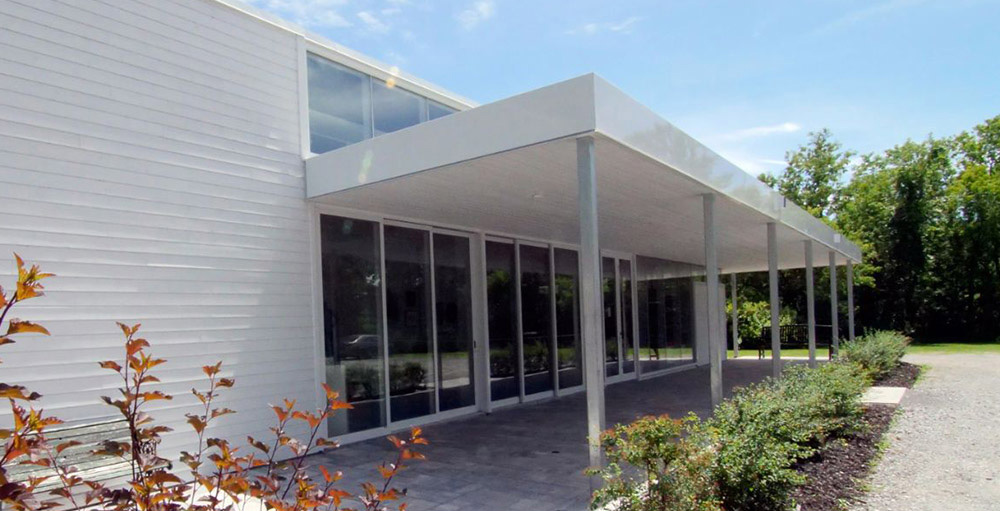
Located in Knowlton in the picturesque Eastern Townships of Quebec, Theatre Lac-Brome was founded in 1986 by Emma Stevens as a non-traditional summer playhouse offering an eclectic program combining classics such as Dario Fo's Accidental Death of an Anarchist and the dark musical Cabaret with modern Canadian pieces including Morris Panych's 7 Stories and its own commissioned translations of works by Michel Marc Bouchard. These productions consistently have attracted some of the most talented names on the national theatre scene, including director Bill Glassco, and actors Bruce Dinsmore and Peter Pringle.
From the early days of the barn-style Brae Manor Playhouse to Theatre Lac-Brome's current building behind a local pub, theatre in Knowlton has been marked by sophisticated summer fare. Theatre Lac-Brome has developed from its initial eight weeks of professional summer theatre into a year-round cultural centre, now named Arts Knowlton, with professional English-language theatre running from mid-June to Labour Day, and an active community and professional theatre scene the rest of the year.
From 1991 to 2017, under the artistic direction of Nicholas K. Pynes, a transplanted New Yorker, Theatre Lac-Brome also made a firm commitment to bringing the works of Canadian playwrights to Townships audiences: John Gray's Rock & Roll; Scott Wentworth's Gunmetal Blues; George Rideout's An Anglophone Is Coming To Dinner; and Stewart Lemoine's Evelyn Strange.
The Theatre has also sought to reflect the cultural diversity of Quebec with such plays as Marie-Lynn Hammond's bilingual De Beaux Gestes et Beautiful Deeds, Michel Marc Bouchard's Heat Wave, Desire and Pierre & Marie in their English premieres, and Michel Tremblay's The Impromptu of Outremont.
The search for stories that are meaningful to Townships audiences led Pynes and collaborator Edward S. Herkes to write the story of Donald Morrison in the musical, The Megantic Outlaw, first produced for the Theatre's 10th anniversary season in 1996.
From its inception, Theatre Lac Brome has also supported and nurtured a vibrant community theatre scene. Echo Art, which was run by theatre founder Emma Stevens, made its mark with productions of Joseph & The Amazing Technicolor Dreamcoat and Jesus Christ Superstar, as well as an original musical centring on the story of Joan of Arc. In the spirit of the original Knowlton Youth Group, Echo Art also ran a summer theatre camp for children of all ages, enabling the development of their artistic talents.
The veteran amateur group in town, The Knowlton Players, entertains audiences with their productions of farces such as Play On! and musicals like Annie. Sunshine Theatre Productions offers a balance of classic comedies such as You Can't Take It With You and Broadway musicals including Guys & Dolls.
A variety of other companies from the Townships and Montreal have also rented the theatre's facilities to mount their own shows. These include Sutton's bilingual Théàtre Mandragore and Montreal's Theatre Onze Heures Onze, which presented productions in the comedia del arte tradition.
Website: www.theatrelacbrome.ca
Last updated 2021-12-13
Théâtre la Licorne
Small theatre complex in Montreal, Quebec, founded by Jean-Denis Leclerc, its first Artistic Director. Denis Bernard was A.D. from 2009 to 2019; the current A.D. is Philippe Lambert.
Théâtre la Licorne houses the productions of Théâtre de la Manufacture and the many companies Manufacture hosts.
Originally housed in a small bar on St-Laurent Boulevard, the house transferred to a new venue in 1981 on Papineau Street (across the street from Théâtre des Variétés and beside a bingo hall).
The venue comprised a flexible café/bar theatre of 150 seats and a restaurant until 1995 when the restaurant was turned into a 60-seat venue.
Much of the work here is contemporary or reappraisals of the classics.
Website: https://theatrelalicorne.com
Last updated 2021-12-13
Théâtre la Seizième
French professional theatre company, based in Vancouver, British Columbia since 1974. It offers plays for adults, adolescents, and children. Its name originates in the title of its first production -- Les Belles-soeurs by Michel Tremblay, in which there are fifteen characters and a director. It also alludes to its present location in Studio 16, a 100-plus seat black box theatre in La Maison de la Francophonie.
It began a regular season of plays for adults in 1998 with Et si Dieu jouait aux dés, and has produced original plays by local playwrights such as Stephan Cloutier (Les Contes de Vancouvérois; Quebec playwrights, including Daniel Danis (Cendres de cailloux); and translations of plays by other Canadian authors, including John Mighton (Des mondes possible), and Joan MacLeod (Mon Joyau). In March 2008, in collaboration with Ruby Slippers Theatre it premiered La Vue d'en Haut, written in English by James Long, and translated into French by Philippe Decros. Set in North Vancouver in 2012, the play takes place following the cancellation of the Olympics because of a three-year-long deluge. It depicts the social consequences for the homeless and the well-healed.
Théâtre la Seizième also hosts productions by other Canadian companies: La face cachée de la lune (Ex Machina); Antarktikos and Trick or Treat (Théâtre de la Manufacture); Le Porteur (Théâtre de l’Oeil); and The Dragonfly of Chicoutimi (Théâtre d’Aujourd’hui).
Recent collaborations with L’UniThéâtre include the production of Lentement la beauté (2009); La Peau d'Elisa by Carole Fréchette (2011); Porc-épic by David Pacquet (2012); and Le Soulier by Paquet (2019).
The Company tours its plays for young people in schools throughout British Columbia and in other provinces, and presents theatre workshops.
Since 2016, Esther Duquette was Artistic Director. In 2023, Cory Haas became the Artistic and Managing Director.
Website: www.seizieme.ca
Last updated 2023-01-10
Théâtre le Clou
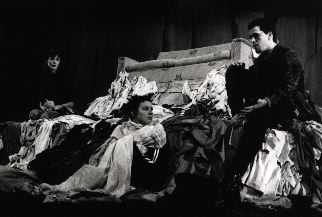
A young people's theatre company in Montreal Quebec, founded by Monique Gosselin, Sylvain Scott, and Benôit Vermeulen in 1989.
The founders had studied together in the theatre program of CEGEP Lionel-Groulx and joined together to form a company that would create theatre specifically aimed at adolescents with subjects that would be a more cutting edge than the theatre then touring schools.
The company's mandate is to create theatre in such a way that the theatrical event becomes a direct encounter between artists and audience. Toward this end, they have created works like Les Zurbains, a multi-part, variously authored, urban story-telling series. Their other works include: Tu peux toujours danser (by Dominique Lavigne, directed by Claude Poissant, 1990), Jusqu'aux Os! (Alain Fournier, Vermeullen, 1993; subsequently presented by the company as To The Bone!, translated by Bernard Lavoie) and Noëlle en juillet (Louise Bombardier, Vermeullen, 1996).
In Les Trains by Olivier Choinière (April, 1999) three teenagers who sit in a beat-up couch near a train-track decide to create a life for themselves, to "get on the train." The author and company used art, music, design, video and sound environment to create the work. It was presented at the Maison Théâtre. In the 1999-2000 season they toured extensively but landed, in May 2001, as part of the Nouvelle Compagnie Théâtrale / Théâtre Denise-Pelletier season with Les Zurbains 2001. In 2006, the company presented Assoiffés by Wajdi Mouawad (dir. Vermeulen) in a co-production with Théâtre d'Aujourd'hui.
In 1997, Vermeulen received the Canada Council's John Hirsch award for his work with Théâtre le Clou. He is currently a co-Artistic Director with Monique Gosselin and Silvain Scott.
Website: www.leclou.qc.ca
Profile by Gaetan Charlebois.
Last updated 2021-12-13
Théâtre l’Escaouette
Professional theatre company in Moncton, New Brunswick, founded by a few of the first graduates of the drama program at the Université de Moncton in 1978, and based in Moncton ever since. Dedicated originally to works for young audiences which it toured to schools across the province, Théâtre l’Escaouette has shifted to works for a more general audience in the past dozen years. However, the company still pursues its mandate for creating original plays, and has produced forty-five in total, many by Herménégilde Chiasson. It has also been enriched by frequent co-productions with companies from central Canada, such as the National Arts Centre, Théâtre de la Vieille 17 and Théâtre du Nouvel-Ontario. The company still does some touring, particularly in Quebec and central Canada. For example, its remount production of Chiasson’s Pour une fois was performed in Toronto (February 2004) in a co-production with Théâtre Populaire d’Acadie.
For its 30th anniversary, the company was the site of two very exciting projects which point to significant advantages in the future of Acadian theatre. The first was the opening of the new theatre space in a converted Legion Hall in Moncton, and the second was the continued success of the biennial new-play development series entitled Festival à haute voix.
The last few years have been ones of transition for Théâtre l’Escaouette, with the renovation and development of the new building, and the administration of the theatre space. Nevertheless, the company has co-produced Herménégilde Chiasson’s two latest plays: Le Christ est apparu au Gun Club (with Théâtre français du Centre national des arts in 2003, remounted in 2005); and La grande séance (with Théâtre français du Centre national des arts and Théâtre populaire d’Acadie in 2004, the 400th anniversary of the founding of Acadie). La grande séance depicts a theatre company preparing to stage an historical pageant to mark this anniversary. The conceit allows Chiasson to use ironic distancing to interrogate both the history the play purports to celebrate and the act of theatrical representation itself as personal and communal performance.
Continuing as the centre of new-play development in Acadie, Théâtre l’Escaouette has produced plays originally developed during the Festival à haute voix: Mélanie Léger’s rollicking comedy Roger, Roger in 2005, and Jean Babineau’s tragi-comedy Tangentes in 2006.
More recently it has engaged in co-productions with other Francophone theatres in New Brunswick and Quebec. In 2011, it produced the award-winning Les trois exils de Christian E. by Christian Essiembre and Philippe Soldevila with Théâtre Sortie de secours, in which a young Acadian actor tries to make the big-time in Montreal. In 2022, it produced a translation of Daniel MacIvor's The Best Brothers as Les meilleurs frères with Théâtre populaire d’Acadie.
The Artistic Director is Marcie Babineau.
Further Reading: Canadian Theatre Review 128 (Fall 2006).
Website: www.escaouette.com
Profile by Glen Nichols, Université de Moncton
Last updated 2022-01-13
Théâtre les Deux Mondes
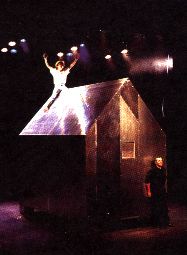
Touring company in Montreal,Quebec, based in the Villeray neighbourhood. In 1996, it opened its own research and production facility that it shares with young companies known as Théâtre Aux Écuries.
Les Deux Mondes was founded in 1973 as Théâtre de la Marmaille by Daniel Meilleur, Monique Rioux and France Merille, and its first productions were aimed at young audiences. Since then, the Company has presented a wide variety of theatre to patrons of all ages and pursued an active research into theatre form.
Productions include Leitmotiv, Rosemonde, and the company's most renowned work Histoire de l'oie/The Tale of Teeka by Michel Marc Bouchard (presented, on tour, in French, Spanish, English and German).
In 1999/2000 it announced an extensive touring schedule for three productions to take in France, Switzerland, the US and Belgium. Since its inception, the Company has toured to 35 countries, 350 cities, and 80 international festivals.
In 2013, playwright Sébastien Harrisson took over as artistic director and focused more on text in new play development. Programming features two-play production cycles, with one play for young audiences and the other for the general public. Designers from different backgrounds collaborate to produce humanist poetic works.
Recent works include: In My Paper House (Dans ma maison de papier, j'ai des poèmes sur le feu) by Phillippe Dorin, translated by Shelley Tepperman (2014).
Website: https://www.lesdeuxmondes.com
Last updated 2021-12-13
Théâtre les gens d’en bas
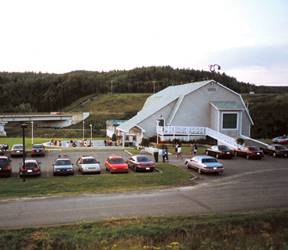
Theatre company, founded in 1973 in Rimouski Quebec in Le Bas-Saint-Laurent region by Eudore Belzile, who has been Artistic Director for its duration. Its first works were devised through collective creation. Since 1989, it has performed plays from Quebec and the world in the intimate Théâtre du Bic (196 seats), mostly during the summer season. It collaborates with other companies in new productions, and tours in the province.
Its mission is to present demanding and diverse works from all sources that question the nature of humanity in relation to the state and to the metaphysical, works that have current relevance.
In 2001, the theatre produced the critically-acclaimed French-language premiere of Michael Healey's The Drawer Boy (as Les étoiles d'Angus), in a translation by André Therien.
Several of its more than fifty productions have received awards from Les Masques de l’Académie québécoise du théâtre (Masques Awards).
Website: http://theatredubic.com/theatre-les-gens-d-en-bas
Last updated 2021-12-13
Théâtre National
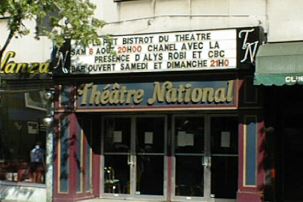
Venue in Montreal,Quebec, that has been, virtually since its opening, the centre of popular Quebec culture. It has a seating capacity of 670.
It was build by impresario Julien Daoust to house one of the city's first French-language repertory companies. Designed by Albert Sincennes and Elzear Courval, it opened on August 12, 1900.
At the beginning, it presented a new work per week to keep audiences coming back. More than 300 new productions were presented between 1900 and 1910. For a while, the theatre was home to the diva Blanche de la Sablonnière.
In the 40s, Rose Ouellette (La Poune) took over the house for her very popular variety shows.
The venue has served as a nickelodeon, a vaudeville house, a movie theatre, a classroom, a Chinese cinema, as home for the doomed Théâtre National Français (which survived all of six weeks), a Gay erotica cinema, and, in recent years, for the comeback of chanteuse Alys Robi and as the home for amateur Gay theatre (as it is in the heart of what is now Montreal's Gay Village).
Last updated 2009-09-15
Theatre Network
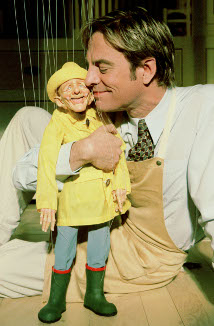
Theatre Network was founded as a non-equity collective in Edmonton in 1975 by a group of University of Alberta BFA students, including Tanya Ryga and Mark Manson. Its original objective was to produce plays about Alberta for Albertans, with a mandate to foster the development of original regional theatre, and to promote the arts in Alberta through the medium of theatre.
Under the direction of Mark Manson, its first productions were developed through collective creation in the form of social satires, docu-dramas, and community plays, including Hard Hats and Stolen Hearts: A Tar Sands Myth (with Gordon Pengilly, 1977). This production relocated to Richard Schechner's Performance Garage in New York. Other significant early productions were George Ryga's Seven Hours to Sundown (1976), and Sharon Pollock's Tracings.
Under Artistic Director Stephen Heatley, the mandate was "to assist, develop, and perform original plays by Alberta playwrights." In 1981, it became part of the Theatresports network. Theatre Network established partnerships with Playwrights' Workshop, Montreal, the Blyth Festival, Studio Theatre at the University of Alberta, the Catalyst Theatre, and Alberta Theatre Projects. In 1986 Heatley initiated a collaboration with other prairie theatres located along the historic Carlton Trail, the 25th Street Theatre Centre in Saskatoon and Prairie Theatre Exchange in Winnipeg, which brought such plays as Connie Gault's Sky to Edmonton.
Following Stephen Heatley's resignation in 1992, Ben Henderson became Artistic Director in 1993. After the demise of Phoenix Theatre in 1997, Henderson amalgamated the funding of the two theatres, and shared the artistic directorship with John Cooper, the last AD of Phoenix. They produced a split season that was half the new play mandate of Theatre Network and half the innovative world theatre mandate of the Phoenix. When Henderson and Cooper both left at the same time, Bradley Moss took over the whole operation and the amalgamated mandates in 1999 as the sole Artistic Director. During his thirty years with Theatre Network, Bradley Moss developed and premiered twenty-seven Canadian plays that were "unexpected and surprising," (Program guide for Bust by Matthew MacKenzie, 2017).
In 2026, Jenna Rodgers was appointed Artistic Director of Theatre Network. She has a B.A. from the University of Alberta; an M.A. in International Performance Research from Amsterdam University and Tampere University, Finland (2018); and was a graduate of the National Theatre School of Canada in Artistic Leadership (2020). She was the founding Artistic Director of Chromatic Theatre for artists of colour; a dramaturg for Playwrights Lab at the Banff Centre for the Arts for ten years; and Director of Theatre Alberta's Arstrek program. She was awarded the Lieutenant Governor of Alberta Arts Award for Emerging Artists in 2001; and the John Hirsch Prize for Directors in 2020.
Other premieres of new Alberta plays by Theatre Network include the musical Country Chorale (1982) by Raymond Storey and John Roby, with kd Lang in the chorus; Wolfboy (1982), Brad Fraser's first play; The Deer and the Antelope Play (1983) with Edmonton actor Paul Gross from the University of Alberta's Studio Theatre; Odd Jobs (1985) by Frank Moher, nominated for the Governor General’s Award for drama; The Last Bus (1987) by Raymond Storey; The Mail-Order Bride (1988) by Robert Clinton, winner of the Alberta Culture Playwriting competition; The Third Ascent (1988) by Frank Moher, winner of an Elizabeth Sterling Haynes Award for Outstanding New Play; Gravel Run (1989) by Conni Massing; Castrato (1992) by Greg Nelson, also winner of a Sterling; Scraping the Surface (1995) by Lyle Victor Albert (Sterling winner); Martin Yesterday (1998) by Brad Fraser; Tinka's New Dress, (Sterling Award), Street of Blood, and Happy (2000), a trilogy of marionette plays conceived and enacted by Ronnie Burkett; Mom, Dad, I'm Living with a White Girl (1998) by Marty Chan (Sterling); three plays by Eugene Stickland: A Guide to Mourning, Excavation, and Midlife; Let the Light of Day Through (2013) by Collin Doyle; Bust by Matthew MacKenzie (2017); and Irma Voth (2017) by Chris Craddock. In 2019, Bradley Moss directed the premiere of The Empress & and Prime Minister by Darrin Hagen to celebrate the gay activism of ted northe which motivated PM Pierre Trudeau to back the passing of Bill C-150, and ending the criminalization of homosexuality.
Outstanding productions of other Canadian plays include High Life by Lee MacDougall; two of George Walker's Suburban Motel plays (1999); La Repetition by Dominic Champagne (2000); Mump and Smoot in Flux; Lawrence & Holloman by Morris Panych; For the Pleasure of Seeing Her Again by Michel Tremblay; Perfect Pie (2003) by Judith Thompson; Thunderstick (2011) by Kenneth T. Williams; Where the Blood Mixes (2013) by Kevin Loring; Little One by Hannah Moscovitch (Elizabeth Sterling Haynes Award for Outstanding Production 2014). In April 2016, Bradley Moss directed the very black comedy, Gordon by Morris Panych. In November 2019, he directed an uproarious and moving production of Bed and Breakfast by Mark Crawford.
New play development, music, dance, and poetry are showcased in the annual NeXtFest Arts Festival, initiated in 1996 under the directorship of Bradley Moss. NeXtFest productions have included SuperEd by Chris Craddock, and Tuesdays and Sundays by Daniel Arnold and Medina Hall (anthologized in NeXtFest, NeWest Press, 2000). Steve Pirot was the Festival Director from 2001 to 2016. The current Festival Director is Ellen Chorley.

Until 1980, the early collective productions toured throughout Alberta, Northwest Territories, Newfoundland and Labrador, and Ontario. A permanent stage for the company was established in Espace Tournesol, a Jehovah's Witness Hall renamed after the resident dance company. In 1989 the theatre moved into the Roxy, a historic movie house on 124 Street, constructed in 1938. In 1993/94 the Roxy was extensively renovated, and improvements to the stage, lighting, seats, and roof continued since then. Sadly, on January 13, 2015, the Roxy Theatre was destroyed by fire, leaving Theatre Network temporarily homeless. For six years, it staged its productions in the former Catalyst Theatre space on 103 Street, renovated and rebranded as the Roxy on Gateway, while fundraising to rebuild its home. The new Roxy opened in April, 2022, with a production of William Shakespeare's As You Like It, A Radical Retelling by Cliff Cardinal.
The archives of Theatre Network are housed at the University of Alberta Archives.
Website www.theatrenetwork.ca
Sources: Theatre Network website.
Don Perkins' essay on the history of Theatre Network at University of Alberta Archives.
Profile by Anne Nothof, Athabasca University.
Last updated 2026-03-18
Theatre New Brunswick
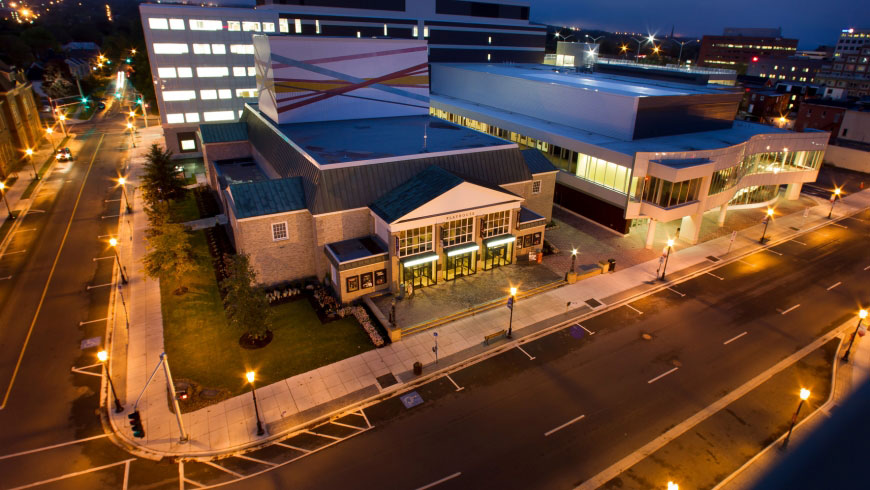
Company in Fredericton, New Brunswick, founded in 1968 by Walter Learning. Its main venue is the Playhouse donated to the people of the province by Lord Beaverbrook in 1961. The Open Space Theatre venue stages new works.
The company initially began with a summer season, funded by box office receipts alone, and then expanded to fulfil Beaverbrook’s mandate to serve the whole province with touring productions. In the winter of 1969 productions included John Osborne’s Inadmissable Evidence, and Tennessee Williams’ The Glass Menagerie, exemplifying Learning’s belief that local audiences should not be patronized.
The schedules at the start included classics and contemporary theatre, and, eventually, Canadian works (some of which Learning co-wrote himself, including The Dollar Woman with New Brunswick poet Alden Nowlan in 1977).
By the end of the third season, TNB had the fastest growing subscription base in the country with ticket sales going from $12,800 the year of its foundation to $83,500 in 1972.
In 1972, the Playhouse was completely renovated, with 709 seats. In 1974, a bilingual Young Company was established for school tours. In 1978 Malcolm Black became Artistic Director and in 1984, Janet Amos assumed the position. In 1988 the AD was Sharon Pollock. From 1990-1995 the company's AD was Michael Shamata, and Walter Learning returned in 1995 to 1999, followed by David Sherren (2000-2002), Scott Burke (2003-2005), and Claude Giroux. Leigh Rivenbark was interim Artistic Producer in 2006, working to eliminate a large debt load, assuming a permanent position from 2007-2009.
The Artistic Producer from 2009 to 2014 was local playwright Caleb Marshall. He launched TNB New Voices Opening Acts, TNB Next Stage Studio Branch, TNB Extras Reading and Presents series. He produced over 50 projects while at TNB, saw the highest percentage of NB theatre artists on stage in the company's 48 year history, oversaw the purchase of its building and the completion of an in-house studio theatre. In 2015, Thomas Morgan Jones became Artistic Director. As of 2018, the AD is Natasha MacLellan.
Among the works presented at the Playhouse were operas by Mozart, Humperdinck and Britten, and plays by Shaw, Beckett, and Shakespeare under the direction of Malcolm Black. Janet Amos produced more Canadian works, and experimental international theatre on the smaller second stage. Canadian works include: David French's Leaving Home; Michael Cook's The Head, Guts and Sound Bone Dance; Norm Foster’s The Melville Boys (which premiered at TNB) and Here on the Flight Path) (2005). In 2010, the Company produced The Bricklin: An Automotive Fantasy by Allen Cole and Paul Ledoux, directed by New Brunswick native Alisa Palmer. Norm Foster’s Hilda’s Yard (2012) was his eighth play to premiere at Theatre New Brunswick, opening fifteen years to the day since his last TNB world premiere. The 2014 season included The Net, A Tragedy of the Sea by Marcel-Romain Thériault, translated by Maureen Labonte and Don Hannah. Set against the backdrop of the 2003 Shippagan fishing riots, the tensions of a society and a precarious way of life play out in three generations of an Acadian family.
The 2015-16 season included Marion Bridge by Daniel MacIvor, and the premiere of Returning Fire by Ryan Griffith, which combined text messaging and live performance. Griffith was appointed playwright-in-residence in April 2016. His new work, Fortune of Wolves, an anthropological study of human nature set in a possible apocalypse opened in 2018 to critical acclaim.
In 2018, TNB celebrated its fiftieth anniversary. It has produced 225 plays, half of which have been Canadian.
website: www.tnb.nb.ca
Profile by Gaetan Charlebois and Anne Nothof.
Last updated 2021-12-14
Theatre Newfoundland Labrador
Founded in 1981 by actor/playwright Maxim Mazumdar(1953-88) as an offshoot of the Stephenville Theatre Festival and the Provincial Drama Academy, Theatre Newfoundland Labrador is now based in Corner Brook, Newfoundland in the Arts and Culture Centre.
TNL’s mandate is to create and produce professional theatre which reflects the lives and diversity of audiences on the province's west coast, extending to Labrador and across the island of Newfoundland. Through the Gros Morne Theatre Festival in the summer, youth theatre programming, main stage productions, courses in theatre instruction, and by touring productions to outport communities, TNL seeks to provide Newfoundlanders with thought-provoking and relevant entertainment, with an emphasis on regional and Canadian work (website).
Edmund MacLean was Artistic Director from 1981 to 1991, followed by Jerry Etienne, and the current AD, Jeff Pitcher.
TNL typically produces four professional main stage works, one play by the youth theatre group, and a community musical each season. It features plays from the classical and modern repertoire, including Canadian plays by David French (Salt-Water Moon and Jitters); John Gray (Billy Bishop Goes to War); and Bernard Slade (Same Time, Next Year). In the 1996/97 season, TNL produced an adaptation of Joan Clark’s Viking saga, Eirksdottir , and in the 1998/99 season Tom Cahill’s The Only Living Father.
In 1996 TLN established the Gros Morne Theatre Festival, which runs from the end of May to mid-September in Cow Head. The Festival uses local history as a basis for many of its plays, including improv comedy sketches called “Neddy Norris Nights.” Each summer the Festival produces seven plays in three venues. The 2005 season included a return engagement of Tempting Providence by Robert Chafe, the dramatic biography of Nurse Myra Bennett, who came to Newfoundland in 1921 in response to the need for nurses, and became known as the “Florence Nightingale of the North.” Tempting Providence toured across Canada, appearing in Magnetic North Theatre Festival in Edmonton, Alberta in June 2004, in the UK at the Edinburgh Fringe Festival, and in Australia. It was nominated for a 2004 Governor General’s Award, and has been published by Playwrights Canada Press. The 2005 Festival also featured Stars in the Morning Sky by Rhonda Payne, who performed with the Mummers Troupe in Newfoundland in the 1970s. Stars in the Morning Sky is a collective creation, based on the stories of Payne’s family that she taped in 1976-77. It dramatizes life in Newfoundland through the eyes of several generations of women struggling to raise families in the outports.
In the summer of 2009 the Gros Morne Theatre Festival produced all of David French's "Mercer plays" - the history of a family of Newfoundlanders.
In 2021, the Company again produced Tempting Providence as an on-line event to celebrate the 25th anniversary of the Gros Morne Theatre Festival, and the opening of the Nurse Myra Bennett Centre for the Performing Arts, when the Covid-19 pandemic shut down theatres across Canada and the world.
Website: www.theatrenewfoundland
Anne Nothof, Athabasca University
Last updated 2022-01-13
Théâtre Niveau Parking
Repertory company in Quebec City, Quebec, founded in 1986 by a group of graduates from the Conservatoire d'art dramatique de Québec. In 1987 the original group invited Marie Brassard, Lorraine Coté and Michel Nadeau to join, and Michel Nadeau became the Artistic Director. After several years, the musician Robert Caux replaced Marie Brassard. In 1999, several other company members left for other projects, and new members joined to form the third troupe: Michel Nadeau (Artistic Director), Marie-Josée Bastien, Lorraine Coté, Hugues Grenette, and Véronika Makdissi-Warren. Since 2016, Marie-Josée Bastien is Artistic Director.
Productions are presented at the Théâtre Périscope.
The Company considers itself a hybrid, presenting a baroque amalgam of music, humour and social and metaphysical preoccupations. It rejoices in the fact that you never know what to expect in a Niveau Parking production. Company members are actors and creators, working together as a troupe. Most of the productions are new works.
Among its productions are Un sofa dans le jardin, 1988 (the extinction of species as seen by an adolescent through the genealogy of his own family); Terminus (a study of the psychic predicament of modern humanity); BUREAUtopsie, 1993 (an examination of self-perception through the lives of four bureaucrats trapped in an office); Jeanne et les anges, 1993 (a girl's search for identity through photographs which the company revived, in association with Compagnie Jean-Duceppe, in 1998); and Lentement la beauté, an absurdist contemporary revisitation of Chekhov's Three Sisters.
Website: https://theatreniveauparking.com
Last updated 2020-11-16
Theatre NorthWest
Company and venue in Prince George, British Columbia, founded by Artistic Director Ted Price and General Manager Anne Laughlin.
Theatre NorthWest (TNW) began establishing its roots in the regional community in 1994 with a 26-performance tour of its first production, The Occupation of Heather Rose by Wendy Lill. One year later a small performance space was created out of a bakery warehouse in The Parkhill Centre in Prince George. Major renovations in 1997 expanded the venue to a 222 seat theatre which has provided a home for all of TNW’s subsequent productions.
In 2014, in celebration of the 20th anniversary season, the theatre made major infrastructural and programming upgrades to include: New theatre seating, a renovated lobby lounge that displays local artworks, a new digital box office system, a new logo, and website.
Four to five professional stage productions are offered each season. The programming model includes modern Canadian and international works with a focus on First Nations issues with plays like Tara Beagan’s Dreary and Izzy. Theatre NorthWest partners with several regional Reserves to provide theatre training where there is no access. The theatre has also partnered with the University of Northern British Columbia (UNBC) to develop a Theatre Appreciation course at the university.
Since 2014, the Theatre NorthWest has added to its four show Mainstage series a Presentation Series of Innovative works, and Theatre for Young Audiences. Through the innovation series it is premiering the Residential School piece Isitwendam (An Understanding) written by Meegwun Fairbrother and co-created by Jack Grinhaus.
Set design by Ted Price and Siebe Kamstra
Photo by Hans Saefkow
Although one of Canada’s smaller regional theatres, the company has gained a reputation for its production values, its penchant for casting from across the country, and local enthusiasm for an emphasis on Canadian work. Typical examples of the latter would include 1949 by David French, Corker by Wendy Lill, A Guide to Mourning by Eugene Stickland, Amigo’s Blue Guitar by Joan MacLeod, The Invisibility of Eileen by Kit Brennan, and the works of Norm Foster, Guy Vanderhaeghe and Lance Woolaver.
The 2006/07 season included The Rez Sisters by Tomson Highway, Hockey Mom, Hockey Dad by Michael Melski, and The Kitchen Witches by Caroline Smith. The 2008-09 season included How It Works by Daniel MacIvor, and Sexy Laundry by Michele Riml. The 2009-10 season included Mesa by Doug Curtis. For the 2010-11 season, TNW hosted I, Claudia by Kristen Thomson in a production by Crow's Theatre, and Kiss the Moon, Kiss the Sun by Norm Foster. The 2011-12 season featured The Clockmaker by Stephen Massicotte.
The 2015-16 season featured The Girl in the Goldfish Bowl by Morris Panych. For the 2016-17 season Theatre NorthWest focused on strong roles for women, including The Drowning Girls by Beth Graham and Daniela Vlaskalic; and Half Life by John Mighton. Theatre NorthWest reopened in 2022 after a closure due to the Covid-19 pandemic with a production of Glory by Tracey Power, directed by James MacDonald, with set and lighting by Narda McCarroll, about the adventures of a girls hockey team.
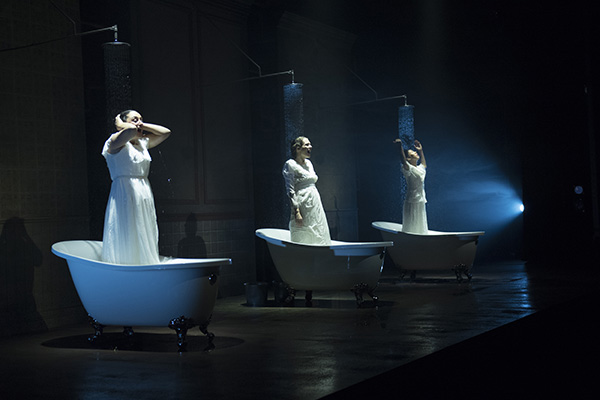
Theatre NorthWest now ranks as the largest arts organization in the northern two-thirds of British Columbia with the most paid attendance, the most annual performances and thousands of subscribers. In 2015, the Artistic Director was Jack Grinhaus. The current Artistic Producer is Marnie Hamagami.
website: www.theatrenorthwest.com
Last updated 2023-08-31
TheatreOne
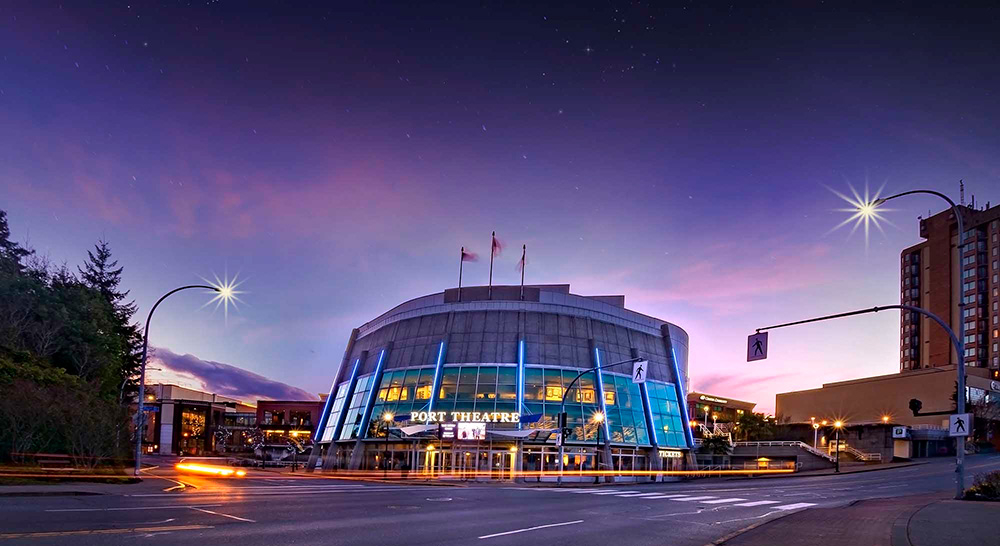
Professional theatre company, based in Nanaimo, on Vancouver Island, British Columbia, performing in the Port Theatre, a theatre-in-the-round. The mandate of TheatreOne is to "bring to the citizens of Nanaimo and Vancouver Island the benefits and advantages of professional theatre; to build an audience for the future through the involvement of young people; to promote and encourage cultural development on Vancouver Island."
The company was founded in 1983 and incorporated in 1984 under the name of "Shakespeare Plus." After the 1988 season, and the success of The Dunsmuirs, Part One by Nanaimo playwright Rod Langley, the company shifted its focus to the development and production of work that promoted the history and heritage of the West Coast, under the name the Nanaimo Festival Heritage Theatre Society, with a mandate to present an annual theatre festival. In 1995 the company moved from a summer to a fall season to better serve a local audience, and changed its name to TheatreOne. In recent years, it has been programming three mainstage theatre events each season, typically consisting of one in-house production and two presentations.
Since 1988, TheatreOne has had a strong record of production of Canadian plays, including Billy Bishop Goes to War (1988) by John Gray with Eric Peterson; Everloving (1989) by Margaret Hollingsworth; Alma Victoria (1990) by Hollingsworth; Midnight Madness (1991) by Dave Carley; The Occupation of Heather Rose (1991) by Wendy Lill; Brother XII (1991) by Frank Moher; Salt-Water Moon (1992) by David French; Some Assembly Required (1994) by Eugene Stickland; Only Drunks and Children Tell the Truth (1999) by Drew Hayden Taylor; Mom, Dad, I'm Living with a White Girl (2001) by Marty Chan; The Shape of a Girl (2002) by Joan MacLeod; The Drawer Boy (2005) by Michael Healey; Mary's Wedding (2006) by Stephen Massicotte; If We are Women (2006) by Joanna McClelland Glass; Vigil by Morris Panych; and Marion Bridge (2008) by Daniel MacIvor.
For 2016/2017, TheatreOne co-presented with the Port Theatre the Arts Club Theatre’s production of Baskerville: a Sherlock Holmes Mystery. It also produced the BC premiere of Jennifer Wynne Webber’s Beside Myself; and presented in celebration of Canada’s 150th birthday The Other Guys Theatre Company’s Flotsam and Jetsam: Songs of the BC Coast.
The 2017/18 season featured With Glowing Hearts: How Ordinary Women Worked Together to Change the World (and did) by Jennifer Wynne Webber (dir. David Mann), "the rousing true story of women in 1940s Kirkland Lake, Ontario who fought to improve working conditions for the men in the mines, and became the heart and soul of a union organizing drive that changed their lives – and the world" (website). The 2018/19 season included Bombay Black by Anosh Irani, Person of Interest by Melody A. Johnson, and Jake’s Gift by Julia Mackey.
TheatreOne is committed to the development of new and emerging playwrights. It has commissioned, developed and presented at the Port Theatre new Canadian plays such as Best Left Buried (2003) by Marty Chan (about the history of Chinatown in Nanaimo); and The Concubine's Children (2004) by Denise Chong (based on her 1994 memoir of her fragmented family history in China and Vancouver). In 2007/08 TheatreOne initiated a monthly series of new play readings called "Emerging Voices."
TheatreOne produces the "Just Kidding Children's Entertainment Series" with Malaspina University College Theatre, for family audiences. Over the past fifteen years, it has produced seventy-five TYA plays. It has also hosted children's shows by other theatre companies, such as Axis Theatre Company, Carousel Theatre, Green Thumb Theatre for Young People, and Vancouver Opera Touring Ensemble.
Artistic Directors have included: Janet Wright(1986); Duncan Fraser (1989-91); Michael McLaughlin (1993-2000); David Mann (2000-03); Garry Davey (2004); Burton Lancaster (2005), and Garry Davey. Since 2013, the AD is David Mann.
Website: www.theatreone.org
Profile by Anne Nothof, Athabasca University. Additional information from Nadine Wiepning, publicist, TheatreOne.
Last updated 2021-12-14
Theatre Orangeville
Theatre company, based in the town of Orangeville, County of Dufferin, Ontario. It was founded in 1993 with the restoration of the Opera Hall on the second floor of the Orangeville Town Hall. Under the leadership of Artistic Director, Jim Betts, Theatre Orangeville opened its first season in 1994.
The company began with an 8-week summer playbill, and has grown into a fully regional theatre company that runs shows all year long, with an emphasis on musical theatre and comedies such as Norm Foster’s Old Love, and John Gray’s Eighteen Wheels, both featured in the 2009/10 season.
Some of the notable theatre artists who have performed on the Theatre Orangeville stage are: Michael Burgess, Michael Therriault, Louise Pitre, Rod Beattie, Avery Saltzman, Douglas Chamberlain, Lally Cadeau, and Ted Follows.
Theatre Orangeville has also developed and premiered a number of new Canadian works that have gone on to achieve success across Canada: Could You Wait?, The Last Resort, War Brides, Dear Santa, Little Women - The Musical, Kiss the Moon, Kiss the Sun, Outlaw, 'Twas, The Giant's Garden, and True Confessions From The Ninth Concession by Dan Needles and songwriter Ian Bell (2018), to name just a few.
The current playwright-in-residence is Kristen Da Silva.
Theatre Orangeville supports several programs for young people, including the Theatre Orangeville Youth Singers, and school shows.
David Nairn has been Artistic Director since 1999, and as of 2025 has directed over 80 plays and musicals during his 25-year tenure.
website: www.theatreorangeville.ca
Profile by Gaetan Charlebois. Updated by Anne Nothof.
Last updated 2025-04-25
Théâtre Parminou
Company founded in Quebec City, Quebec, in 1974 by students of the National Theatre School of Canada and the Conservatoire d'Art Dramatique de Québec (including Martine Beaulne and Normand Canac-Marquis). The company's name is a play on words meaning Theatre Among Us.
They performed in and around Quebec City before moving to the small town of Victoriaville in the centre of the province in 1976.
From the start the group dedicated itself to the concept of collective creation and socialist culture, often creating works at the request of a community or labour group. Their work is characterized by use of clowns and music and very little dialogue.
Their work Toujours plus gros toured to France in 1977. The company has created plays which address the plight of the homeless such as Des miettes pour les pigeons (May, 1999), and violence against women, in collaboration with Senegal's Bamtaare troupe. Recent productions include: Encore (2005), Les vendredis de Sophie (2005), Deux poids, deux mesures (2006), Les contes de la richesse (2007), Femmes de mèche (2008).
Théâtre Parminou has twice attended the "Festival pour le développement" at Ouagadougou in Burkina Faso, and worked on the creation of Planète pauvre (1996) with Manila's Théâtre Peta in the Philippines. Since 1996 it has collaborated with Belgium's Théâtre-Action, and invited to play several regions of Belgium and France in presentations of Mon paradis d'enfer and Mondialissimo, a joint creation with the Compagnie du Campus (Belgique), the Acteurs de l'Ombre (Belgique), the Théâtre du Levant (France) and, more recently in Revenez Lundi a joint production with the Théâtre du Campus in Belgium.
Co-Artistic Directors are Hélène Desperrier and Jean-Francois Gascon.
Further Reading: Maureen Martineau. "The Théâtre Parminou: Thirty Years of History. A Test of Commitment." Canadian Theatre Review 117 (2004): 5-9.
Website: www.parminou.com
Last updated 2021-12-14
Theatre Passe Muraille
Pioneering theatre company in Toronto, Ontario, founded in 1968 by Jim Garrard at Rochdale College. "Passe Muraille" translates as "beyond walls," or "without walls," speaking to the Company's mandate to create theatre that is open and inclusive, moving beyond the confines of traditional theatre space to reach into the community. Its early controversial production, Futz was performed at the Central Library Theatre. It then located to the Guildhall at Holy Trinity Church courtesy of Reverend Jim Fisk. Since the late 1970s, it has performed in its own space, a converted bakery and stables at 16 Ryerson Ave, an historic site. Garrard resigned in 1969 to teach theatre at Simon Fraser University. Martin Kinch was artistic leader from 1969 to 1971, followed by Paul Thompson in 1972.
Though collective creation was already in wide use throughout Canada (having fuelled many of the productions of George Luscombe's Toronto Workshop Productions/TWP), it was Passe Muraille and Thompson who took the movement and truly ran with it. Within one decade of its founding, the company had produced 22 collective creations and had taken the philosophy all over the country, and brought proponents of the form, such as Codco) to Toronto.
Thompson has been quoted as saying, "I would like to make theatre as popular as bowling," and with collective creation he almost succeeded. With works like The Farm Show, The Immigrant Show and The West Show, the ensemble was sent out into the community to be "presented" and encouraged to record oral histories, anecdotes, jokes and songs for inclusion in the production which was then, often, first presented before the audience it concerned. Many communities saw reflections of themselves in theatre for the first time.
Most importantly, Passe Muraille has and does serve as inspiration to companies across the country: its existence assures that there is an audience and interest in alternative and experimental theatre.
Playwrights who have been involved in the process or who have had works created at Passe Muraille include Rick Salutin, Linda Griffiths, Judith Thompson, Anita Majumdar and Anusree Roy.
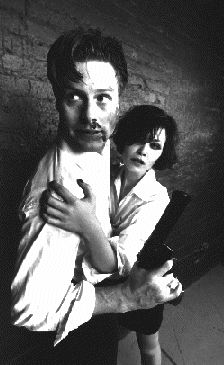
In February, 1999, Passe Muraille presented a work which alluded to The Farm Show called The Drawer Boy, written and directed by two of The Farm Show's company, Michael Healey and Miles Potter. To celebrate its 40th anniversary in the 2007-08 season, Passe Muraille remounted The Drawer Boy in an all-new production.
Passe Muraille has also supported works by and about women. In October 2001, it presented an all-female cast in Shakespeare's A Midsummer Night's Dream. Its 2014-15 season featured two one-woman performances: Hooked, enacting the tumultuous creative lives of Myra Hindley, Unity Mitford, Zelda Fitzgerald, Dora Carrington, Elizabeth Smart, Carson McCullers and Jane Bowles, based on poems by Canadian poet Carolyn Smart, and performed by Nicky Guadagni in the TPM Backspace; and R-E-B-E-C-C-A by Sara Farb, based on the playwright's younger sister who was born seven weeks prematurely and diagnosed as developmentally delayed.
In 2012, TPM's production of Crash a new play by Asian-Canadian author Pamela Mala Sinha, won two Dora Awards for best play and best actress. The 2012 season included MT Space's Body 13; Obsidian Theatre Company's Shakespeare's Nigga; and Atomic Vaudeville's Legoland. The 2013/14 season featured new works by seminal Canadian playwrights George F. Walker (Moss Park) and Linda Griffiths (Heaven Above, Heaven Below).
In 2016, TPM premiered Elle. Based on a true story, adapted and acted by Severn Thompson from the Governor General’s Award-winning novel by Douglas Glover, Elle enacts the ordeals and adventures of a young French woman deliberately marooned on a desolate island off the coast of Newfoundland in 1542. The play then toured across Canada.
Clarke Rogers was Artistic Director from 1982 to 1987. Layne Coleman was Artistic Director from 1999 to 2007. Andy McKim was A.D. to June 2019; his vision was more culturally inclusive: "TPM has a special interest in supporting and presenting independent artists and companies, emerging artists, collaborative and multidisciplinary work, culturally specific and inter-cultural work, and marginal voices" (website).
To celebrate the theatre's 50th anniversary in 2018, Playwrights Canada Press published TPM: A Collective History, ed. Martin Julien and Samantha Serles, with visual editor Rae Johnson.
Marjorie Chan was appointed AD as of July 2019. She reasserted Passe Muraille's mission "to break down walls by pushing against boundaries; to create art with and for an audience, examining the marginal, the unexplored and the unforeseen; to articulate a distinct Canadian voice that reflects the complexity of our intercultural society" (website). The theatre space was closed to live audiences during the Covid-19 pandemic in 2020 and 2021, but reopened for the 2022-23 season with seven productions, six of which are produced by Passe Muraiile, beginning with The Year of The Cello, created by Marjorie Chan and composer Njo Kong Kie. The show was staged in the renovated Bob Nasmith Innovation Backspace.
The company's archives are at the L.W. Conolly Theatre Archives of the University of Guelph, Ontario.
Profile by Gaetan Charlebois. Additional information provided by L.W. Conolly and J. Kelly Nestruck ("Nestruck on Theatre", Globe & Mail 11 Oct 2022). Profile updated by Anne Nothof in 2022.
Website: www.passemuraille.ca
Last updated 2022-10-13
Théâtre Périscope
Theatre company/venue in Quebec City, Quebec, founded in 1985 under the name of Implanthéâtre. It was founded to provide a space for the development and dissemination of new work by the companies scattered throughout the city, including Théâtre du Gros Mécano, Théâtre du Vieux-Québec, Théâtre de la Commune and Théâtre Repère. It supports the companies through a series of services including rehearsal halls, meeting halls, PR advice, ticket sales and technical and administrative services. Théâtre Périscope has been home to creation, exploration and theatre performance research.
The venue is an old synagogue in the city's Upper Town. It is now a base for Théâtre Niveau Parking, Théâtre du Grand jour, Théâtre Sortie de Secours, Théâtre Blanc, Théâtre des Fonds de Tiroirs, and Productions Les Gros Becs.
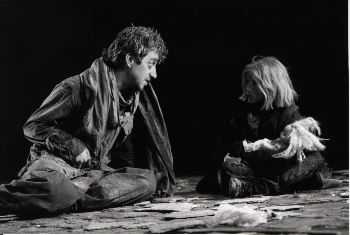
The first work presented at the venue was Marie Laberge's L'homme gris. Among other works presented there have been La trilogie des dragons and Le polygraphe, both by Robert Lepage. Jean-Marc Dalpé's Lucky Lady, Daniel Danis' Cendres de cailloux, Normand Chaurette's Les reines and Serge Boucher's Motel Hélène. Since its inception, over 25,000 spectators have attended productions of more than 150 works (including some eight to ten premieres per year).
The Director General is Frédéric Guay.
Website: www.theatreperiscope.qc.ca
Last updated 2021-12-17
Théâtre Petit à Petit
Company in Montreal, Quebec, founded in 1978 by Claude Poissant, René Richard Cyr, and Marie-France Bruyère. In 1998, Poissant assumed artistic directorship, and the company's name was changed to PàP.
Initially PàP presented an eclectic mix of new works aimed at adult and adolescent audiences. Its most famous work is probably Michel Marc Bouchard's Les Feluettes/Lilies. It has also presented Poissant's Si tu meurt, je te tue, Roger Gaudet's À tout hasard, and Cul sec by François Archambault. In 1998, PàP celebrated its 20th anniversary with an omnibus work called Huit péchés capitaux , bringing together eight well-known Quebec playwrights including Michel Tremblay and Michel Marc Bouchard. In February 1999, it presented Couteau: sept façons originales de tuer quelqu'un avec... by Isabelle Hubert, and in October 1999, it produced Geneviève Billette's Crime contre l'Humanité.
For the 2010/2011 season, PàP featured two plays by Larry Tremblay: Abraham Lincoln va au théâtre and Dragonfly de Chicoutimi.
Poissant and Cyr had an unbeatable track record for presenting aesthetically pleasing and arresting theatre. Their stunning production of Serge Boucher's Motel Héléne in 1997 was unforgettable.
The current artistic directors are Julie Marie Bourgeois and Patrice Dubois. Their productions were usually at Espace Go. Since 2017, PÀP is the resident company of Théâtre de Quat'Sous.
Website: www.theatrepap.com
Profile by Gaetan Charlebois.
Website: https://theatrepap.com
Last updated 2021-12-16
Theatre Plus
Company in Toronto, Ontario, founded in 1973 by Marion André.
Its goal was to present politically and socially relevant theatre, a goal which seemed to become less and less important as the years passed. Under André's artistic directorship (to 1985) it presented the works of Anouilh, Guare, Durrenmatt, Orton, Williams, Miller and Rabe.
It also presented Canadian theatre (Michael Cook's Gayden Chronicles; Leslie Arden's The House of Martin Guerre).
Its subscription rates were solid, with a high of over 8,000 reached for its tenth anniversary season.
Malcolm Black was the company's AD from 1985-89, succeeded by Duncan McIntosh (1989-93). Actors who appeared at the company include Frances Hyland, Roland Hewgill, Douglas Rain, and Brenda Robins.
When the company folded in 1993, it had accumulated a debt of $500,000.
The company's archives are at the LW Conolly Theatre Archives of the University of Guelph, Ontario.
Profile by Gaetan Charlebois
Last updated 2011-02-04
Théâtre populaire d’Acadie
The oldest continually operating professional theatre in Acadie, Théâtre populaire d’Acadie has been based in Caraquet in the north-east corner of New Brunswick since 1974. With over 130 productions to its credit, TPA’s repertoire, while including important original Acadian creations, has tended to emphasize international and classical plays, developing performance styles drawn from diverse sources such as commedia dell’arte and French neo-classical drama. TPA has developed a strong tradition of collaboration with Québécois and international theatre companies. It tours extensively not only through the Maritimes, but also into Quebec and across Europe.
TPA witnessed a renewal as, after twelve years as Artistic Director, René Cormier decided not to return for a fourth three-year mandate, and TPA named Maurice Arsenault as the new AD. Arsenault has had a long history with Acadian theatre, including a six-year stint as Artistic Director of Théâtre l’Escaouette in the early 1990s.
Arsenault’s vision for the company included the continuation of co-produced works in the TPA repertoire: “Even though these collaborations pose certain challenges in terms of harmonizing the artistic practices of the various partners, they create for the Acadian theatrical milieu an intensely stimulating space of artistic encounter and confrontation. The trap of our theatrical milieu would be to close in upon itself, and these co-productions force us to open it up and question it” (Arsenault). This desire for openness and questioning extended to his view of the social role of theatre which is “essential for our society” because while it “contributes to the construction of the collective Acadian identity,” it also “participates in the development of critical thinking in the individuals that compose it” (Arsenault).
Two plays from Cormier’s final season, both by the young Emma Haché, reflect the double trajectory of the company and the complex relationship to Acadian identity which it appeared Arsenault shared. On one hand we have the grand spectacle of Les défricheurs d’eau. Not unlike Antonine Maillet’s L’Odysée at Pays de la Sagouine, this TPA co-production (with Théâtre la Dame de Coeur de Upton, first produced in 2004 and remounted in 2005) was performed at the Village Historique Acadien near Caraquet. The “grandiose family spectacle” featuring 8 professional actors and 50 volunteers, depicted the great moments in Acadian history in order to celebrate the ingenuity, creativity and resilience of the Acadian people. On the other hand, is Haché’s lyrical piece entitled Murmures which TPA co-produced with Théâtre français du Centre national des arts in the fall of 2005. The play depicts personal tragedies arising out of the creation of a leper’s colony in Tracadie, New Brunswick in the mid-nineteeth century. The colony’s existence is historical fact; Haché’s play, however, does not retell the story, but uses the story to examine how walls, both physical and psychological, become as destructive as the disease and infection (real or metaphoric) they are built to contain.
The current Artistic Director and Co-Director General is Allain Roy. When the Covid-19 pandemic closed theatres across Canada in 2020, he initiated a series of four "balados" or podcasts - an auditory experience that stimulates the imagination and intellect: "Arrière-scène" profiles backstage theatre creators; "Histoires de la Côte" enacts historical events and stories; "Tempête" is an auditory adaptation of Shakespeare's play; "Wannabe Concepteur Sonore" features interviews with Acadian theatre practitioners. These are accessible via the theatre's website.
Website: www.tpacadie.ca
Further Reading: Canadian Theatre Review 128 (Fall 2006).
Profile by Glen Nichols, Université de Moncton
Last updated 2021-12-16
Théâtre Populaire du Québec
Company in Quebec, founded in 1966 with the noble goal of touring theatre across the province.
It began with a slate of more classical works (Musset, Racine, Molière, Corneille etc.) until 1969 when Albert Millaire took over the artistic directorship of the company and made an effort to bring Quebec works into the repertoire. But it was from Jean-Guy Sabourin's directorship (which began in 1972) that the creeping eclecticism - which caused the eventual doom of the company when it was read as a lack of artistic focus - began. In a given season, works by Arrabal were matched up with the works of Jean Barbeau. However, the relatively unsophisticated theatre-starved regional audience, in most cases, embraced TPQ. The content and presentation, however, played less and less well in the major centres. The productions had to be designed for touring and the rough and ready feeling of TPQ left the audiences of Montreal and Quebec, now being exposed to Gilles Maheu and Robert Lepage, failed to appreciate the necessary rusticity of the operation.
What killed the company in 1996 was a brutal peer-assessment tendered at the level of provincial funding. Though the company's fiscal health was solid, as were its subscription rates, questions arose about the very eclecticism that had kept the group going for over three decades. Maryse Pelletier, the last artistic director of the company, was accused of weakness in her choice of plays. The company was told that its funding would be cut by half, and then scrubbed altogether. It decided, instead, to disband.
Profile by Gaetan Charlebois
Last updated 2022-02-19
Theatre Projects Manitoba
Theatre company, based in Winnipeg Manitoba, founded in 1990 by Harry Rintoul. It is committed to the development of Manitoba plays and artists. Since its inception, it has staged over fifty new works which connect to local community, history and culture.
Productions of new plays include: The Elmwood Visitation by Carolyn Gray (2007); Stretching Hide by Dale Lakevold & Darrell Racine (2008); Encore by Marc Prescott (2008); North Main Gothic by Gray (2010); The Moonlight Sonata of Beethoven Blatz by Armin Wiebe (2011); Dionysus in Stony Mountain by Steven Ratzlaff (2011/2012); Sargent & Victor & Me by Debbie Patterson (2013/2014); The Miser of Middlegate by Carolyn Gray (2013/2014); and Five Moments by Rick Chafe (2019/20).
Theatre Projects Manitoba also presents new works by established Canadian playwrights, including Daniel MacIvor and Linda Griffiths, and hosts productions of Canadian plays such as Almighty Voice and His Wife by Daniel David Moses. It has produced Proud by Michael Healey (2013/2014 season); White Rabbit Red Rabbit (2014/2015); Bashir Lazhar by Evelyne de la Chenelière (2012/ 2013); and John and Beatrice by Carole Fréchette (2012/2013).
The 2011-12 season included an adaptation of Chekhov's Three Sisters by Bruce McManus.
Theatre Projects has also presented the "In the Chamber" event in January, featuring solo works by writer/performers such as Sarah Constible, Gord Tanner, and Steve Ratzlaff.
Performances typically take place in appropriate Winnipeg spaces. For the 2021 season, when the Covid-19 pandemic closed performance spaces across Canada, Theatre Project Manitoba devised The Chautauqua: Interlake Trail, to extend its reach to Interlake communities including Arborg, Riverton, Selkirk, and Eriksdalein with a safe mix of micro performances in outdoor spaces, and digital sharing.
Harry Rintoul was artistic director from 1990-94, Bruce McManus from 1995-2000, Margo Charlton from 2000-02, Ken Brand from 2002-05. From 2005 to 2021, the artistic director was Ardith Boxall, who oversaw the development and production of 21 Manitoba plays.
Website: www.theatreprojectsmanitoba.ca
Profile by Anne Nothof. Additional information from Chris Johnson, University of Manitoba.
Last updated 2021-12-16
Theatre Prospero
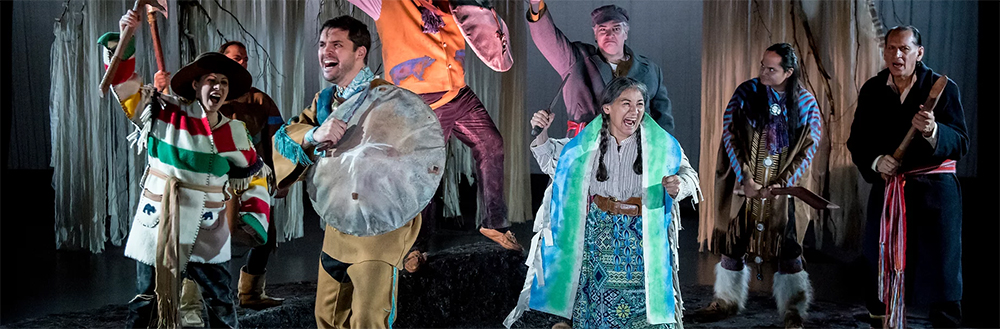
Theatre company, based in Edmonton, Alberta, founded in 1994 by Edmonton actor, director, and producer Mark Henderson and Edmonton actor/director Owen Brierly. Its mandate is to provide innovative and affordable classical theatre for student and community audiences, and to provide high-level training and performance opportunities for teenagers. As Theatre Prospero expands into a broader role in the arts community with ambitious new projects, it remains true to this vision.
Under Artistic Director Mark Henderson, it is known for its high-energy performances, with casts that include high school students and professional actors. The average cast size is six professional actors and up to thirty students, although student casts have been as large as two hundred and fifty in the company’s week-long residency programs. Its productions tour schools throughout Alberta. Theatre Prospero’s website states that “our primary role is in arts education and audience development. We like to give young performers a chance to fly. Many of our student performers keep coming back to our projects in increasingly challenging roles. We believe that putting faith in youth can only have positive psychological and sociological repercussions.”
Theatre Prospero’s first production was The Taming of the Shrew in 1994, directed by Brierly and described by Edmonton Journal theatre critic Liz Nicholls as “a high-speed low-tech small-budget brawl of a production, full of pratfalls, thrashings, screams, body slams, raucous high spirits... The audience is delighted.”
Although the company has focused on the plays of Shakespeare, it has also presented adaptations of Nicholas Nickleby, The Bacchae, The Second Shepherds Play, and other classics. Recently, it has expanded into new play development and production, including the four-part Sterling Award nominee Maggie Now adapted from Betty Smith’s novel by Jennifer Spencer, a saga about an impoverished Irish immigrant family’s struggles and survival strategies in New York at the beginning of the twentieth century; and Blood Opera: the Raven Tango Poems, featuring text by Edmonton poet Jannie Edwards, images by Paul Saturely, choreography by Kathleen Ochoa, performances by Jennifer Spencer, Jenny McKillop and Calvin Malaka, and direction and poeturgy by Mark Henderson.
In January 2009, Theatre Prospero launched its Serca Festival of Irish Theatre, in which it produced Maggie Now Part One. The next iteration of the Festival in June of 2010 featured three Irish plays (Spokesong by Stewart Parker; This Limetree Bower and The Good Thief by Conor McPherson), with Irish poetry readings and music between performances. The Festival also presented Maggie Now Part Two by Jennifer Spencer. In June-July 2011, Serca featured Secrets of Immortality by Jeff Page, based on Oscar Wilde's De Profundis; Beckett's Shorts, presented by Surreal SoReal Theatre; Mojo Mickybo by Owen McCafferty; and Molly Sweeney by Brian Friel.
In 2017, Theatre Prospero initiated a collaborative project with First Nations artists and authors: Pawâkan Macbeth: A Cree Tragedy by Reneltta Arluk - a reimagining of Shakespeare’s brutal tragedy into Cree history, legend and cosmology. Set in Plains Cree territory in the 1870s, before the establishment of First Nations reserves, Pawâkan Macbeth takes place in a time when First Nations warred with each other and the Canadian Government over territory, food supply and trade. The harsh conditions and desperate struggles awakened the darkest of Cree spirits, the Wihtiko – an evil being with an insatiable appetite for human flesh. The cast comprised professional actors and students. The play premiered in Edmonton, and toured schools throughout the city before undertaking an ambitious touring itinerary.
Theatre Prospero’s goal for the future is to maintain high energy audience appeal while deepening its artistic explorations and broadening its audience base.
Theatre Prospero website: www.theatreprospero.ca.
Profile by Joyce Miller and Mark Henderson
Last updated 2021-12-17
Théâtre Répère
Company in Quebec City, Quebec, founded in 1980 by Irène Roy and Jacques Lessard (among others) but now chiefly remembered for the works of Robert Lepage. It disbanded in 1994.
Lepage was first an actor, then director, then artistic director with the company which toured the world with his works including La Trilogie des dragons.
The company refused to be niched and if one were to attempt to do so, multidisciplinary might come closest. It was, first and foremost, a theatre of exploration that always presented works with a highly visual element.
Profile by Gaetan Charlebois
Last updated 2022-12-02
Theatre Replacement
A collaborative company, founded in 2003 in Vancouver by James Long and Maiko Yamamoto, who are co-artistic directors. They use extended processes to create performances from simple beginnings such as conversations, interviews and arguments, to provide theatrical experiences that are authentic, immediate and hopeful. The Company mandate is to recognize the accomplishments and failures of the world; use biographical material to magnify these events through extended collaborative processes and training programs; and reproduce the results for local, national and international audiences (Website).
Theatre Replacement collaborates with a wide range of artists in order to attract diverse audiences and challenge their relationship to performance. It participates in a global network of artists, creators, presenters and producers, and assists others in developing new works through mentorship and educational programming.
The Company’s work has been presented in 39 cities across North America and Europe, including the international festivals Festival TransAmériques, Magnetic North Theatre Festival, Free Fall Festival (Toronto), High Performance Rodeo and playRites, On the Boards (Seattle WA), Fusebox Festival (Austin TX), Noorderzon Festival (Groningen NL) PAZZ Performing Arts Festival (Oldenburg, Germany), Lokal (Reykjavik, Iceland), Dublin Theatre Festival (Ireland), Aarhus Festival (Denmark), INTERsection (Terni, Italy), Foreign Affairs (Berlin) and Soho Rep (New York).
Its productions include: Clark and I Somewhere in Connecticut, Sexual Practices of the Japanese, BIOBOXES: Artifacting Human Experience, Weetube, Dress me up in your love, The Greatest Cities in the World, and Winners and Losers (with Marcus Youssef, dir. Chris Abraham).
In Kate Bowie (2014), Kate Bush and David Bowie rent a secluded mansion in a remote part of England to work on an album together for one month. Nothing is known about the nature or the results of this collaboration. Thirty years later, a Canadian couple spends a weekend in a remote cabin in northern British Columbia with a keyboard, an electric guitar and a lot of gin, in an attempt to recreate their collaboration.
Mine, a play by and for adults and tweens was devised in 2019. A mother/son relationship is explored through the narratives of Beowulf, Bambi, and The Terminator, using Minecraft as a theatrical form. Productions in each touring location include four local young people as performers.
In 2019, Maiko Yamamoto and James Long were awarded the Siminovitch Prize in Theatre for directing.
Website: www.theatrereplacement.org
Last updated 2020-10-26
Theatre Royal
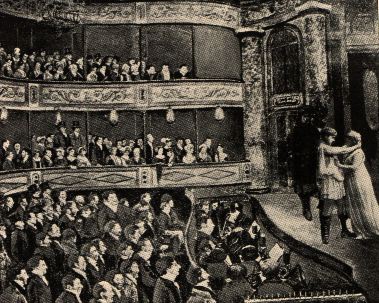
First permanent theatre building in Montreal, Quebec, opened in 1825, built by English merchant, John Molson, to attract bigger names to the city which lacked such a venue. It cost the magnate $30,000.
The theatre seated 1000, with two tiers of boxes, and a full proscenium arch. It had a 50-member company of actors, technicians and musicians, and presented a repertory of Shakespeare and the Restoration authors. The venue was also used for concerts and circuses.
After presenting a season of 111 full-length plays, the in-house company went bankrupt in 1826 and the building struggled along through rentals, financially unsuccessful touring operations and a cholera epidemic.
It served Molson's purpose, however: Dickens and Kean played there but so, too, did local companies which began to spring up in the city. (See Documents of Interest for Dickens' description of his experience.)
The house was demolished in 1844 and the site was used for the Bonsecours Market (still standing). Another venue, also called Theatre Royal, was built not far away in the section of Montreal now called Old Montreal. This building, too, no longer exists.
Sources: Eugene Benson and LW Conolly. English-Canadian Theatre. Toronto: Oxford University Press, 1987. Franklin Graham. Histrionic Montreal. Montreal: John Lovell & Son, Publishers, 1902.
Last updated 2009-09-15
Théâtre Sans Fil
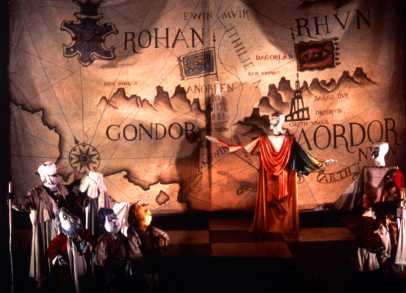
Company in Montreal, Quebec, founded in 1971 as a marionette theatre for adults as much as children. The name translates as "Theatre Without Strings." It was inspired by Japanese Bunraku theatre, but now uses a wide range of innovative styles and techniques. It is still led by co-founding artistic director André Viens, who has directed all of its productions.
It has had success not only in Canada but world-wide, touring adaptations of Indian legend (Tales From the Smokehouse) and the works of J.R.R. Tolkien (The Hobbit, Lord of The Rings) in French and English, the work which catapulted Théâtre Sans Fil into the international theatre scene.
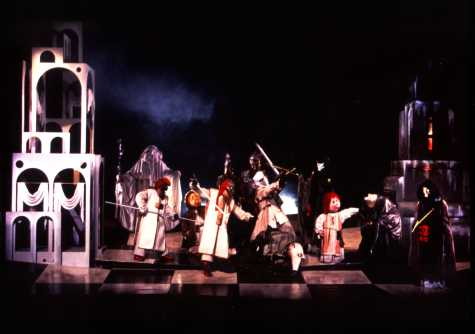
In 1992, the company participated in a gigantic outdoor spectacle honouring the 350th anniversary of the City of Montreal: Le Grand jeu de nuit. It was seen by more than 150,000 spectators during its summer run. In December 2000, it mounted a production of Humperdinck's opera Hansel and Gretel.
Other works include: The Crown of Destiny (1995) and The Dream Catchers (1992) (both by Henriette Major)
In 1996, the company received a lifetime achievement award at the Masques Awards.
In 2003, it relocated its studios to the historic Caserne Letourneaux.
Website: www.theatresansfil
Last updated 2022-01-13
Theatre SKAM
Theatre company, founded by Matthew Payne, Sarah Donald, Karen Turner, and Amiel Gladstone in 1995, and based in Victoria British Columbia. Its mandate is “to produce high quality provocative theatre for audiences in Victoria and on tour, working to create dialogue and partnership with like-minded arts practitioners (professional & non-professional), community groups and local experts” (website). It strives “to effect positive social change in [the] community” and to support and encourage the careers of emerging artists in Victoria.
After twelve years as an ad-hoc, project-based company, in 2007 Matthew Payne took over as Artistic Producer, with a mandate to move the company to year-round operations. Theatre SKAM also runs a theatre school, and creates new work, including many site-specific productions.
Works include: Aerwacol and Billy Nothin’ by Sean Dixon (1999), Hippies and Bolsheviks, The Wedding Pool, Black Box and My Three Sisters by Amiel Gladstone.
In 2003 and 2004, Theatre SKAM produced Lieutenant Nun by Elaine Avila in McCaulay Point Park, where the story of the arrival of Spanish conquistadors moved with its audience from the beach through the park, past crumbling concrete gun mounts, and through a candle-lit tunnel.
More recent work includes Cariboo Buckaroo (2014), developed in partnership with the Xeni Gwet’in First Nation and presented with community partners throughout the Cariboo Chilcotin; Smalltown (2014), a new musical by Amiel Gladstone and Lucas Myers, selected as Victoria’s Critics’ Choice Spotlight Awards Best New Play; and Shop Talk by Matthew Payne (2016), which explores sexual politics in the work place.
SKAMpede, a three-day, site-specific, multidiscipline festival was initiated in 2008. It features short performances by companies from across Canada in twelve locations along the Galloping Goose Regional Cycling Trail, with the audience on bikes or on foot.
Theatre SKAM has toured to Nanaimo, Vancouver, Toronto, Seattle, Philadelphia, New York, France, Cardiff, and Bristol.
Website: www.skam.ca
Source: Matthew Payne. “Origin Story: SKAMpede,” Canadian Theatre Review 173 (Winter 2018): 65-70.
Last updated 2018-04-09
Theatre Smith-Gilmour
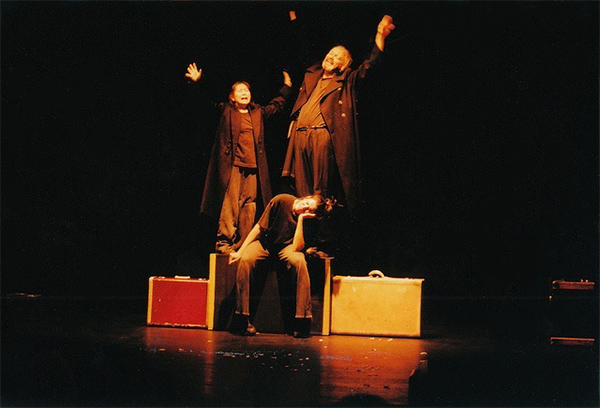
Innovative physical theatre company, which has enjoyed international exposure, based in Toronto, Ontario. Theatre Smith-Gilmore was founded by Dean Gilmour and Michele Smith in 1980; they met in 1978 while studying at the School of Jacques Lecoq in Paris. Smith and Gilmour have since created 40 shows, many adapted from cultural classics, and 15 original plays.
Theatre Smith-Gilmour is a theatre of image and action: The actor’s imagination is at the centre of the process of creation and production. Performers articulate primarily with their bodies, expressing words, set and design.
Highlights from the past twenty years include: Chekhov’s shorts (2000-01), which played Factory Theatre, the Firehall Arts Centre in Vancouver, Workshop West Theatre, the Hong Kong Cultural Arts Centre, Eastern Front Theatre. the Saidye Bronfman Centre, and the Chekhov International Theatre Festival in Moscow.
Part II of their Chekhov Cycle, Chekhov longs…In The Ravine also had a successful run at Factory Theatre in February 2002, and at Carrefour International Theatre Festival in Quebec City; the Magnetic North Theatre Festival in Ottawa; the Festival TransAmériques in Montreal; the Yukon Arts Centre in Whitehorse; the RCA/Artistic Fraud of Newfoundland theatre in St. John’s, Newfoundland; the Chiang Kei Sheik International Theatre Festival in Taipei, Tiawan; the Shanghai Dramatic Arts Centre in Shanghai; and the Chinese National Theatre in Beijing, China.
In 2007 Smith and Gilmour travelled to Shanghai to create and perform Lu Xun Blossoms the first Sino-Canadian co-production in theatre. With three actors from the Shanghai Dramatic Arts Centre and three actors from Canada, Lu Xun Blossoms premiered in Shanghai and toured to Beijing, Hong Kong, Guangzhou and Macau, China. The Canadian premiere was at the Luminato Festival in Toronto in June 2011.
In 2008, Katherine Mansfield opened in Toronto, to critical acclaim: “Katherine Mansfield adapts four stories in the company’s signature Commedia dell’arte style. We see spinster sisters coming to grips with their father’s death; a schoolgirl’s erotic daydream; a mother’s heartbreak at the loss of her soldier-son; and the cruel slaying of a duck. Mansfield’s fiction comes out well though the Smith-Gilmour wringer… The troop’s physicality makes the everyday emotive: a flurry of cacophonous meringue-crunching, for example, conveys profound uncertainty on the eve of hysterical grief” (Sheila Hanlon, EYE Weekly).
Also in 2008, Theatre Smith-Gilmour began to work with the Humber School of Drama to create a new original work. Over four months of development, the group worked on a total of 25 stories from the Brother Grimm. GRIMM, which included six of these stories, premiered at Humber College in November, 2008. GRIMM Too was presented in association with Factory Theatre in February 2010.
In October 2009, Smith and Gilmour collaborated with Adam Paolozza and Ravi Jain to create SPENT, “an absurd account of falling off the corporate ladder” (website). The production was nominated for three Dora Mavor Moore Awards, winning one for Best Performance by an Ensemble.
The Assholes: A Cabaret opened at the Factory Studio Theatre in April 2016. Using a bouffon style, it targets the exploitative 1% minority – the greedy hypocrites, the assholes, who control the world. The show challenges the lack of conscience in our world.
In 2016-17, Theatre Smith-Gilmour toured an “unsentimental” and physically strenuous interpretation of William Falkner’s novel, As I Lay Dying to One Yellow Rabbit’s High Performance Rodeo in Calgary and the PuSh International Performing Arts Festival in Vancouver.
Their productions have won ten Dora Mavor Moore Awards.
Website: http://theatresmithgilmour.com
Last updated 2022-01-14
Théâtre Sortie de Secours
Theatre company founded in 1989 by Philippe Soldevila, and based in Quebec city. Sortie de Secours (Emergency Exit) is dedicated to developing new works in collaboration with artists beyond its immediate milieu in order to explore complex questions of identity through a diversity of voices. It also creates works inspired by the art, literature, and myths of other cultures to achieve a critical distance on individual and social behaviour. It considers the cultural consequences of immigration, and the nature of Canadian interculturalism. The company often translates and adapts Spanish works. It engages actively in co-productions with other Francophone theatre companies in Quebec and across Canada. The Artistic Director since 1989 is Philippe Soldevila.
Among its early works are: Le miel est plus doux que le sang by Simone Chartrand et Philippe Soldevila, in which Salvador Dali, Frederico Garcia-Lorca and Luis Bunuel meet as young men in a student residence in Madrid, and are all creatively inspired by a cabaret singer. It was nominated for three Masques Awards. Other productions include : Bhopal by Rahul Varma (2005) ; Santiago by Helene Robitaille (Théâtre Périscope 2006) ; Le Magicien prodigieux (2008), a free adaptation of Calderon’s play by Soldivila ; À la défense des moustiques albinos (Théâtre Périscope and La Nouvelle Scene in Ottawa, 2010), a translation by Soldevila of the Spanish play by Mercè Sarrias.
In Les trois exils de Christian E. by Christian Essiembre and Soldevila (Théâtre Périscope and Théâtre l’Escaouette 2011), a successful young Acadian actor played by Essiembre tries his luck in Montreal, and encounters a very different cultural milieu. Essiembre won several awards for his portrayal of multiple characters : Prix du public Radio-Canada; Prix de l’Association québécoise des critiques de theatre; and Prix Paul-Hébert. Philippe Soldevila was awarded the Prix Artiste de l’Acadie du Québec.
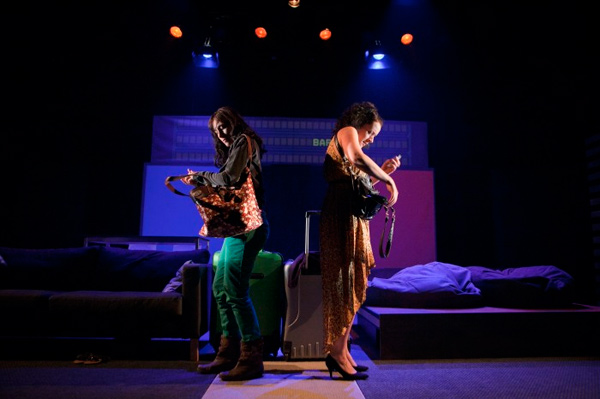
Québec-Barcelona (2012) shows the cultural and personal consequences when two cousins from Quebec and Spain exchange houses. The cast included two Quebecois and two Catalan actresses, and the production played in Quebec and in Barcelona.
Quand la mer … by Esther Beauchemin was presented in September 2013 at Théâtre Périscope in a co-production with Théâtre de La Vieille 17 and Théâtre du Nouvel-Ontario. The inhabitants of an isolated fishing village struggle to keep their livelihoods while their traditions are eroded, the sea inexorably retreats, and the fish disappear.
Website : www.sortiedesecours.org
Profile by Anne Nothof, Athabasca University
Last updated 2022-01-14
Theatresports
An improvisational organization founded by Keith Johnstone in Calgary, Alberta in 1978. The organization (or theatrical chain) is an offshoot of Loose Moose Theatre, a Calgary company founded in 1977. Theatresports developed by stages over the seventies from an intimate and loosely structured game played between two competing teams of Johnstone’s students and former students from the University of Calgary into a sporting event played the world over.
As the name indicates, the game has attributes of both theatre and sports. Teams of actors vie for control of the stage by performing improvised scenes. A team gains stage time by performing the most entertaining scene and earning the most points, as decided by a panel of judges. In the end, the team with the most points wins. Over time, other variations on this basic format have evolved, including “The Danish Game” which foregoes the judges and allows the audience to choose a winner, and “The Challenge Match” which sees each team alternately challenging the other to specific improvised games. The team winning the most challenges wins the match.
Similar to Ligue Nationale d’Improvisation, these improvised games can be funny and esoteric, but are always competitive. Theatresports is now played by teams on six continents, and an international improvisational Theatresports school convenes annually in Calgary. Theatresports is licensed to the International Theatresports Institute (ITI).
Emerging out of Theatresports have been a number of other related but structurally unique improvisational forms including “The Life Game” (improvisational scenes based upon live interviews with invited guests) and “Gorilla Theatre” (a series of directed improvisations with greater focus upon the director as improviser). See also: Canadian Improv Games.
Further Reading: Kathleen Foreman and Clem Martini, eds. Something like a drug: an unauthorized oral history of theatresports. Red Deer, AB: Red Deer College Press, 1995.
Keith Johnstone. Improv for Storytellers. London: Faber and Faber, 1999.
Profile by Clem Martini, University of Calgary
Last updated 2022-01-14
Theatre St. Thomas
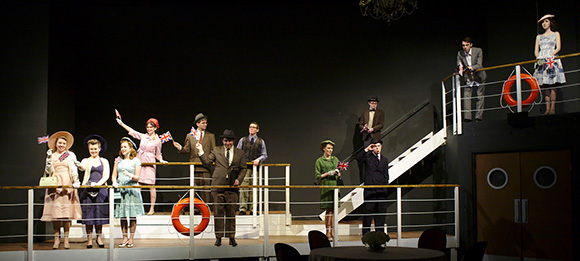
Theatre St. Thomas (TST) is an extra-curricular theatre company in Fredericton, New Brunswick. Operating out of St. Thomas University (STU), TST’s history dates back to when the liberal arts institution was first located in Chatham, New Brunswick between the years 1910 and 1964. TST began as a primarily student-run extracurricular activity. After the university’s relocation to Fredericton in 1964, faculty member Ted Daigle took charge of the group. In 1978, Ilkay Silk took over responsibilities for TST when she was hired as STU’s Drama Coordinator. After Silk’s retirement in June 2014, drama professor Robin C. Whittaker became the group’s Faculty Advisor and Artistic Producer. The current technical director for TST is Chris Saad.
Founded on the principles of a liberal arts education, TST offers students the opportunity to participate in theatre in ways their courses may not provide. Its constitutional mandate is to “act as the official organization representing extracurricular dramatic interest of students of St. Thomas University” and “to promote an active interest in theatre and to expand its members’ knowledge about various technical and performing aspects of the theatre.” In doing so, it provides a safe and nurturing, professional environment where students can engage with drama practically and critically. The company holds that the experience of live performance promotes critical thinking and is at the core of enhancing a liberal arts education. Theatre participation includes onstage and backstage activities. Students are able to volunteer as stage managers and tech crew for TST productions.
Auditions for TST’s shows are open to all students, faculty, staff, and members of the community identifying as professional or non-professional practitioners. Since 1978, most productions have been directed by Silk, but students and guest theatre artists have also directed shows.
The company’s two performance venues are both located on the STU campus. Before 1994, TST performed all of its productions in the 160-seat proscenium-style Ted Daigle Auditorium. In 1994, TST added the Black Box Theatre, a flexible-seating studio theatre that has been called “the best of its kind east of Montreal.” It was built to accommodate increasing theatre activity on campus.
TST has been praised for producing high quality, challenging and affordable works that aim to develop critical audiences. Notable productions include Kent Stetson’s Warm Wind in China (1991) in collaboration with AIDS New Brunswick; David Mamet’s Oleanna (1997), with an actual professor and student from STU in the main roles; Timberlake Wertenbaker’s Our Country’s Good (2001), for which a former convict led workshops to educate actors on prison life; and the New Brunswick premiere of Michel Marc Bouchard’s The Coronation Voyage (2014). In February, 2016, Theatre St. Thomas produced a new work by playwright Robin Whittaker and social worker Sue McKenzie Mohr, entitled No White Picket Fence. This verbatim play tells the stories of ten women who have experienced foster care. In November 2018, the theatre presented A Life of Galileo by Bertolt Brecht (trans. Mark Ravenhill).
Outside of its main theatre activities, TST has created shows for the university’s Orientation Week to present issues like date rape and homophobia. In the past, federal grants were acquired to employ summer students for the purpose of staging productions. This niche is now filled by NotaBle Acts Theatre Festival. TST also helps run the New Brunswick Provincial Drama Festival and Conference (DramaFest), which the university hosts on its campus.
Notable TST alumni: Anna Silk (TV actor, Lost Girl); Ryan Griffith (National Theatre School of Canada graduate and founding artistic director of The Next Folding Theatre Company); Tania Breen (Director of Theatre New Brunswick Theatre School & Young Company).
Profile by Robin C. Whittaker and Rodrigo Flores, St. Thomas University
Last updated 2022-01-14
Théâtre Ubu
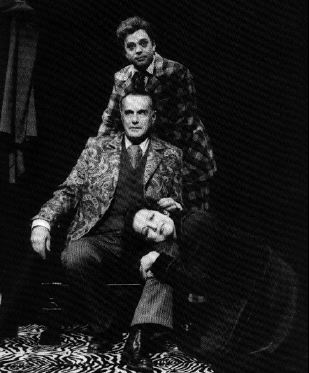
Company in Montreal, Quebec, founded in 1984 by Denis Marleau. It has become one of the most respected Companies in the country and, through presentations at the Festival d'Avignon in France, in the world.
From the start, Théâtre Ubu's productions have been characaterized by a highly evolved aesthetic and musical tone. They are stark, sensationally lit, with stylized acting. At the beginning, the Company presented collages or deconstructions of works by Jarry (Ubu cycle, 1989) or Beckett (Cantate Grise, 1990), or examine artistic movements like the Russian Futurists (Luna-Park, 1992) and Dadaism (Coeurs à gaz et autres textes dada, 1981).
Théâtre Ubu turned to the exploration of the modern repertoire with productions of Roberto Zucco by Bernard-Marie Koltès (1992), Woyzeck by George Büchner (1994), Maîtres anciens by Thomas Bernhard (1995), Le Passage de l'Indiana by Normand Chaurette (1996), Urfaust (1999) and Le Petit Köchel (also by Chaurette, 2000). The Company often co-produce its work with other theatre groups.
Since 2002, the Co-Artistic Directors are Stéphanie Jasmin and Denis Marleau.
Website: www.ubucc.ca
Profile by Gaetan Charlebois
Last updated 2022-01-14
Theatre Yes
Independent theatre company, based in Edmonton Alberta since 2001.
The mandate of Theatre Yes is to produce intelligent theatre for adventurous audiences--diverse artistic events that surprise, challenge and empower (website). It instigates inquiry into risky national and international issues through the production of unique works from Canada and the world. The Company's work often has to do with space and relationships to audiences, and it may take small audiences to unusual found spaces-–such as sleazy hotel rooms and subterranean car parks for Ravenhill’s Shoot/Get Treasure/Repeat (Edmonton International Fringe Festival 2010), and eight different elevators in Edmonton for The National Elevator Project in 2013/14.
Artistic Director until November 2019, was Heather Inglis, a graduate of the National Theatre School of Canada. Artistic Associates of Theatre Yes were designer Brian Bast, and actors Melissa Thingelstad and Lora Borvold.
Productions of Canadian works, all directed by Inglis, include Treatment by Trevor Schmidt (2001), which traces the decline and resurrection of a mental patient; Halfway House, a collective creation by a company of actors, dancers and musicians (2002), inspired by Christina Rossetti’s poem, Goblin Market and reconfigured as The Enchantment in 2007; The Making of Warriors by Sharon Pollock (2003), an unsettling investigation of the murder of Native activist Anna Mae Pictou Aquash; Get Away by Greg MacArthur (2006); and The List by Jennifer Tremblay (2012).
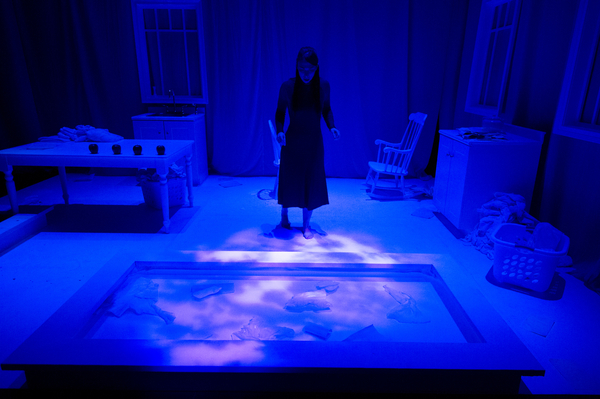
The National Elevator Project (2013/14) included commissioned five-minute plays by playwrights from across Canada: Brad Fraser, Kenneth T. Williams, Catherine Banks, Rick Chafe, David van Belle and Eric Rose, sponsored by Eastern Front Theatre, Artistic Fraud of Newfoundland, Mulgrave Road Theatre, Playwrights Atlantic Resource Centre, Magnetic North Theatre Festival, Nightswimming Theatre Company, Persephone Theatre, Unithéâtre, Ghost River Theatre, Workshop West Theatre, The Canadian Centre for Theatre Creation at the University of Alberta, Shadow Theatre, and Rumble Theatre.
In September, 2015, Theatre Yes produced a riveting interpretation of Bone Cage by Catherine Banks, with the cast positioned around and on a wooden platform and scaffolding, observing and participating in the entropic scenario of a small lumber town in Nova Scotia. The Company also premiered The Laws of Thermodynamics by Edmonton playwright Cat Walsh.
Anxiety (2016) comprised a collage of six short plays from theatres across Canada: Northern Light Theatre, Theatre Skam (Victoria), Outside the March (Toronto), LoHiFi Production (Halifax), Curtain Razors, and Théâtre à corps perdus (Montreal). Participating companies received packages in the mail with objects that prompted their contribution to the project on the theme of anxiety. The audience was taken in a bus to a warehouse located in an unidentified Edmonton suburb in which the plays were performed in small rooms. It made for an anxious and surprising experience for performers and audience.
In November 2018, Inglis mounted a documentary place in which actors playing the diverse lives of oil patch workers tell their stories one-on-one to audience members. According to Inglis, "The reality and complexity of ordinary peoples’ experiences working in the epicentre of Canada’s most contentious and powerful industry is not often given voice in public dialogue. VISCOSITY gives us the opportunity to share time and space with the men and women whose lives and work are fuel for Canadian society" (website).
Theatre Yes has also mounted compelling productions of the challenging British play, My Name is Rachel Corrie by actor Alan Rickman and journalist Katharine Viner (2008), and the contentious American play, Race by David Mamet (2012).
Theatre Yes's play-reading series, entitled Stripped Down, was designed to showcase recent controversial works from other places in Canada and abroad. In 2011, it included The Toxic Bus Incident by Greg MacArthur; Scarborough, a 2007 two-hander about an affair between a teacher and her teenage student by English playwright Fiona Evans; and Afterimage, the 2010 Governor General’s Award-winner by Robert Chafe.
In 2019, the Citadel Theatre and Theatre Yes co-developed and produced a site-specific, roving production which took the audience from the Citadel lobbies to its backstage spaces. Sight of Mind by Beth Graham (dir. Inglis) employs the characters of detective fiction to investigate the nature of truth in a "hall of mirrors" scenario.
The Company's productions have been nominated for ten Elizabeth Sterling Haynes Awards (Sterling Awards).
In 2023, Max Rubin and Ruth Alexander were introduced as the the new Artistic Leadership team for Theatre Yes.
Website: http://theatre-yes.ca
Profile by Anne Nothof, Athabasca University
Last updated 2023-02-06
The Chop Theatre
Collective theatre company, founded in 2004 and based in Vancouver British Columbia. The creative artists are Emilia Symington Fedy and Anita Rochon, both of whom are actors, writers, and directors, and graduates of Studio 58 in Langara BC.
The Chop Theatre began working with clown technique in 2002 to develop three monologues entitled Patti Fedy Trilogy. It now focuses on developing new works based in community interaction, in collaboration with other companies and individuals from across the country, including: 2 Truths + 1 Lie = Proof (HIVE 2006, co-produced with Rumble Theatre); Townsville (Magnetic North Theatre Festival 2008); Kismet: One to One Hundred (Magnetic North 2011); and How to Disappear Completely (Chutzpah Festival 2011), in collaboration with playwright/ performer/ lighting designer Itai Erdal. This tour-de-force show is part autobiography, part live theatrical lighting demonstration, telling the story of a son helping his mother in her struggle against cancer. It has toured internationally, including stops in Vancouver, Seattle, Portland, Toronto, Halifax, and the Stratford Festival.
In August 2019, The Chop presented Pathetic Fallacy at the Edinburgh International Fringe Festival. It examines our changing relationship to weather in terms of the response of one person, a different one for each performance, selected from the Fringe participants. "This piece questions the value of emotion in the face of a coming storm" (website). The performer receives all his or her staging instructions live, standing in front of a temperamental broadcast media green screen. Pathetic Fallacy has toured to FoldA, Darwin Festival, Offta & Farnham Maltings. In November 2020, Pathetic Fallacy was live-streamed across Canada, when theatres were closed because of the Covid-19 pandemic.
Web site: http://thechoptheatre.com
Last updated 2020-11-27
The Collected Works of Billy the Kid
Poetic novel by Michael Ondaatje adapted to theatre collectively and by the author over twenty times, and performed across Canada, notably at the Stratford Festival, Theatre 3, Belfry Theatre, and Great Canadian Theatre Company (September, 1998, directed by Richard Rose). The novel was a winner of the Governor General’s Award for poetry in 1970, although Prime Minister Diefenbaker, at the time, said it was unworthy of the prize. It is a collage of poetry and prose, photos, illustrations and “clippings,” written from Billy the Kid's perspective, culminating in his death at the hands of Sheriff Pat Garrett (published in 1970 by Anansi).
The play is studded with magnificent monologues and duos, reflections of the Far West and the machismo needed to survive it. Ondaatje's language has a broad palette which allows directors to be equally broad in their scenic explorations.
In a 1999 interview with Hillel Italie (Associated Press) Ondaatje said of the work's creation, "I grew up in Sri Lanka loving westerns [sic] and wanting to be a cowboy...so when I wrote Billy the Kid, it was my way of writing a Western."
Commentary by Gaetan Charlebois
Last updated 2022-01-05
The Crackwalker
Play in two acts by Judith Thompson, premiered November 26, 1980 at Theatre Passe Muraille, directed by Clarke Rogers, designed by Patsy Lang, featuring JoAnn McIntyre, Jane Foster, Hardee T. Lineham, Geza Kovacs and Graham Greene.
Thompson's first play, it explores the lives of the marginalized (like Thompson's other plays, I Am Yours and Lion in the Streets).
The Crackwalker is a dark portrait of the underbelly of Kingston Ontario, where Thompson had been a social worker. Theresa, a mentally challenged woman and her dysfunctional boyfriend Alan struggle to find love and the security of a home, but make disastrous decisions which result in the death of their baby. Although Alan has idealized Theresa as a madonna, he cannot cope with her erratic behaviour. The relationship of their "friends" Sandy and Joe, is predicated on sexual violence and submission, fueled by alcohol and smokes. A homeless Native man, whom they call the Crackwalker, haunts their lives, an embodiment of social and personal failure and hopelessness. Despite all their failings, however, the characters retain a semblance of friendship and loyalty, and even the Crackwalker consoles Alan in his final isolation and despair.
Thompson has said that the play has wider existential implications: it is about 'the abyss,' the depths that are hidden from us, and the cracks in the opaque surface that give us dizzying glimpses of the abyss. Through heightened violence, raw dialogue, and extended confessional monologues, Thompson conveys human failings and fragility.
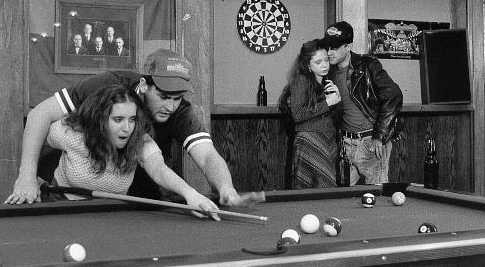
Thompson exploded onto the Canadian theatre scene with this work. She directed a production herself for the Hudson Guild in New York City, also featuring Graham Greene.
The Crackwalker is published by Playwrights Canada Press.
Commentary by Gaetan Charlebois and Anne Nothof
Last updated 2014-05-09
The Donnellys
Trilogy of plays, each in three acts, by James Reaney including: Sticks and Stones, The St. Nicholas Hotel and Handcuffs. The plays were born from Reaney's "Listeners' Workshops," a process by which a work was created from actions and images (first in Southern Ontario, then in Halifax, Nova Scotia).
Sticks and Stones premiered at the Tarragon Theatre, November 24, 1973, directed by Keith Turnbull, lighting by John Stammers, featuring Bob Aarron, Richard Carson, David Ferry, Jerry Franken, Rick Gorrie, Miriam Greene, Ian Lange, Carol Lazare, Patricia Ludwick, Don MacQuarrie and Fletcher T. Williamson. A Protestant Irish family with seven sons and one daughter emigrates to Biddulph in southern Ontario from Tipperary in 1846 to find their new land also divided by religious factions. The tragic finale of the trilogy, the immolation of the parents, two sons and a niece in their own home, is foreshadowed, but the violence and horror become the means to revision the deaths of the Donnellys as redemptive, thereby constructing positive images by which a community or a nation can see itself. Reaney dramatizes what Rick Salutin has called Canada's "missing history," "the history of those who stood against entrenched interests and forces that sought to limit personal and social freedom and progress." Each play is a series of overlapping and intersecting variant tellings by members of the family, primarily the mother, Johannah, the second son, Will, and the daughter, Jennie, but it is also enacted by their friends and enemies in the community, played by the same fourteen actors. Their lives are circumscribed by surveyers' lines and roads, demarcations of the territories occupied by Catholic and Protestant families. Irish history is replicated in Canada as a struggle over land ownership.
The St. Nicholas Hotel premiered at the Tarragon, November 16, 1974, directed by Turnbull, set by Rosalyn Mina, lighting by Vladimir Svetlovsky, featuring Ken Anderson, Nancy Beatty, Jay Bowen, Tom Carew, Peter Elliott, Ferry, Franken, Gorrie, Miriam Greene, Michael Hogan, Ludwick, MacQuarrie, Keith McNair, Gord Stobbe and Suzanne Turnbull. The Donnellys are now at war for mastery of the road. The play traces the feud through the second generation of the family, through the story of Will's stagecoach business and the fierce competition with the rival companies, which sometimes reduces their stage coaches to fragments of wood and their barns to burned-out shells. Religious alignments are entrenched in political loyalties, and the Donnellys again refuse to conform, throwing their weight behind the Reform Party, resulting in the narrow defeat of the Conservative candidate.
Handcuffs premiered at the Tarragon, March 29, 1975, directed by Turnbull, set by Mina, lighting by Stammers, featuring Bowen, Carew, Caryne Chapman, Elliott, Ferry, Franken, Gorrie, Greene, Ludwick, MacQuarrie, McNair, Jill Orenstein, Stobbe and Turnbull. Reaney shows how the community intensifies its threats and violence against the Donnelly family with the collusion of the parish priest. Against the formidable opposition of church and state, Reaney pits the strong wills of the Donnellys, to show how the words and deeds of a few can inform the life of a community. The mother, Johannah is cast not as a Medusa, but a warrior queen with considerable fortitude and endurance, who believes "There's fields of grain to garner with bread for you all." The light she places in her window as she awaits the return of her husband from prison shines "past of the borders of life." She gives her son Will a fiddle for his twelfth birthday, believing that in Canada they are "free as it is to play all the tunes." Will has the gift of music and of words; he is the most literate of the brothers and therefore the most feared. He rides a black stallion named Lord Byron. The family functions as a social paradigm for cohesion and loyalty, but they also have their failings: the youngest sons engage in inflammatory pranks or violent reprisals, and can be stubborn, arrogant and aggressive in protecting their interests.
In his program note for the 1975 production of "Handcuffs," Reaney included a simple statement: "It's hard to handcuff wheat." Vitality, courage, and determination will prevail, despite repression and brutality, or the "mind-forged manacles" of bigotry and ignorance.
The trilogy won the Chalmers Award, and toured throughout Canada in 1975, again with Turnbull directing.
The legends that surround the clan are treated with Reaney's unerring sense of the theatrical. Herbert Whittaker (Globe and Mail) called Part I "a thoroughly involving theatrical experience." The charm had clearly not waned when Part II was presented a year later. Scott Beaven, reporting for the Calgary Albertan referred to it as, "viable, virile, vigorous theatre..." With the presentation of Part III, Urjo Kareda (then with the Toronto Star), echoed many of his colleagues when he wrote, "[there is] no lapse in power or vision from the stature of its predecessors...The whole cycle is not just beautiful, but also dangerously exciting..."
Despite the excitement that greeted the work, it has rarely been revived in its entirety.
Further reading: Anne Nothof. "Variant Tellings: the Reconstruction of a Social Mythology in James Reaney's The Donnellys, Identities and Marginalities: International Journal of Canadian Studies 10 (Fall 1994): 71-85.
Commentary by Gaetan Charlebois and Anne Nothof.
Last updated 2022-01-17
The Dragonfly of Chicoutimi
Long one-act monologue by Larry Tremblay, premiered at Théâtre d’Aujourd’hui, May 1995, as part of the Festival de Théâtre des Amériques (now Festival TransAmériques); directed by the author, set designed by Mario Bouchard, lights by Michel Beaulieu and costume by Amaya Clunère. Performed by Jean-Louis Millette, who went on to win as best actor in the Masques Awards. The work toured in 1998-99 (notably to Vancouver's Waterfront Theatre with Millette performing). It was meant to continue its tour, but when Millette died of a heart attack, all plans for subsequent performances were cancelled in deference to the memory of Millette's spell-binding performance. The work was revived in January, 2002, at Factory Theatre featuring Dennis O'Connor.
The Dragonfly of Chicoutimi is an odd but fascinating play about a francophone man who begins to speak after years of silence. However, now he speaks in English, but through the filter of a francophone mind. Why? "...what I'm looking for in life is to keep in touch..." he says at the play's beginning.
A flood of poetic words follows, laden with images of intense violence mixed with potent homo-eroticism.
Commentary by Gaetan Charlesbois. Additional information provided by Christopher Hoile.
Last updated 2022-01-17
The Drawer Boy
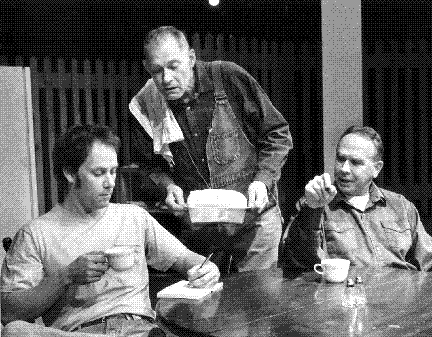
The Drawer Boy (1999) by Michael Healey revisits the origins of an alternative and experimental theatre in Canada - the collective creation of The Farm Show in 1972 by Theatre Passe Muraille.
In the 1970s a group of actors, including Miles Potter and David Fox accompanied Paul Thompson, the Artistic Director of Passe Muraille, on a theatre research trip to the rural heartland of southern Ontario. After interviewing local farmers and their families, they created a landmark Canadian theatrical event: The Farm Show. Almost two and a half decades later, Michael Healey went to work as an actor at the Blyth Festival and came into contact with many of the farmers and members of the local community whose stories had served as inspiration for The Farm Show. The impact of that experience, in turn, inspired the playwright to write his tribute to the power of art, The Drawer Boy.
It replays the adventures of a young actor from a Toronto theatre group who visits the rural Ontario home of two elderly bachelor farmers to "research" farm life for a new play. In doing so, he demonstrates the way in which a collective creation appropriated the lives of its subjects and changed their own interpretation of it. The two farmers, Morgan and Angus, have achieved a precarious balance in their lives together. Morgan, a tough-minded, stubborn man, cares for Angus, who has had brain damage and lost his memory during the bombing of London in the Second World War. Angus is initially identified as "the drawer boy" because he used to design buildings, and has the talents of an architect. Miles calms and reassures Angus by retelling their story - of the two tall women whom they loved, and who came to live with them in Canada. The young actor, Miles, learns, however, that this story is a fiction, and that the truth is much sadder. It would, in fact, destroy their friendship. In the process of telling their story as play, however, he reawakens Angus's memory. Art becomes life. Miles is in effect the "drawer boy," delineating and creating an alternative reality. As he tells Morgan, "We're here to get your history and give it back to you." The Drawer Boy is fundamentally about the power of storytelling in creating and interpreting reality, and how it can transform lives. There is much more in the play than a history of Canadian drama.
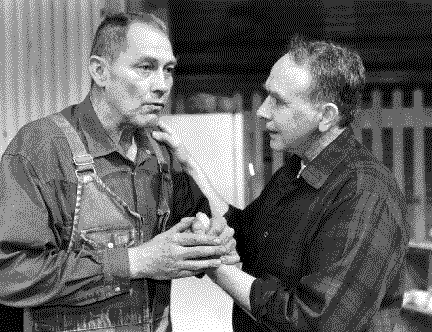
The Drawer Boy premiered in Toronto at Theatre Passe Muraille in 1999, directed by Miles Potter, and with David Fox as Angus, Jerry Franken as Morgan, and Tom Barnett as Miles. It was subsequently produced by Ed Mirvish Productions at the more opulent Winter Garden Theatre in Toronto and the Manitoba Theatre Centre, Winnipeg in 2001. The 2001/02 revival by the National Arts Centre in Ottawa toured to the major regional theatres: Hamilton's Theatre Aquarius, Edmonton's Citadel Theatre, and the Vancouver Playhouse. It has been produced across North America, in London and Dublin, and has been translated into German, French and Japanese. It has recently been made into a feature film, shot in Blyth, Ontario, with a cameo by Paul Thompson. In concert with the release of the film, The Drawer Boy was again performed at Passe Muraille in February, 2018 (dir. Nina Lee Aquino) in celebration of the theatre's fiftieth anniversary, with Anishinaabe actor Craig Lauzon as Angus and Andrew Moodie as Morgan.
It has won the Dora Mavor Moore Award for Outstanding New Play, a Chalmers Award, and a Governor General’s Award.
As Joel Greenberg stated in his theatre review for Aisle Say, "Thirty years ago, when The Farm Show was first created - it is the inspiration for Healey's play - no one in the local theatre community would have guessed that such movement was possible. That was a time when the 'underground' and the 'mainstream' were separated by a gulf too wide to consider negotiable. Happily, time has provided a bridge that makes such distinctions increasingly irrelevant." Canadian novelist and poet Michael Ondaatje believed that "it is one of the few plays to create an authentic tradition in our culture," and former Globe and Mail critic Kate Taylor, concluded that it was "fast turning into a Canadian classic."
Photos courtesy of Theatre Passe Muraille.
Commentary by Anne Nothof, Athabasca University
Last updated 2022-01-17
The Dumbells
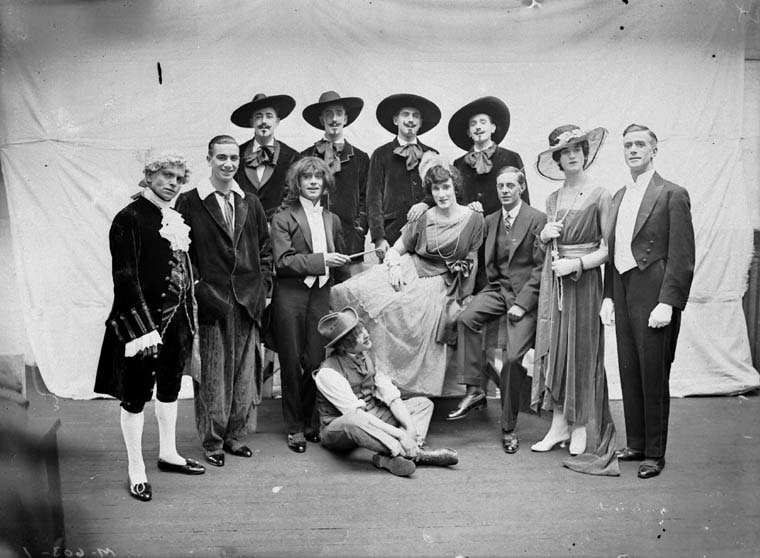
All-male musical revue including Merton and Al Plunkett, Jack Ayre (pianist and musical director), Elmer A. Belding, Ted Charters, Allan Murray, and Jack McLaren, created in 1917 to entertain troops on the front lines in France in order to improve morale. The troupe performed original satiric sketches, comic songs, dances, and female impersonations, improvising sets, lighting and costumes. The name derives from their Third Division insignia: crossed red dumbells, signifying strength, although its comic associations are obvious. The Dumbells enjoyed a popular success for a performance in London in 1918. At the end of the war, the troupe toured across Canada as a professional variety show, and appeared in Broadway in 1921 in a show entitled Biff, Bing, Bang. The original group split in 1922 over financial disagreements, but the Plunketts continued to tour with new members until 1932, finally defeated by the Depression, the decline in popularity of vaudeville, and the advent of film.
Among its satiric reviews was a real estate sketch by McLaren, in which he attempts to sell property in No Man's Land to another soldier, pointing out the advantages of on-site water and gas. The troupe's black humour and satire has since come to characterize much of Canada's musical theatre, such as Spring Thaw, and the comic sketches of performers such as Johnny Wayne and Frank Shuster; it is also evident in works such as Billy Bishop Goes to War.
A popular Dumbells' song "Oh! It's a Lovely War" inspired the English radio play by Charles Chilton, The Long Long Trail (1961), which was transferred to the stage by Gerry Raffles in partnership with Joan Littlewood and her Theatre Workshop in 1963 as Oh What a Lovely War.
A work about the revue - The Legend of the Dumbells, devised by Alan Lund - played at the Charlottetown Festival in 1977.
An archival collection on this subject is available at the Toronto Reference Library, and at the National Library Archives on-line.
Readings: Jason Wilson. Soldiers of Song: The Dumbells and Other Canadian Concert Parties of the First World War. Wilfrid Laurier University Press, 2012.
Anton Wagner, ed. Contemporary Canadian Theatre: New World Visions. Toronto: Simon and Pierre, 1985.
Last updated 2022-01-20
The Ecstasy of Rita Joe

Drama in two acts by George Ryga, premiered at the Vancouver Playhouse, November 23, 1967, directed by George Bloomfield, set and lighting designed by Charles Evans, costumes designed by Margaret Ryan, featured Frances Hyland, August Schellenberg, Chief Dan George, Henry Ramer, Walter Marsh, Robert Clothier, Patricia Gage, Rae Brown, Claudine Melgrave, Bill Clarkson, Merv Campone, Alex Bruhanski, Jack Leaf, Jack Buttrey, Leonard George, Robert Hall, Frank Lewis, Paul Stanley, Willy Dunn and Ann Mortifee as the Singer. This production opened the studio theatre of the National Arts Centre in 1969, and played in Washington, DC, in May, 1973, with George and Hyland. It has subsequently been produced by Alberta Theatre Projects in 1976; by Citadel Theatre in 1979, with Susan Andre and John Hamelin as the lovers, Tanya Ryga, the playwright's daughter, as "The Singer", and Margo Kane as Eileen Joe; by Prairie Theatre Exchange in 1981, with Tom Jackson as Jaimie Paul and Margo Kane as Rita Joe, and an all-Indigenous cast; and by Western Canada Theatre Company in 2009 (dir. Yvette Nolan), with August Schellenberg as David Joe, Lisa Ravensbergen as Rita Joe, Kevin Loring as Jaimie Paul, and Layne Coleman as the Magistrate.
The play was published by Talonbooks in 1970, and anthologized in Modern Canadian Plays Vol 1 (ed Jerry Wasserman) in 1985. It was translated into French by Gratien Gélinas and presented at the Comédie-Canadienne. It was adapted as a ballet by the Royal Winnipeg Ballet in 1971. In 2007, it was produced at the Maple Leaf Theatre, Tokyo in a translation by Toyoshi Yoshihara.
Although Indigenous and critical responses have varied since its first production, the play is seminal in the history of modern Canadian drama. The Ecstasy of Rita Joe recounts the story of a young Indigenous woman who comes to the city to find freedom from the limitations of reserve life, only to experience racism, marginalization, and finally rape and murder. This contemporary tragedy condemns the brutality of a system that limits, rejects, or sentences Indigenous people to lives of social and spiritual poverty, that takes away their pride, their traditions and their language. The death of Rita Joe comes as a consequence of the imposition of a colonizing power on Indigenous peoples.
The story is told in songs, montages and disconnected scenes -- in a stream-of-consciousness style which collapses past and present, as Rita Joe recalls her youth on the reserve during her arraignment in court on charges of prostitution. Events and characters are presented from her point of view, as the salient moments of her life are replayed just before her moment of death. Her "ecstasy" is an ironic allusion to the euphoric state of enlightenment experienced by a Christian martyr before her reunion with God.
Ryga effects this collapsing of time through the set design -- a circular ramp that encloses the present, with a cyclorama to evoke the past. Lighting effects isolate characters and cast shadows of prison bars across Rita Joe as she sleeps, creating a mood of fear and claustrophobia. This "expressionist" style and form projects the state of mind of the protagonist, externalizing feelings through action and image. Ryga portrays the helplessness of the individual in the face of large social and political forces. The structural metaphor of The Ecstasy of Rita Joe is that of the trial -- of Rita Joe, but more significantly, of the audience.
The characters, particularly the white antagonists, tend to be stereotypes representing large, impersonal forces -- the law, the church, white "do-gooders." The portrait of Rita Joe is more complex: she is insecure and defiant, caught between two cultures.
The critics were virtually unanimous on two counts: the work's structural challenges; the work's odd power. Jack Richards of the Vancouver Sun echoed many other writers with, "I don't know if it is a great play. But if the role of the stage is to communicate...Ryga and...Bloomfield have accomplished their purpose." On the revival in 1976, Jamie Portman of the Vancouver Province wrote, "Yet...the play still worked. Rita Joe was a landmark in more ways than one. It was - and remains - a play for all seasons and for all peoples." However, Indigenous playwright Kenneth T. Williams has called it a white tourist play, "poverty porn", which is "just as destructive as the forces of colonization Ryga decries in his play" (quoted from Day, 23). More recently, it has been regarded by director Yvette Nolan as just as current and powerful as when it was first produced. It has reached international audiences, and was the first Canadian play produced in China -- at the Shanghai Theatre Academy.
Readings: James Hoffman. The Ecstasy of Resistance: A Biography of George Ryga. Toronto: ECW Press, 1995.
Moira Day. "Ryga, Miss Donohue, and Me: Forty Years of The Ecstasy of Rita Joe in the University," Theatre Research in Canada 38:1 (2017) 11-30.
Commentary by Gaetan Charlebois and Anne Nothof
Last updated 2020-06-12
The Komagata Maru Incident
Drama by Sharon Pollock first presented by Vancouver Playhouse January 1976. It was directed by Larry Lillo, designed by Jack Simon, with Allan Stratton as T.S., Richard Fowler as Hopkinson, Heather Brechin as Evy, Leroy Schulz as Georg, Nicola Cavendish as Sophie, and Diana Belshaw as the East Asian woman.
The play is based on the true story of a Japanese freighter, named the Komagata Maru, carrying 376 immigrants to Canada from the Punjab in 1914. It was prevented from docking in Vancouver by government officials. After a standoff of seven weeks, the ship returned to India, leaving behind only twenty passengers who could prove former residence in Canada. The repercussions were a riot in India, a radicalization of Sikhs in Vancouver, the murder of the official who oversaw the exclusion, and the execution of his Sikh assassin. As Pollock says in her program note: “By the early 1900s, the Canadian government believed it had devised an airtight method to virtually exclude immigration from Asia” – by prohibiting the landing of immigrants who came by other than continuous passage from the embarkation point.
In her program note Pollock also explains that “The Komagata Maru Incident is a theatrical impression of an historical event seen through the optique of the stage and the mind of the playwright. It is not a documentary account, although much of it is factual. To encompass these facts, time and place are often compressed, and certain dramatic licence is employed.
The play is set in a brothel, and the atmosphere is that of a circus with a Master of Ceremonies (T.S.) orchestrating and commenting on the action and words of the characters embroiled in the events. He is also the voice of public policy and public opinion. The Sikh passengers are represented by an East Asian woman on board the ship. As the agent of political policy, Pollock casts a Canadian of mixed heritage, Inspector William Hopkinson, whose mother was Punjabi, and whose father was a British sergeant stationed in northern India. Hopkinson has established a network of informers in the Vancouver Sikh community in an attempt to keep them under control, and to keep out more immigrants. His mixed race origins are exposed by the prostitute Evy, and he is forced to acknowledge his self-destructive hypocrisy before accepting his death as the hand of a revolutionary Sikh as a just retribution for his lack of compassion for others and his betrayal of his own people. In a series of short scenes and speeches which directly implicate the spectators, the work deals not simply with the systematic bigotry of the era but also with personal responsibility and (finally) liability. Again, Pollock exposes difficult issues in the country's past, raising problems that she rightfully feels the nation has not completely addressed. As she succinctly states in her program note, “Until we recognize our past, we cannot change our future.”
In 2017, the Stratford Festivial staged a revised version of The Komagata Maru Incident in the Studio Theatre (dir. Keira Loughran). The director took a more inclusive interpretation of the play, in an unnecessary attempt to make it more current and relevant. The prostitutes were characterized as Chinese, T.S. appeared initially as a First Nations woman in full ceremonial regalia, then as a colonial exploiter spouting government edits. The Woman's presence on the ship was emotionally amplified through her singing of traditional music.
Readings: Sharon Pollock. The Komagata Maru Incident, in Collected Works Vol I, ed. Cynthia Zimmerman. Toronto: Playwrights Canada, 2005.
Sharon Pollock: Essays on Her Works, ed. Anne F. Nothof. Toronto: Guernica, 2000.
Commentary by Gaetan Charlebois and Anne Nothof.
Last updated 2017-09-29
The League of Nathans
Drama in two acts by Jason Sherman. It was first performed by Orange Dog Theatre on April 23, 1992 at Theatre Passe Muraille, directed by Ian Prinsloo, with costumes by Sylvie Plamondon, lighting by David Gibbons, and set and stage management by Cheryl Mills. It featured David Gow, Alyson Green, Michael Healey, Melinda Little, Alex Poch-Goldin, and Cyril Sherman. It was subsequently rewritten (and it is this text that was published by Scirocco in 1996), and premiered in it revised form by Winnipeg Jewish Theatre, January 13, 1996, at Prairie Theatre Exchange, directed by Richard Greenblatt, with set and costumes by Craig Sandells, lighting by Aisling Simpson, music and sound by Cathy Nosaty, and stage management by Laura Astwood. It featured Healey, Ari Cohen, Jordan Pettle, and Harry Nelkin. It was also performed at Great Canadian Theatre Company.
The League of Nathans is a prickly play about a prickly subject. It goes back and forth in the lives of three Jewish men, friends since childhood and all named Nathan: Abramowitz, Isaacs, and Glass. The three have differing attitudes towards their culture. It is, finally, an examination of the sometimes tenuous links between young people and their heritage and between Jewish North Americans and Israel. The play also looks at how history can form (or even deform) a human being. At the play's conclusion, in a confrontation between one who is now a Zionist and one who is a pacifist, no answers are given.
Sherman reached a wide audience with this work which won a Chalmers Award. Though the subject is deadly serious, he serves up his characters and situations with a healthy dose of humour. It is a perfect illustration of what he told the CBC in 1999, "A great quote Charles Ludlum has is: 'If you are going to tell people the truth, you better make them laugh.' Nobody wants to feel like they're going to be preached at in the theatre. You want to feel like you are going to recognize something of yourself in what's going on stage otherwise, you feel left out."
Commentary by Gaetan Charlebois
Last updated 2022-01-17
The Maggie Tree

Collective, Edmonton Alberta-based theatre company with a mandate to support the development and visibility of women in creative leadership roles in the arts. The company was founded in 2007 by actors Kristi Hansen and Vanessa Sabourin (former Artistic Director of Urban Curvz in Calgary). The formation of the Maggie Tree was inspired by Sabourin's attendance at a Magdalena Project in 2006 - a dynamic cross-cultural network of women’s theatre and performance, facilitating critical discussion, support and training, with a commitment to ensuring the visibility of women’s creativity. The Company's name, The Maggie Tree, references the Magdalena Project.
The Maggie Tree focuses primarily on new work by and about women. A preference is given to projects which create strong new roles for women and/or give voice to a female perspective.
The Company also privileges work that investigates the integration of movement and text, developing its own process and methodology for working these two elements into a dynamic and inventive relationship.
Productions of Canadian works include: Hunger Striking by Kit Brennan (2008); A Life in the Day by Beth Graham (2009, Sterling Award); Folie à Deux by Trevor Schmidt (2010, Sterling Award); Hroses: An Affront to Reason by Jill Connell (2011); Shattered by Trina Davies (2011).
In 2013, The Maggie Tree produced Age of Arousal by Linda Griffiths (C103 Theatre, 2013), in collaboration with Blarney Productions, and in association with Theatre of the New Heart, with a strong ensemble of Edmonton actors: Sandra M. Nicholls, Kristi Hansen, Melissa Thingelstad, April Banigan, Caley Suliak, and Jesse Gervais. This was an exceptional production of a challenging, witty play, which expressed complex emotions of women under duress with a sense of historical irony.
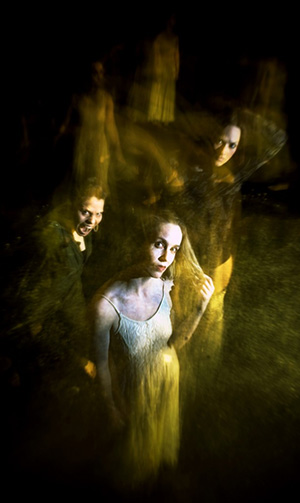
In April 2014 the Company premiered Monstrosities (dir. Sandra Nicholls), a collective creation by actors Amber Borotsik, Kristi Hansen, Vanessa Soubourin (with playwright Jill Connell) in a co-production with Urban Curvz. In three monologues which express extreme physical and mental states, these women enact the ways in which they may be perceived as "monsters": Borotsik is a fragile agoraphobic who has lived in a room with her fantasies for two years until finally making contact with a man (either imagined or real or both); Sabourin is a Manticore with three sets of teeth, tough and resistant, but living inside of a tornado; Hansen is a beautiful woman who has enacted many diverse sexual roles in which her truncated leg (phocomelia) functions as a sex organ. In her review, Liz Nicholls suggests that "The essence of Monstrosities is the reverse--apparent strangeness that turns out to be human and somehow quite familiar" (Edmonton Journal 18 Apr 14).
In April, 2015, The Maggie Tree launched Category E, a commissioned play by Belinda Cornish. This "comedy of menace" with an animal rights agenda, shows the disturbing lethal effects of testing cosmetics on three women, who pass the time before their next experiment in the cell of an English laboratory. The claustrophic, end-game scenario recalls the absurdist plays of Samuel Beckett and Harold Pinter. It won five 2015 Sterling Awards: best New Play, Independent Production, Supporting Actress (Jenna Dykes-Busby), Lighting (T. Erin Gruber), and Multimedia Design (ShowStages Collective).
The Supine Cobbler by Jill Connell premiered in April 2016. Using macho Western mythology and imagery, it ironically interrogates the fraught subject of abortion from several women's perspectives.
In April 2017, The Maggie Tree presented the Off Broadway hit 9 Parts of Desire in association with Theatre of the New Heart (dir. Vanessa Sabourin). Written by American-Iraqi performer playwright, Heather Raffo, the play enacts the lives of nine Iraqi women between the first and second Gulf Wars, exploring the conflicting aspects of what it means to be a woman in a country at war.
In October 2022, the Company produced The Wolves by Sarah De Lappe in association with Citadel Theatre as part of the HIGH WIRE series. Directed by Sabourin, it features a diverse cast of nine young women as soccer players in a U17 team with mixed motives and desires, who bond or fracture under the stress of the game.
Website: www.themaggietree.com
Profile by Anne Nothof, Athabasca University
Last updated 2022-10-21
The Magnificent Voyage of Emily Carr
Three-act play by Jovette Marchessault, originally written in French as Le Voyage Magnifique d’Emily Carr, premiered at Théâtre d’Aujourd’hui 1990, with Catherine Begin, Louise Bombardier, Louisette Dussault, and Michel Laperriere; directed by Reynald Robinson; designed by Augustin Rioux. It was translated into English by Linda Gaboriau (Belfry Theatre 1992), and published by Talonbooks in 1992.
The Magnificent Voyage of Emily Carrdramatizes the internal life of the artist: the mise en scene is a projection of the way in which Emily Carr sees her world. The play takes as an organizing metaphor the journey -- in this case a journey towards artistic self-realization. Its characters are the people and places which haunt the imagination of the artist, and it delineates a mental landscape through a juxtaposition of stage images.
One of these characters is Lizzie, Emily's older sister, who articulates a doctrinal social and religious point of view, the antithesis of the pantheistic beliefs of the Natives whom she attempts to convert, and of the vision expressed by Carr in her paintings and writings. The Native way of seeing is embodied in Emily's friend Sophie and the totem D'Sonoqua, played by the same actress. In her story of D'Sonoqua from Klee Wyck, Emily Carr describes this Haida totem as a goddess of creation and destruction. In Marchessault's play, Sophie, who bears a child a year, and buries a child a year, is a manifestation of this cycle of birth and death. She is also the wise voice of Native spirituality, speaking in a language of moral superiority to the non-Natives. The creative impulse is also portrayed through the symbolic figure of the "The Soul Tuner," and through the character of Lawren Harris, the Group of Seven artist who most encouraged Carr to reach beyond mimetic art to a more expressionist style -- both played by the same actor.
As in Marchessault's other plays about marginalized women artists, La Saga des poules mouillees (1981), La Terre est trop courte, Violette Leduc (1982), Alice et Gertrude, Nathalie Renee et ce cher Ernest (1984) and Anais dans la queue de la comete (1985), the voices of the imagination speak with the same authenticity as those of "real" characters.
The delineation of time is fluid, suggesting moments of vision rather than temporal sequences: "Sometimes dawn, sometimes the middle of a starry night, sometimes a moment of dazzling light in the forest and sometimes the dark night of the soul" (5); each moment evokes the way the artist sees and what she sees.
Like many expressionist plays, The Magnificent Voyage of Emily Carr is loosely structured as a journey to a "New World," in this case one in which feminist values and aesthetics will be recognized and celebrated. The journey takes the form of three "voyages," each of which comprises an increasing number of "tableaux." An approximate chronology is suggested only through the juxtaposition of significant events in the artist's life which may also be aspects of an imagined life. "Reality" is suggested through the conflict between Emily and Lizzie, and through the incantations of D'Sonoqua in the "Third Voyage," when Emily has begun to explore the spiritual dimensions of landscape. However, even the physical properties which invest her environment take on symbolic significance: in her struggles with doubt and despair she wrestles with her father's armchair, which she perceives as Jacob's angel--a figure of stultifying orthodoxy and patriarchy.
In delineating the struggles of one woman artist against a dominant patriarchy, Marchessault is undoubtedly dramatizing her own. Like Emily Carr, she is a painter, sculptor, and writer, a strong individualist who lives in the country and surrounds herself with what she calls her "therapy group"--her dogs, cats, ducks, guinea-fowl, and geese. Her work pervasively reflects the way in which an artist grows towards a way of realizing her natural environment through highly coloured images, and the ways in which women artists realize their own creative impulses. Marchessault takes almost nothing from Carr's own writings, however; she constructs the world of the artist in her own words. In effect, then, it is her world too.
Emily's final words in the play are, however, taken from Carr's journal, Hundreds and Thousands (264): "There's words enough, paint and brushes enough, and thoughts enough. The whole difficulty seems to be getting the thoughts clear enough, making them stand still long enough to be fitted with words and paint. They are so elusive, like wild bird singing above your head" (104). They articulate Carr’s attempt to vivify one art form through another, the same enterprise undertaken by Marchessault. The Magnificent Voyage of Emily Carr dramatizes the struggle of any artist who aspires beyond literal representation.
Commentary by Anne Nothof, Athabasca University; excerpted from “Staging a Woman Painter’s Life: Six Versions of Emily Carr,” Mosaic 31.3 (Sept 1998): 83-110.
Last updated 2022-01-17
The Melville Boys
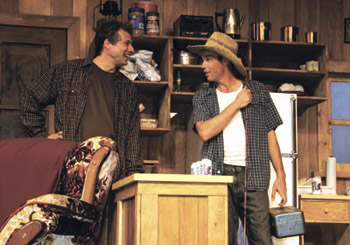
Dramatic comedy in two acts by Norm Foster, premiered at Theatre New Brunswick October, 1984, directed by Malcolm Black, set and costumes by Patricia Clark, lighting by David Gibbons, featuring Robert King, John Dolan, Deborah Kimmett and Patricia Vanstone. It was subsequently produced extensively across the country and abroad in French and in English. The Melville Boys was Foster’s second published play, and established him on the Canadian theatre scene. In 1988 it won the Los Angeles Drama-Logue Award.
It is not difficult to see why this play is so popular both with theatre companies and audiences. It has the right blend of comedy, character, plot and a touch of drama that comes dangerously close to (but never teeters into) melodrama.
Two working class brothers, one a big goof, the other a slightly more cerebral fellow (who is terminally ill with cancer) come to a lakeside cabin for a weekend. While there, they encounter two sisters, one a silly wannabe actor, the other a more serious, intelligent lady. They pair up, and the result is a story that is satisfying with some comic set pieces that are little gems (including a moment when the silly sister acts out her most famous commercial and then thinks, "I'm dying" is a pick-up line). The second act is much shorter and handles most of the dramatic weight of the work.
Though the characters could be dismissed as caricature, Foster offers genuine humanity in the writing and, indeed, sets out acting challenges for performers.
Readings: Norm Foster. The Melville Boys. Toronto: Playwrights Canada Press, 1986.
Commentary by Gaetan Charlebois
Last updated 2013-02-11
The Next Folding Theatre Company
Theatre Company, founded in 2011, and based in Fredericton New Brunswick. It is dedicated to producing theatrical works created by new and emerging Canadian artists. It assists playwrights by providing them with workshop productions, and second productions of their scripts. It also works through collective creation with diverse local artists to produce works rooted in New Brunswick history.
Collective works include: Henry Moon: Conducts and Mischiefs of the Lunar Rogue; Pistols and Petticoats: Shadows of Sarah Emma Edmonds; and Cold Woman: New Brunswick’s Murderess (2012), which enacts the nefarious deeds of one of New Brunswick’s most famous serial killers, Sophia Hamilton.
Artistic Director is Ryan Griffiths.
Website: www.nextfolding.ca
Last updated 2015-03-08
Theodore, Bobby

Translator, playwright, and screenwriter, born in Montreal Quebec, who as of 2020 has translated twenty-five plays from French to English. Bobby Theodore graduated with a Bachelor of Arts in Creative Writing from Concordia University in 1994, and from the National Theatre School of Canada's playwrights program in 1998.
He is probably best known for his translations of François Archambault's plays, including 15 Seconds (playRites 1999), for which he was nominated for a Governor General’s Award in 2000. Translations of Archambault’s other works include: The Leisure Society (Trafalgar Studios, New York, 2012), and You Will Remember Me (Alberta Theatre Projects, 2014). He has translated the works of Quebec playwrights Geneviève Billette (Crime contre l’humanité, University of Alberta, 2007), Nathalie Boisvert, and Olivier Choinière (Trains and Zoé). In 2016, he translated The Just by Alberta Camus for Soulpepper Theatre Company.
Theodore has no formal training in translation. It is an intuitive process. When possible, however, he works closely with the playwright: “I like to tell people that when I translate, I get inside the playwright’s skin, wearing it like a cloak, like a child playing make-believe.” (The Accidental Translator)
His radio play, The Ball and the Pins was produced by the CBC in 1998. Gravity premiered at Monument National, also in 1998. With Canadian choreographer, Ame Henderson, Theodore created 300 Tapes (The Theatre Centre and Alberta Theatre Projects, 2010). A collection of 100 stories recorded on 100 mini cassette tapes, are repeatedly performed by three actors. The stories may or may not be personal memories, and they change with each repetition. Moreover, the audience does not know whose stories they are.
Theodore has worked as a writer and story editor of several Canadian television shows, including Instant Star (2006), Murdoch Mysteries (2008), Cra$h and Burn (2009), and Flashpoint (2010-2011). He also wrote an episode the CBC radio drama series, Afghanada.
From 2016 to 2019 he was the host and resident dramaturg of the Glassco Translation Residency in Tadoussac, Quebec, a collaborative retreat for Canadian playwrights, translators and adaptors.
Bobby Theodore currently lives in Toronto.
Profile by Anne Nothof, Athabasca University.
Last updated 2020-05-06
The Only Animal
Innovative theatre company, founded by Kendra Fanconi and Eric Rhys Miller in 2005 in Vancouver British Columbia. The Only Animal creates theatre work that engages with specific locations and landscapes, both physical and imaginary. It explores the possibilities of the human condition through a wide range of works—from intimate performances with an audience of one, to large-scale spectacles. Many of its productions are collaborative projects with members of a coalition of creation-based Vancouver theatres called Progress Lab, and with other theatre companies across Canada.
In 2005 The Only Animal created Other Freds, featuring the work of 35 professional artists and 125 community members in a musical-clown-boat-bicycle extravaganza about the possibilities of parallel worlds, staged on and around False Creek, Vancouver. The One That Got Away (created with Electric Company Theatre) premiered in 2000 in Vancouver, was remounted in 2007, and toured to the Magnetic North Theatre Festival in Ottawa. NiX, Canada’s first theatre of snow and ice, premiered at the Enbridge playRites Festival in Calgary in February 2009 as a co-production with Alberta Theatre Projects and Ghost River Theatre. NiX was featured in the 2010 Cultural Olympiad at Lost Lake, Whistler. You and the Moon, an intimate work for one audience member at a time, was presented by The Cultch Micro Theatre Series in 2010.
The Only Animal has produced short site-specific works for three HIVE festivals in Vancouver in 2006, 2008, and 2010, in which eleven eclectic theatre companies present mini-plays in a single venue. Sea of Sand by Eric Rhys Millerwas a site-inspired hybrid performance on the beach at Spanish Banks in 2011, combining pre-taped dialogue and live action in and out of the water, and alluding to the Selkie myth in its story of the consequences of a couple rescuing a young woman from drowning. In his review, Jerry Wasserman applauds the effective use of a beach location: “Unlike a lot of site-specific work where the setting is the only star and the script a minor player, Sea of Sand benefits from a smart, complex and often funny script along with strong acting, excellent swimming…” (ww.vancouverplays.com). Out On A Limb, comprising 52 stories of growing up and growing older, was performed in the trees of Strathcona Park in 2012. In 2013, The Only Animal created a short play for Theatre Yes’s The National Elevator Project, performed in an elevator in Edmonton Alberta.
Works by The Only Animal have been nominated for thirty Jessie Richardson Awards and have won eight, including Best Production and twice for Significant Artistic Achievement.
Website: www.theonlyanimal.com
Last updated 2022-01-17
The Orphan Muses/Les Muses orphelines
Play written in French by Michel Marc Bouchard; premiered in 1988 at Théâtre d’Aujourd’hui, Montreal, Quebec; dir. André Brassard, with Anne Caron as Catherine, Dominique Quesnel as Isabelle, Roy Dupuis as Luc, and Louse Saint-Pierre as Martine.; set and costume design by Meredith Caron. The published English translation is by Linda Gaboriau.
The plays of Michel Marc Bouchard have had a wide appeal in Quebec and Europe in their original French, and in English translation across Canada. His imaginative vision plays well outside of Canada: it is not limited by national politics, although it is informed by the social and religious strictures of Quebec in the Duplessis years of the 1950s.
Like Quebecois playwrights René-Daniel Dubois and Normand Chaurette, Bouchard turned in the 1980s to traditional themes and images, but in a highly imaginative dramaturgy. He offers a poetic vision, suggesting rather than demonstrating, creating an allegorical universe populated by symbols: "Je pense, tout comme Genet, que le théâtre est un lieu de symboles et de codes, que les symboles touchent davantage parce qu'ils appartiennent au poétique et non à l'utilitaire" (quoted in Lesage).
According to Marie-Christine Lesage, his plays assault ideas of normalcy, of disposition, of truth, insofar as they are determined by our society and our culture. His characters reside on the margins of established society, and are often victims of an ossified environment. However, they are not angry, self-destructive victims or anarchists: "Ces personnages sont des marginaux qui communiquent quelque chose; ce ne sont pas des gens qui crient ‘ vive l'anarchie ! ’. En fait, ces êtres hors norme poussent les autres à devenir eux-mêmes au lieu de suivre ce que la société leur dicte. Fondamentalement, je crois qu'il n'y a personne de normal, il n'y a qu'un compromis social" (Bouchard, quoted in Lesage).
"Dans Les muses orphelines, c'est Isabelle, considérée comme l'attardée de la famille, qui va les bousculer tous, les remettre en question. Ce que je cherche à dire par là c'est que la vie serait peut-être beaucoup plus jolie si on avait le courage de nos propres poésies. Mais il est vrai que j'ai beaucoup parlé des victimes, des gens oppressés. Et j'ai l'impression que ces personnages touchent les gens parce qu'ils s'identifient à leur blessure, à celle que tout le monde a en soi. Mais actuellement je me demande si j'ai besoin que tous mes personnages soient des écorchés vifs pour parler. J'émane d'une culture où il existe beaucoup d'identification aux victimes, et je réfléchis en ce moment sur le pouvoir tyrannique des victimes. Maintenant, j'ai envie de me servir de l'oppression ou de la violence comme déclencheur d'action qui va révéler beaucoup plus l'agresseur que la victime" (Bouchard, quoted in Lesage).
Bouchard recognizes the importance of myth, the larger pattern which informs, shapes, or provides meaning to individual lives. And life has meaning only in relation to the spiritual and sacred. Theatre is a realization of myth in terms of symbols. It tries to represent what is inexplicable: "Le mythe est essentiel en ce qu'il ramène au sacré; je pense que notre vie doit être en relation avec le sacré, que nos décisions, nos gestes ont une dimension beaucoup plus importante qu'on peut le penser. Et le théâtre, à la différence du réalisme qu'offre le cinéma et la télévision, permet de renouer avec une vision symbolique du fait que c'est avant tout une construction et une convention avouée. De toute façon, le théâtre, comme la plupart des arts, vient de la religion ; il tente de représenter ce qui est inexplicable" (quoted in Lesage).
Even though he remains an idealist, Bouchard strongly believes in the necessity of dreaming and imagination in a disenchanted and utilitarian world. However, his characters seem to prefer an unbridled imagination to reality: "Mais autrement idéaliste, Michel Marc Bouchard affirme avec force la nécessité du rêve et de l'imaginaire dans un monde désenchanté et trop imprégné d'une mentalité utilitaire. D'ailleurs, ses personnages semblent préférer les débridements de l'imaginaire à la réalité."
His plays express a vision in which truth and reality appear unattainable, where living comprises game-playing and a succession of roles: "Mais qu'est-ce que vivre sinon passer son existence à apprendre des rôles ! Je crois que le seul rôle qu'on n'apprend pas c'est celui de mourir. Et tous ces rôles constituent en fait des cages qui donnent envie de fuir. Si j'écris, c'est probablement parce que la vie ne m'intéresse pas telle qu'elle est. Et je pense que le théâtre doit être porteur de poésie comme de liberté. Mes personnages sont marginaux, idéalistes et mythomanes parce qu'au fond ils sont plus purs. Et j'espère que leurs rêves, ou la double réalité de leurs fantasmes, offrent une ouverture" (Bouchard, quoted in Lesage).
Bouchard believes that in art is the world’s hope for peace, for more enlightened societies. We have a great need for spiritual values; material values are inadequate. He extols loyalty, freedom and openness, even if what one thinks is hard to accept. If he abnegates his values, he would become one of the many “yappers” or carpers whom he despises. It is too easy to complain, to blame others, to behave like victims. We need constructive values. Bouchard thinks that one reason The Orphan Muses has been well received is that Isabelle decides not to kill herself, but instead to change the order of things. Her baby is her muse, inspiring her to a better life. According to Bouchard, “L'avenir se bâtit sur le choix de faire vivre ou de détruire les enfants.”
The Orphan Muses is set in 1965, on the last day of Lent – Holy Saturday – the day before Christ rose from the dead. Three sisters and a brother have come together at the invitation of the youngest, Isabelle, who announces that their mother, who has abandoned them years ago to run away with a Spaniard, is returning. Isabelle, considered “slow” by the others, has been raised by the domineering oldest sister, Catherine. Martine has joined the army, and Luc has pretensions as a writer – the subject being his mother’s romantic life. The return of the mother - like the arrival of Godot in Samuel Beckett’s absurdist play, Waiting for Godot – represents the family’s hopes and dreams for freedom from a haunted and unhappy past. Her return will vindicate her departure from a living death is a stifling, bigoted community. But at the end of the play, Isabelle announces that their mother is not returning, and that she has orchestrated a hoax in order to free herself from the family.
The mother in her role as liberated woman and artist (she played the church organ and “spoke beautifully”) has inspired in her children a need to free themselves from the limitations of their own lives. Isabelle extends her vocabulary so that she can understand the world better, and she assumes the role of her mother in making her own departure to begin a new life, inspired by a new muse – her unborn baby. She functions as a variation of the “wise fool” in the play, who orchestrates the reunion, and who is most in touch with the emotional needs of the family members. Although her language may be limited, her imagination is not. She may act like a child, and speak like a child, but she is neither childish nor mentally challenged. In effect, the “child” of the family redeems her surrogate parents.
Although Martine replays the role of the father in the family drama as the tragic victim, she also has found her own way to express her desires. Her apparent military demeanour and intransigence are, like her uniform, a camouflage for a passionate lesbian relationship.
Catherine’s attempt to play the role of the mother is repressive and limiting, rather than nurturing, particularly in respect to Isabelle, yet, ironically, in her financial support of Luc, she has also played the role of “muse” to his art. She is painfully sensitive to community attitudes, and deplores uninhibited behaviour and extroverted feelings, playing the role of social reactionary, enforcing “community standards,” but she has an alter ego as the town slut, since she has had a liaison with almost every available male.
Luc has also imaginatively recreated his mother, but his “story” is a delusion, and his attempt to replay her departure ends in disaster. He is much further beyond the social pale than is Martine, flagrantly flouting gender roles by dressing in his mother’s Spanish skirt, and outraging the community by appearing in full drag at the church service. He in effect wants to become his mother – reliving her gestures of freedom in an oppressive town. And he has rewritten her life as a novel. His discovery that she has not in fact lived as he imagined is devastating. His role in the family as the imaginative, liberated artist is undermined by his self-delusion and selfishness. He has exploited his sisters as his muses. But, ironically, in replaying his mother’s gestures towards freedom, Luc discovers that they were his own creations, and his own possibilities. Even in his failure as an artist he has inspired in Isabelle a desire for freedom. The final scene, after the departure of Martine and Isabelle, ironically reconfigures the family scenario, and replicates the “pieta” of Mary holding the body of Christ in her arms. It is an ambivalent image, suggesting love and forgiveness, but also a continuation of the family trap of dependence and need.
The reluctant revisiting by the “orphan muses” of the circumstances of their abandonment by their mother as children is an investigation of the ways in which truth is constructed or subverted. The siblings “play out” the family history, as each assumes a role from the past. Only through a disinterring of the truth can there be any emancipation or resurrection.
Source: Marie-Christine Lesage. “Michel Marc Bouchard: Entre le rêve et la tourmente,” (entrevue). Nuit Blanche 61 (Sept 1995).
Commentary by Anne Nothof, Athabasca University
Last updated 2022-01-18
The Other Guys Theatre Company
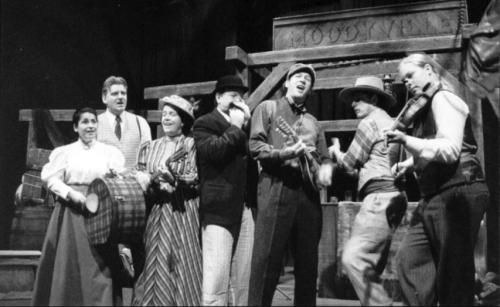
L. to R.: Patricia Leger, John Gogo, Colleen Eccleston, Craig Moddle, Kelt Eccleston, Mark Hellman and Adam Iredale.
Based in Victoria British Columbia since 2000, The Other Guys Theatre Company is an evolution of the Five White Guys sketch comedy troupe. The company was created to provide employment for professional artists and facilitate an outlet for seasoned and emerging artists to collaborate in the Victoria area. The Other Guys produces new Canadian works primarily musicals. Past productions have included the premieres of SEX: the musical by Ross Desprez, The Vinedressers (opera) by Tobin Stokes, Moodyville Tales by Ross Desprez, Tortoise Boy by Charles Tidler, and The Ballad of Jim Pane by Ross Desprez.
In 2007 the Company presented Hockey Mom, Hockey Dad by Michael Melski. Its musical revue, Good Timber: Songs and Stories of the Western Logger premiered in July 2010 at the Royal BC Museum in Victoria, and toured the province in 2012. A new opera, entitled Rattenbury is based on the infamous murder dramatized by Terence Rattigan. It opened in the Crystal Ballroom of the Empress Hotel, Victoria in 2012, starring acclaimed tenor, Richard Margison with the Victoria Symphony. In 2016, The Other Guys premiered the musical revue, Flotsam & Jetsam: Life on the West Coast. In March 2019, the Company presented its tenth premiere, called I Walked the Line by Allan Morgan, about unions, treachery, and solidarity. SlugFest, a musical comedy by Ross Desprez and Tobin Stokes premiered in 2019. It is set in a slug-infested Vancouver Island community, where the residents discover that slug slim as a medical miracle, and are determined to reap the harvest, despite environmental consequences.
The artistic director is Ross Desprez; the musical director is Tobin Stokes.
Web site: www.otherguystheatre.ca
Last updated 2020-07-10
The Other Theatre
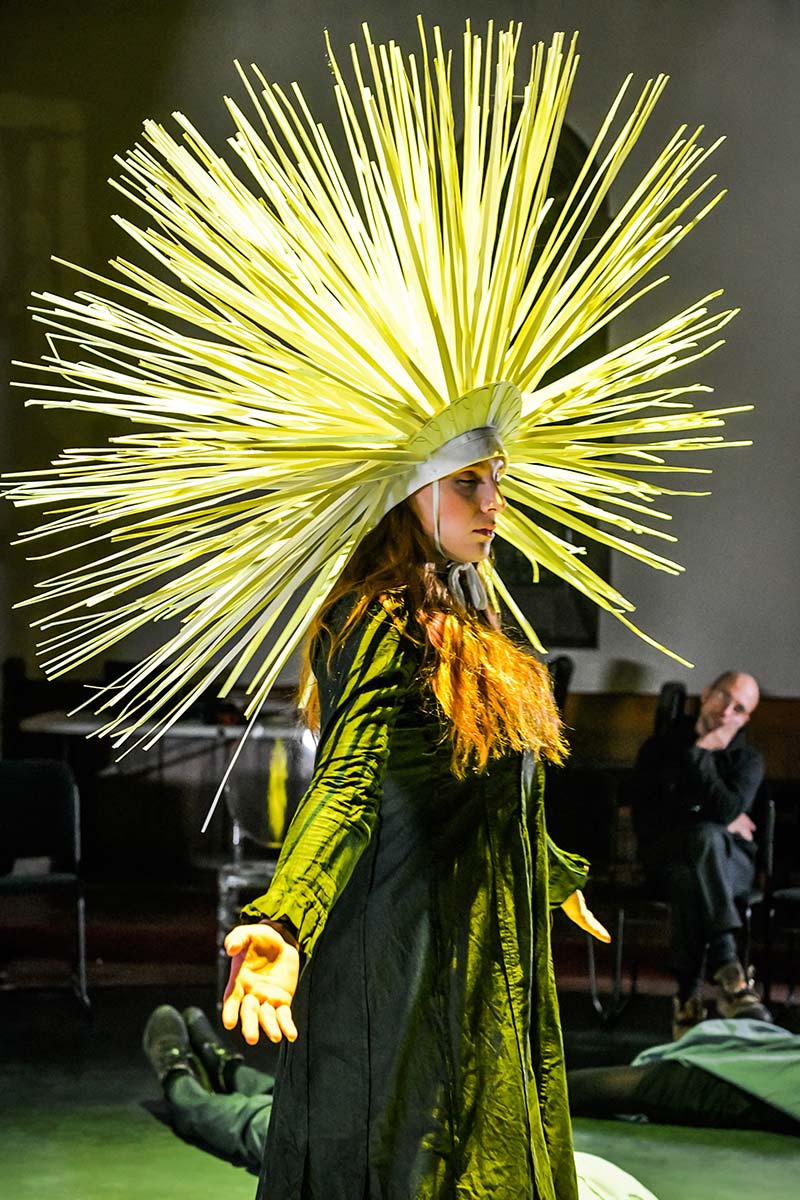
Alternative and experimental theatre company, founded in Montreal, Quebec in 1991, by Stacey Christodoulou and Laura Raboud. The Other Theatre has earned a solid reputation for its transgressive and deconstructive approach to material from various media, and performs in both French and English.
Its long-term goal is to create an ensemble of actors devoted to physical, experimental creation, and its productions have a strong dance/movement element. The process of creating a work takes a minimum of two months.
Among productions are Arrabal's Fando and Lis (1991); Jumping Over Fences (a collective creation, 1992); Medeamaterial (Heiner Müller, 1992); The Dark (adapted from Andrea Dworkin, 1993); Pre-Paradise, Sorry Now (R.W. Fassbinder, 1995); Kaspar (Müller, 1997); Year Zero (collective, 1997); Atomic Reaction/Human Collision (collective, 1999, Montreal English Critics Circle Award); The Glass Box Theatre Project (2000); Carlos in Therapy (2001); Crave (Sarah Kane, 2003); Expulsion (2004); and Galapagos (Centaur Theatre's Brave New Works, 2005). In April 2010, the Company performed a Haitian interpretation of Macbeth, in French and Haitian Creole, with a cast of five, and a supernatural aura.
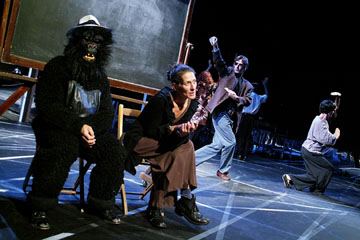
The Other Theatre has played in a number of found spaces, but also at Espace Libre, in the Festival de Théâtre des Amériques (now Festival TransAmériques ), and the Montreal Fringe (see Fringe Movement).
Artists who have worked with the Company include France Rolland and Eo Sharp. The current Artistic Director is Stacey Christodoulou.
Website: www.othertheatre.com
Profile by Gaetan Charlebois and Anne Nothof.
Last updated 2022-01-21
The Rez Sisters

Comedy in two acts by Tomson Highway, premiered at the Native Canadian Centre, Toronto by Native Earth Performing Arts, November 26,1986, directed by Larry Lewis, with Gloria Miguel as Pelajia Patchnose, Muriel Miguel as Philomena Moosetail, Monique Mojica as Marie-Adele Starblanket, Anne Anglin as Annie Cook, Gloria Eshkibok as Emily Dictionary, Margaret Cozry as Veronique St. Pierre, Sally Singal as Zhaboonigan Peterson, Rene Highway as Nanabush, and Cheryl Mills a Bingo Girl. It was translated into French by Jocelyne Beaulieu as Les Reines de la réserve and premiered by Théâtre Populaire du Québec in 1993. In 2011 it was revived by Ken Gass with a culturally diverse cast at the Factory Theatre. For the Stratford Festival's 2020 season (delayed to July 2021 by the Covid-19 pandemic), The Rez Sisters was performed in a tent by an Indigenous cast, with Jani Lauzon as Pelajia Patchnose, Tracey Nepinak as Philomena Moosetail, and Nicole Joy-Fraser as Annie Cook (directed by Jessica Carmichael).
The plot follows the pattern of the journey motif. Seven women on the "Rez" share anger, laughter, hardship and gossip when they decide to go to Toronto for the world's biggest bingo game. During the trip, one woman dies of cancer, and another wins $600, which she uses to install a new toilet in her home. A male trickster or Nanabush is present throughout, transforming into a Bingo Master, a Seagull and a Nighthawk during the action.
Highway has indicated that the work was strongly influenced by Michel Tremblay's Les Belles-soeurs, touching on the themes of complicity among women and on games-playing as way of reinforcing a community. It was also influenced by the work of James Reaney in its enacting of the interconnection of mythology and everyday life.
The work mixes crackling dialogue with a First Nations spiritualism to show the forces shaping these women's lives: traditional and modern. Although written primarily in English, it interjects Cree and Ojibway, the languages of the reserve on Manitoulin Island where the action takes place.
All of the women have experienced colonial and patriarchal abuse, but find strength in their shared goal. Winning the bingo becomes a means of overcoming their privations and limitations, although it is the journey towards this goal that provides them with communal strength and resolve. Nanabush interacts with each, provoking, challenging, thwarting, and encouraging.
Reading: Anne Nothof. "Cultural Collision and Magical Transformation: The Plays of Tomson Highway." Studies in Canadian Literature 20.2 (1995): 34-43.
Commentary by Gaetan Charlebois and Anne Nothof.
Last updated 2026-04-01
Thériault, Yves
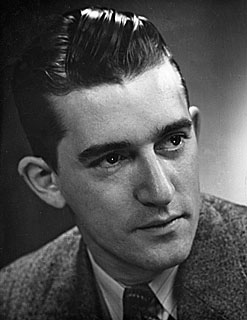
Playwright born in Quebec City, Quebec, in 1915, died in Montreal in 1983.
He worked at several odd jobs and as a radio announcer before joining the National Film Board. In 1944 he published his first anthology of short stories. His best-known work is the novel, Agaguk, about cultural conflict between Inuit and white men, published in 1958, and translated in seven languages. He subsequently began to write for radio and television and won several awards for his broadcast plays. He wrote over 1300 works.
In 1971, he received the Molson Prize. 1n 1975, he was made an Officer of the Order of Canada in recognition for being "one of the most prolific writers and best-known novelists in Canada."
Stage plays include: Le Marcheur (1950, premiered at Salle du Gésu), Bérengère; ou la chair en feu (1965, Théâtre de la Fenière).
Last updated 2014-03-22
Thérien, André
Quebec-based character actor/singer who studied in New York and who works in French and English.
He has appeared in ten separate North American productions of Les Misérables (including the Montreal bilingual one), as well as in Snapshot Productions' world-premiere of the musical Jeanne. He also played Lumière in the Toronto production of the mega-musical Beauty and the Beast.
Among his straight theatre credits are performances at Espace Go, Théâtre du Nouveau Monde and Théâtre de Quat'Sous. He won the award for best supporting actor from the Association québécois des critiques de théâtre for his performance in the Espace Go production of Billy Strauss.
In 2001, he translated and directed the French-language premiere of Michael Healey's The Drawer Boy (as Les étoiles d'Angus) for Théâtre les gens d’en bas, where it played to critical acclaim.
Profile by Gaetan Charlebois
Last updated 2022-01-19
The Saints and Apostles
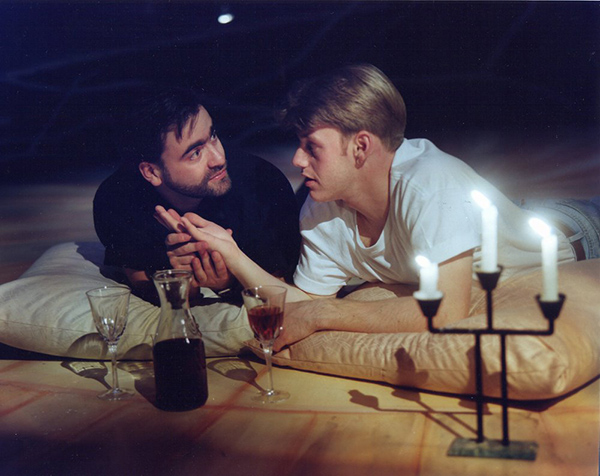
A moving and thoughtful depiction of family members and loved ones during the AIDS pandemic in the 1970s by Raymond Storey. The Saints and Apostles, premiered at Workshop West Theatre in Edmonton, Alberta, November 1991. It won an Elizabeth Sterling Haynes Award for Best New Play and for Best Actor (Michael Spencer-Davis). The production was directed by Raymond Storey, and featured Brian Taylor as Peter, Julie Bond as Madeline, Michael Spencer-Davis as Michael, Glyn Thomas as Daniel, and Ann McGrath as Rita.
The Saints and Apostles is set in Toronto, and explores issues of urban isolation and fear, and the possibility of caring, loving relationships in times of suffering and crisis. It is a deeply philosophical play that considers the conundrums of morality and religion, of sin and sainthood in a secular society.
Designer David Skelton conceived the set for the Workshop West premiere as a triptych – a three-part panel on which three different, but interrelated “religious” portraits are depicted. Peter the Elder, seated on a “throne” in the central panel or shrine upstage, is characterized by Storey as “a virile man in his early forties. His niche is filled with a clutter of paper, medical degrees, charts and books. His throne is an Italian modern reclining chair of chrome and leather.” He likes to be in control. As the play begins, he is looking through some photographs of his ex-wife, Lorraine, and his son, Daniel, and remembering Daniel's childhood, in light of their current estrangement and Daniel's illness.
On the left panel of the triptych is "Saint Madeline," a fundraiser for an opera company in her late thirties, who likes a good time, but has trouble finding it. “She wears a bath robe and has wrapped her hair in a towel. She examines her reflection in a mirror on her makeup table, which is covered with brushes, cosmetics, and perfume bottles, a tape player, a bottle of extra-strength Tylenol, and a bottle of Absolut." As she gazes into the mirror, she laments over her mental and physical state. She has left an early abusive marriage and lives with her good friend Michael, a gay theatre director.
The right panel is occupied by Rita, a woman in her early fifties, a faded blonde who has kept her figure on a diet of cigarettes and white wine. Her niche is a cramped highrise balcony. She rests against the wrought iron rail and blows smoke into the distance towards the planes that take off or land at the airport near her apartment. Her relationship with her son, Michael, is a fraught one.
These three “saints and apostles” are closely connected to the two men whose precarious relationship the play explores: between Michael, a cynical, neurotic thirty-five-year-old director, who wears black well; and Daniel, twenty-one, tall, slender, blond with almost translucent white skin. who has AIDS. They are all frustrated by the limitations in their lives, and trying to connect with someone or something that will give their lives some significance or value, trying to find some form of salvation. Daniel’s final realization, after he has left Michael, is that life has meaning only in a full awareness of the moment. The point of the exercise is the exercise itself; one runs the course for the exhilaration of the run. The length is of no importance.
Commentary by Anne Nothof, Athabasca University
Last updated 2019-05-24
The Theatre Centre
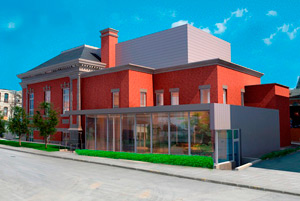
Cultural centre for the research and development of the arts, providing space, subsidy and mentorship to aspiring artists, based in Toronto Ontario. It was formed in 1979 by a co-operative of five independent theatre companies: Buddies in Bad Times Theatre, Autumn Leaf Theatre, AKA Performance Interface, Necessary Angel and Nightwood Theatre to create, rehearse and present new work. Although the founding companies left by the mid-1980s, The Theatre Centre remained to assist other artists and groups.
The Theatre Centre’s mission is “to nurture artists, invest in ideas and champion new work and new ways of working” (website). It supports artists who wish to develop Alternative and Experimental Theatre, that may include music, dance, visual art and new media.
The Centre’s two-year Residency Program provides groups and individuals with space, funding and collaborative relationships to develop provocative and innovative plays. Residency companies/artists have included: Sixth Man Collective; Philip McKee & Tanja Jacobs; and Project: Humanity. Artists who have worked with the Centre include: Jennifer Tarver, Chris Leavins, Sarah Stanley, bluemouth inc., Ame Henderson, ATSA, Cathy Gordon, Independent Aunties, Juliet Palmer, Michael Rubenfeld, One Reed Theatre, Jon McCurley & Ame Lam, Susanna Hood and Ravi Jain. In 2018, The Theatre Centre presented Secret Life of a Mother, a graphic, honest portrait of the traumas of motherhood by Hannah Moscovitch with Maev Beaty and Ann-Marie Kerr.
In 2002, The Theatre Centre presented its first Free Fall, a biennial festival dedicated to celebrating innovative work from across Canada and abroad.
Franco Boni was the Artistic Director from 2003. In 2019, he relocated to the position of Artistic and Executive Director of PuSh International Performing Arts Festival in Vancouver. The current General and Artistic Director is Aislinn Rose.
The Centre operated out of ten different rental locations since its inception in 1979. In 2014, it moved to the historic Carnegie Library at 1115 Queen Street West, following a $6.2 million redevelopment of the heritage property. The building includes new additions such as art galleries, a 200-seat performance venue, a lobby café, and affordable rehearsal spaces for emerging performers. In 2015, the Centre enjoyed is first full calendar year of presenting and producing performances at its new location. During the Covid-19 pandemic in 2020-22, it was forced to close. By 2023, The Theatre Centre was fully operational again, featuring works such Punctuate! Theatre's production of The First Metis Man of Odessa by and starring Matthew MacKenzie and Mariya Khomutova.
Website: www.theatrecentre.org
Last updated 2023-04-02
Since October 2002, Athabasca University has hosted the web site, with an editorial board of theatre scholars from across Canada.
To submit an entry, please consult the guidelines for submissions.
Email your submission to: Anne Nothof, Professor Emerita, Athabasca University.

The Encyclopedia collects and disseminates information on plays, playwrights and theatre practitioners. It does not respond to requests for information, auditions, bookings, or tickets.
The Canadian Theatre Encyclopedia web site was originally conceived and developed in 1996 by Gaetan Charlebois—theatre critic, playwright, and actor.
